
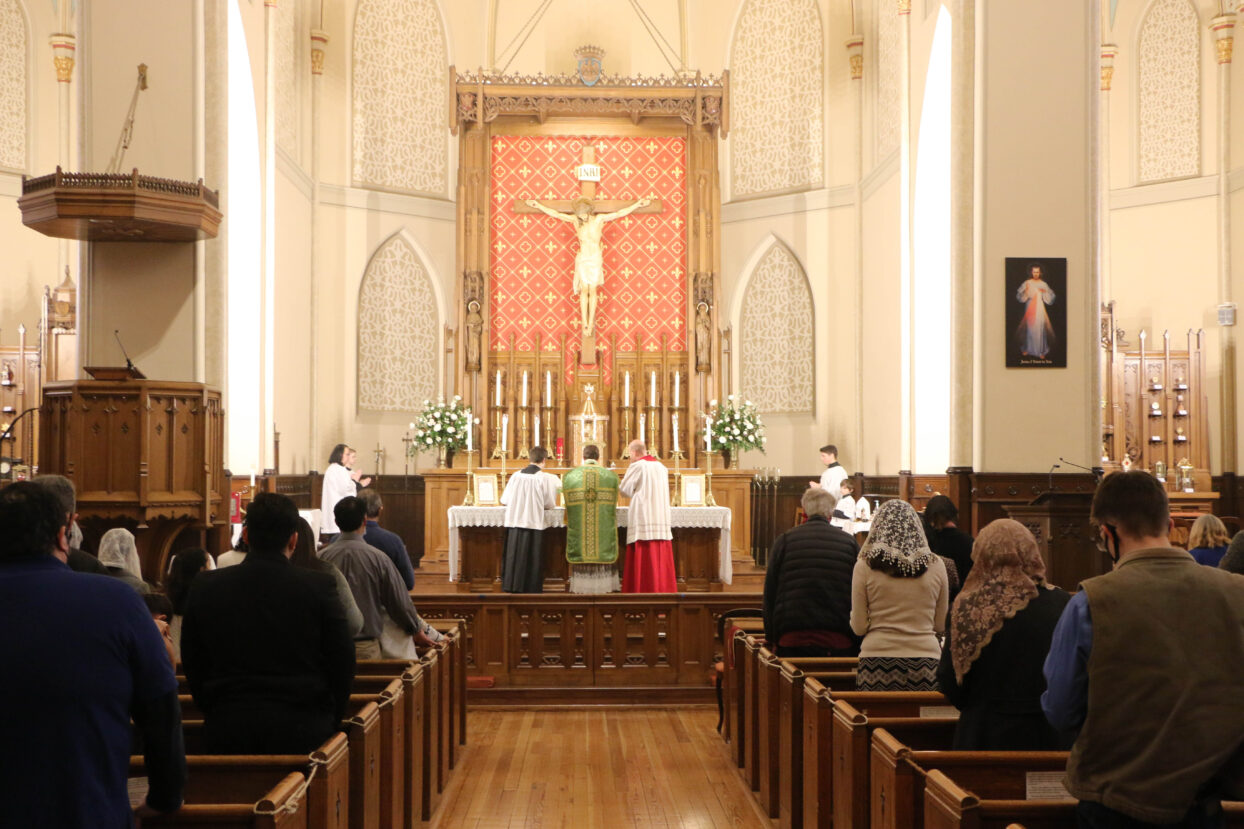
Traditional Latin Mass transitioning to the Novus Ordo
By John Mecklenborg
Bishop Mark Beckman is implementing Traditionis custodes in the Diocese of Knoxville. Parishes with Traditional Latin Mass communities are transitioning to the 2002 Roman Missal.
The parishes will still offer Mass in Latin according to the 2002 Missal while committing to all the traditional options permitted in its rubrics. The rubrics allow for Gregorian chant, the Latin language, ad orientem, etc.
In response to the desires of the faithful to have a continued experience of the Traditional Latin Mass (TLM) according to the 1962 missal, and to honor donor intent, the Mass will be celebrated monthly at Christ Prince of Peace (CPOP) Retreat Center in Benton. Mass dates and times are posted on the CPOP website, dioknoxretreat.org.
The apostolic letter, Traditionis custodes, issued as a motu proprio by Pope Francis on July 16, 2021, regulates the use of the 1962 Roman Missal—colloquially known as the Traditional Latin Mass, Tridentine Mass, or the Extraordinary Form—to promote unity around the post-Vatican II liturgy.
In a letter to the faithful on Nov. 25, Bishop Beckman wrote, “it became clear to me that the desire of the Holy Father was that we move in the direction of re-establishing one form for the celebration of the Roman Rite.”
The response
The TLM community was first made aware of this decision by pulpit announcements on Oct. 12 at each of the three homes for the Extraordinary Form in East Tennessee: Holy Ghost in Knoxville, St. Mary in Johnson City, and the Basilica of Sts. Peter and Paul in Chattanooga.
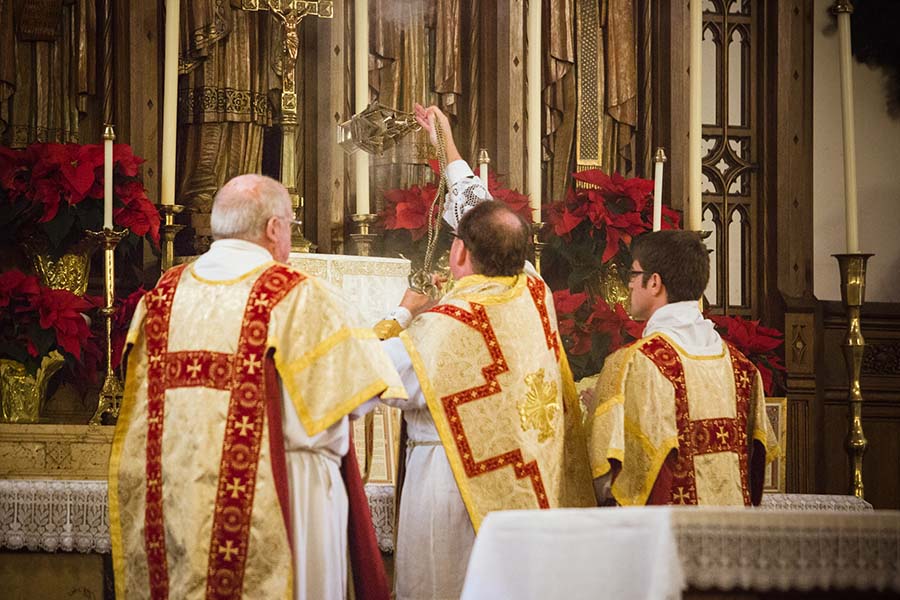
The Traditional Latin Mass is celebrated at Holy Ghost Church in Knoxville in 2015. Father John Orr, center, is the celebrant, with Father Michael Hendershott, right, serving as concelebrant. Assisting at the Mass is Deacon Gordy Lowery, left.
Father David Carter, rector of the basilica, stated in his homily that day, “Since Christmas 2014, we have enjoyed the celebration of Mass according to the 1962 Missal. … I remind you that our parish is a Novus Ordo parish at which the Traditional Latin Mass is celebrated, and that the primary purpose of doing so was mutual enrichment.”
He continued, “We are not masters of the liturgy; we are its servants.” He then proceeded to outline his plan for transitioning the Latin Mass at the basilica from the 1962 Missal to the 2002 Missal while committing to all the traditional options permitted in its rubrics.
“This is not the path of loss—it is the path of unity,” Father Carter stated as he promised to retain Latin language, prayer, chant, sacred silence, and ad orientem worship in conjunction with fuller cycles of Scripture, the unified calendar, and deeper participation.
“These are not enemies; they are gifts meant to complement each other,” he added.
The promises of preservation in terms of beauty, reverence, tradition, and sacredness from parish pastors were nonetheless met with disappointment, sadness, and frustration by some members of the TLM community. News immediately traversed outside the confines of the diocese as online and international watchdog groups immediately elevated this to a crisis—with several sources painting the decision as suppression, and others painting it as a novel alternative to the more common path of relocation and consolidation.
In the following days and weeks, Bishop Beckman received many messages, phone calls, and requests for meetings. These messages contained stories of spiritual nourishment, conversions of heart, deep connections, and even physical relocation of families from areas of the country where the TLM had been regulated or removed.
It is clear that this community is filled with spiritual passion, love of Scripture, and connection to the depths of the Catholic faith, and that any change to the TLM in East Tennessee represents a profound sadness in their spiritual lives.
Listening sessions
On the evening of Nov. 5, Bishop Beckman and Father Carter held a listening session at the Basilica of Sts. Peter and Paul to hear directly from parishioners at the frontline of the transition.
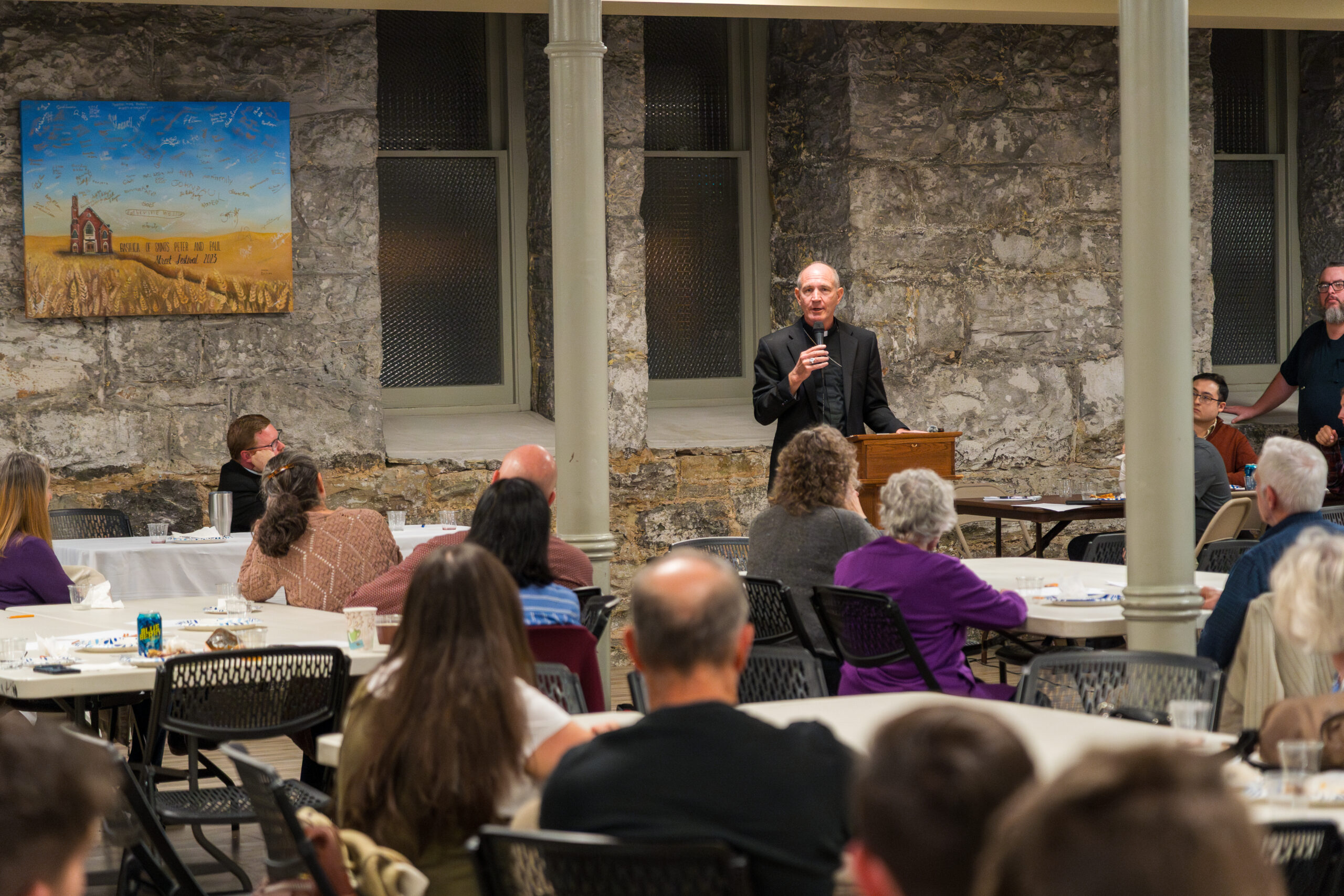
Bishop Beckman meets with parishioners at the Basilica of Sts. Peter and Paul on Nov. 5 to hear their thoughts and feelings on the Traditional Latin Mass and the transition to the 2002 Missal. (Photo John Mecklenborg)
Community members expressed a range of emotion: connection, nourishment, uncertainty, reverence, and desire for a stable and recognizable Catholic Church. Many of the speakers stated they were converts, catechists, or Catholics who did not find their spiritual home until they encountered the TLM.
The attendees brought up requests for the bishop to appeal to Rome for an extension, as several dioceses around the United States and world have done with successful outcomes. They further asked if the TLM could be moved to an approved chapel or if an external order could be brought in to celebrate the TLM in the diocese.
After listening to the comments and requests, Bishop Beckman assured the community that their voices were heard and that, “I sincerely believe, based on my direct witness of Father Carter, that those elements will all continue as he celebrates the Latin Mass in the Novus Ordo. I am convinced he will do that because he knows this community, he loves you, and I know you all love him.”
Shedding some light on the background of this decision, Bishop Beckman revealed that his predecessor had filed for an extension in March 2023 and that he had been contacted by the Vatican Dicastery for Divine Worship and the Discipline of the Sacraments while still a bishop-elect with a request that he revisit what Pope Francis said in Traditionis custodes.
In the revisiting process, discussions with pastors explored the option of finding another chapel, but Father Carter expressed the importance of maintaining the unity of the community at the basilica, the lack of suitable non-parochial locations, and the lack of other qualified and trained clergy to offer this form of the Mass.
Further, the Vatican indicated it was unlikely an exemption would be granted as the basilica holds special designation from the pope. As such, churches holding the title of a minor basilica are held to a higher standard as they hold a special bond of communion with the Roman pontiff that is greater than that of other churches in a diocese.
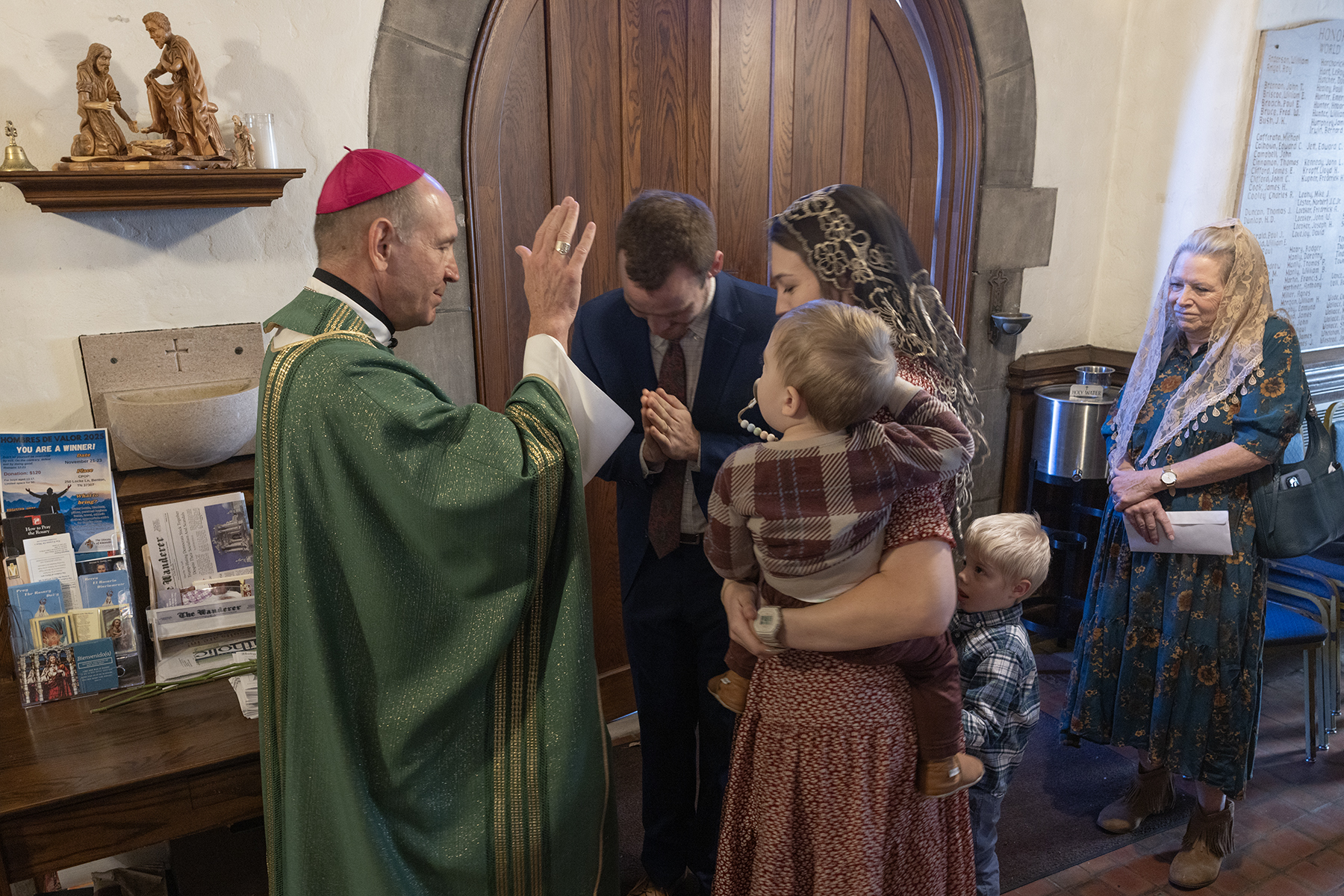
Bishop Beckman blesses a family at Holy Ghost Church on Nov. 16. The bishop met with parishioners there to listen as they shared their experiences with the Traditional Latin Mass and their concerns over the implementation of Traditionis custodes. (Photo courtesy Jim Richmond)
On Sunday, Nov. 16, Bishop Beckman visited Holy Ghost Church to continue hearing from the local TLM community.
In this visit, he met directly with the faithful after celebrating the 10 a.m. Novus Ordo Mass. Standing in the narthex, he greeted Holy Ghost parishioners as they exited and entered the church, hearing both support and concerns from the faithful. A line quickly formed with many of the sentiments from the Chattanooga listening session being again reflected in the individual conversations with Bishop Beckman.
One parishioner, Eric Laschon, was keen to mention that for the past 11 years he has traveled from Kentucky to attend the Mass at Holy Ghost Church—72 miles each way. At the same time, other members passed out instructions to Mass-goers in the pews for petitioning the decision to the diocese, the apostolic nuncio in Washington, D.C., and the Dicastery for Divine Worship in Rome.
Jim Richmond, 83, recounted how happy he was to experience Mass in English for the first time in the 1960s–he could finally understand what they were saying.
Community voices
Parishioner Michael Dunn, several days after Bishop Beckman’s visit to Holy Ghost, said that his path was one of intellectual conversion.
“The Novus Ordo is a beautiful Mass in itself, and it speaks to certain people,” he said.
“When I decided to go down the road of the Traditional Latin Mass, that is when I experienced a conversion of the heart.”
Saying it forced him to slow down, he continued, “it was hard and arduous, and everything about it was a mystery—that was the pivotal moment that has allowed me to grow spiritually. That’s the conversion of my heart in the faith versus intellectually.”
Mr. Dunn hopes that the TLM continues in the Knoxville area and he has been open about supporting a building project and outside orders to accommodate it.
What’s next?
The three diocesan parishes are currently transitioning to the 2002 Missal by the new year.

Rorate Mass in the Extraordinary Form is celebrated at St. Mary Church in Johnson City. The Mass celebrant is Father Dustin Collins, pastor of St. Mary.
The Basilica of Sts. Peter and Paul began the transition process on the celebration of Christ the King on Nov. 23.
Parishioner and Notre Dame High School religion teacher Ian Hoerner commented on the Mass that day: “I think a lot of people wouldn’t have even noticed … there was still beautiful music. There was still what we oftentimes get described as like the smells and bells that I think a lot of people probably still appreciate.”
Mr. Hoerner is a strong supporter of the TLM, and when asked about what he is most concerned about in the transition, he said: “The main thing I think is just the stability … if you go to a modern, a Novus Ordo Mass, you don’t know what you’re getting … it’s really rough to have our community affected this way when those types of communities are oftentimes just let loose and not corrected in any public way.”
Bishop Beckman expressed his most ardent hope that the faithful in the diocese may continue to experience the richness and traditions of the liturgy in the reformed rite.
“I do believe the reform of the liturgy as directed by the Second Vatican Council and as implemented by St. Paul VI and St. John Paul II is a gift of the Holy Spirit for the Church,” Bishop Beckman said.
Comments 1
So there is no pre-1955 rite available? What a shame. The remnant gets smaller every day.