

Catholic traveler, on his way to visit every country, tells of imprisonment in Syria and promise to God
By Dan McWilliams
In coming to St. Patrick Church in Morristown on Oct. 25, Sam Goodwin continued to fulfill a promise he made to the Lord more than six years ago.
Mr. Goodwin, a cradle Catholic from a family of seven in St. Louis and one of few people to visit all 193 United Nations-designated countries in the world, was taken hostage by state police in Syria in 2019 and held in prisons for more than 60 days, including at the infamous Branch 215 that was the site of an untold number of tortures and executions. His release to neighboring Lebanon came only after much prayer, a little assistance from a Maronite saint, and a phone call made by his sister that most directly led to his freedom when the efforts of U.S. and international leaders were seemingly at a stalemate.
“On June 14, 2019, I made a promise to God that if He got me out of the situation I was in, I would never pass up an invitation to share this story with others. It’s a privilege to be here in Morristown and to share a little bit of my story with all of you this evening,” Mr. Goodwin said to an audience of 125 in the St. Patrick parish center.
Parishioner Renee McGarel emceed the talk, which followed a catered buffet dinner, and the event was among the first facilitated by St. Patrick’s new social-activities coordinator, Kimberly Toby.

Sam Goodwin autographed copies of his book, Saving Sam: The True Story of an American’s Disappearance in Syria and His Family’s Extraordinary Fight to Bring Him Home, after his talk at St. Patrick Church. (Photo Dan McWilliams)
Mr. Goodwin, an entrepreneur who has also visited all 50 states and delivered keynote talks around the world, wrote Saving Sam: The True Story of an American’s Disappearance in Syria and His Family’s Extraordinary Fight to Bring Him Home, published by Center Street in September 2024. The author signed copies of his book after his talk at St. Patrick.
Accompanying him to the Morristown church, as it has to every country in the world, was Mr. Goodwin’s backpack from his high-school days made by The North Face.
Mrs. McGarel welcomed longtime parishioners, newcomers, and guests to Mr. Goodwin’s talk and thanked volunteers for helping set up and clean up.
“Your presence breathes life into our parish family,” she said.
St. Patrick pastor Father Miguel Vélez and associate pastor Father Hoan Dinh attended the talk, with Father Vélez prefacing the blessing of the meal by saying that the full parish center was a sign “we need a bigger place.”
Mr. Goodwin has family in St. Patrick Parish and spoke there two weeks before his wedding. He now lives in Tampa, Fla., with his bride.
Mrs. McGarel said Mr. Goodwin’s talk came about after a friend “gave me a book to read … about a relative of mine.” The friend introduced Mrs. McGarel to Mr. Goodwin’s parents, and she soon heard from the speaker.
“We connected, had some conversations, and set the date, and here he is to share his story,” she said.
Mr. Goodwin is a former Division I hockey player at Niagara University and holds a bachelor’s degree from there, a master’s from Washington University in St. Louis, and a doctorate from Johns Hopkins University. He co-founded a tech company and NGO in Singapore, spending six years in that country after starting with the intent to work there only three months.
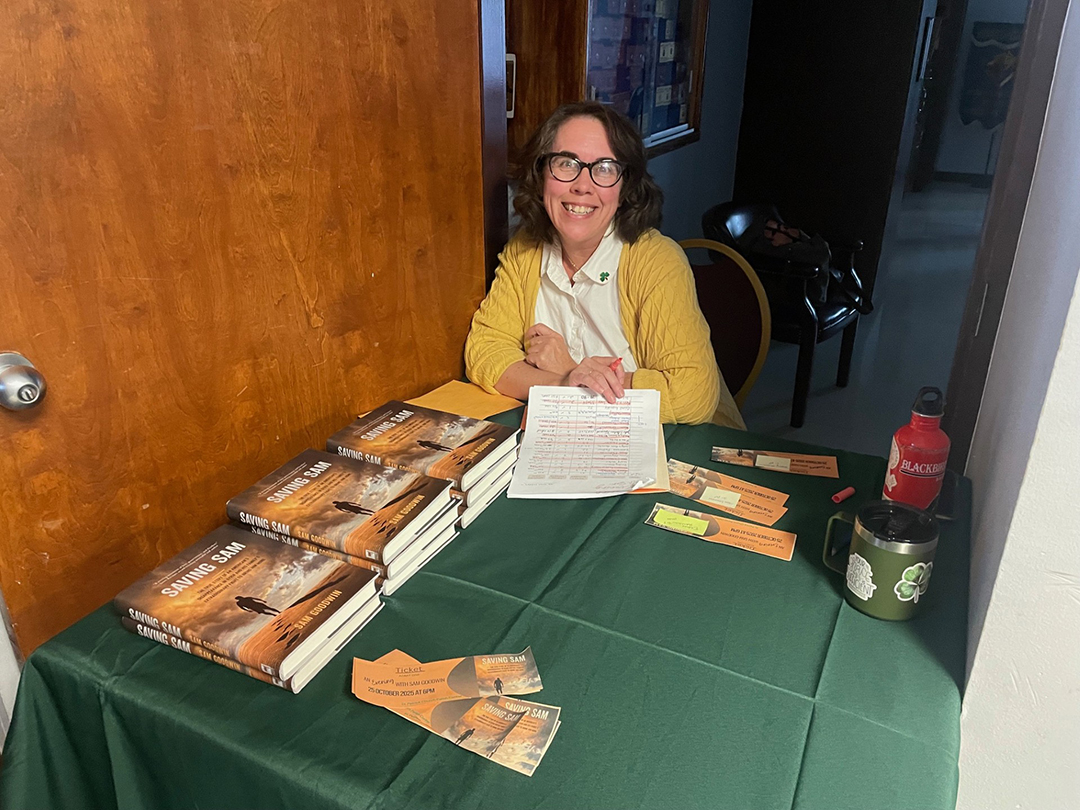
Kimberly Toby, St. Patrick Parish’s new social-activities coordinator, facilitated Sam Goodwin’s appearance. She sits at the check-in table with copies of Mr. Goodwin’s book. (Photo Dan McWilliams)
His talk at St. Patrick opened with a video of a newscast announcing his release from captivity in Syria.
Mr. Goodwin began his world travels on weekends and other breaks in his work schedule while in Singapore.
“Throughout this time, I traveled as much as I could. I was in my early 20s, in the heart of southeast Asia, had a little bit of flexibility in my work schedule, and had the world’s best airport in my backyard,” he said. “I took advantage of the opportunity to explore as much of the region and beyond as possible. I didn’t like to repeat places, so even if I went somewhere and had a fantastic experience—the next weekend, the next holiday, the next opportunity I had—I would just go somewhere different. I put this formula into play for about six years, and in early 2018, I realized that I had traveled to 120 countries in the world.”
That made him start counting countries.
“I remember thinking: well, how many are there?” he said. “Most importantly, I learned: travel was the best education I ever had. It was never about ticking boxes or checking places off a list.”
When he learned there were 193 fully recognized UN sovereign states, he “thought to myself: maybe I could go to all of them. The competitive athlete in me likes setting goals and working toward achieving them.”
More research involving a map, his bank account, and people who could help with visas led him to “ultimately decide I was going to give this a shot. I had no idea if I could do it. I might fail miserably. I didn’t know what that would look like, but I then worked toward achieving something that I thought was extraordinary.”
By spring 2019, he had been to 180 of the 193 countries.
“It was at this point when the next place I was going to go to was Syria, a country that’s experiencing arguably the most tragic humanitarian disaster of our lifetime,” Mr. Goodwin said. “By conservative estimates, a half a million people have died in the conflict. The UN stopped counting at 250,000. But one of the most important things that I have learned through my travels is that places that are negatively perceived or that western media tells us we’re not supposed to like—these are the same places where I’ve had many of my best experiences and where my perspectives were most meaningfully impacted.
“Despite everything that was happening there, I was confident that the same would be the case. One of the most important or compelling things for me about Syria specifically was its religious significance. It’s the cradle of civilization. It’s mentioned more than 300 times in the Bible. Mary Magdalene was of Syrian descent. King David conquered northern Syria. Paul the Apostle’s conversion took place on the road, of course, to Damascus.”
Mr. Goodwin’s Catholic faith “was a big part of my travel journey,” he said.
“I’d been to Mass in 65 countries. I’d visited Catholic churches in 115. In fact, the reason that I chose to enter Syria on a Saturday was so that I could attend Mass there the following morning,” he said. “Little did I know, God had other ideas, and I didn’t make it to Mass that Sunday or any of the next nine Sundays.
“On May 25, 2019, I went to the northeast region of Syria. I went to a town called Qamishli. Just two hours after arriving, I was walking through a roundabout on the way to meet up with my guide, when all of a sudden a black pickup abruptly pulled up next to me. Two armed men jumped out of the back seat and instructed me to get inside. Thankfully, they weren’t violent, but I didn’t have a choice. I was scared, confused—I had no information or anyone to help. I was desperately trying to understand what’s happening. These men were loyal to the then-Syrian President Bashar al-Assad and told me that they were skeptical of my travel history and my travel motives.”
The truck “sped down back alleys of the city, with the officers in the vehicle accusing me of espionage, of being an American spy, and collaborating with terrorists. Nothing like this had ever happened to me before,” Mr. Goodwin said. “The truck drove for about five minutes, then it stopped. Then the officer in the vehicle next to me reached into his pocket, and he pulled out a blindfold and put it over my eyes. The truck drove for about one minute, then it stopped. I stepped out of the vehicle. They took the blindfold off. I looked up, and I was underneath a massive Syrian military airplane out on the tarmac of an airport.
“They handcuffed me behind my back, took me over to the ladder, and threw me into the cargo hold of the plane. About 30 minutes later, the plane took off. I realized now at this point that I was lying on an airplane but didn’t know where it was going, and this overwhelming cloud of uncertainty was beginning to grow all around me. About 90 minutes later, we landed in what I learned to be Damascus, the Syrian capital city. I was taken from the airport, driven in to the center of town, and taken into the basement of a facility that I now know is called Syria’s military intelligence prison No. 215, a facility notoriously known for housing political prisoners.”
The officer in charge spoke a bit of English and escorted Mr. Goodwin to a cell “in the back of the basement. When he put me in there, he went to the inside of the cell door, and he said, ‘Food, water, toilet—knock—otherwise quiet, no talking,’ and he slammed the door and left,” he said. “I was stunned and in disbelief at what had happened in just a few short hours. My life had spiraled out of control in the most terrifying of ways. I felt exactly the way they wanted me to: hopeless, utterly cut off from any control of my life.
“Thankfully, the cell wasn’t too small—I could walk around just a little bit, but it had no window, it was all-concrete. I had nothing but a small blanket to lay on the concrete floor as a bed. I remained here in solitary confinement for 27 days. The only human interaction I had was for a few seconds in the morning and evening when the guards brought bread and boiled potatoes and water. During this time, I was never physically harmed, but the facility was not soundproof. Every day I would hear the sounds of inmates in neighboring cells being beaten and tortured.”
Mr. Goodwin said he “couldn’t help wondering: when is my turn? I realized I was in an environment where nothing was off limits. I never stopped caring about dying or the long list of other bad things that I thought might happen, but I began to lose the energy to be afraid. Normal or average prisoners spend their time counting down the days to the end of their sentences, but hostages count up.”

Sam Goodwin brought his high school backpack, made by The North Face, to St. Patrick for his talk. Mr. Goodwin has taken the backpack to all 193 UN-recognized countries in the world.
In his cell, Mr. Goodwin “leaned on perspectives that I’d developed from traveling different corners of the world, which provoked gratitude just for the basic food and water I was being given” and on competitive-athlete skills and perspectives such as mental toughness and critical thinking.
“I leaned on the belief that I had a purpose in life and a desire to see family and friends again, but most importantly in that cell I leaned on my faith,” he said. “Everything had been taken from me: my material possessions, my communication, my freedom. But no matter what, I knew my faith was absolute. My prayers became this uninterrupted conversation with God. I was constantly talking to Him, pacing back and forth, kind of like I’m doing right now, saying things out loud. Even though they told me not to talk, I said, ‘God, I’m here. I’m listening. What are you trying to tell me today? What can I learn today? What are perhaps the positives about my situation today? My No. 1 prayer was always, ‘God, please keep my situation safe and peaceful. Please keep me physically unharmed.’”
His second prayer was about the timeline, Mr. Goodwin said.
“If this was all going on peacefully, then the next question was ‘when?’ And this was the prayer that for me became the most tricky and intense, and I remember almost positioning it like a business deal. I said, ‘God, I know you have a plan, but is it possible, would you consider, an adjustment to the timeline? Can that work with your plan?’” Mr. Goodwin shared. “I then finished all of my prayers by saying the rosary. I would dedicate each decade to something different. I would pray for my family, my friends, anybody who I thought would be working to get me out of this situation. I would pray for world peace. I would pray very hard for the courage to forgive my captor. And through that, I discovered that I was working to forgive people who weren’t even sorry, and that’s strength. Forgiveness, I found, is not a feeling—it’s a choice.”
The strength from those prayers helped him make it to day 27, Mr. Goodwin said.
“It was at this point I was taken out of solitary confinement. I was driven across town to the outskirts of the city and taken to a facility called Adra, which is the country’s central federal prison. I was put in a cell with about 40 other men, and I remained here for the next 35 days, for another month,” he said. “During this time, I was also put on trial in Damascus. I went to court four times, and in all four sessions, the judge denied me a lawyer, denied me a translator, continued to characterize me as a spy and a terrorist, without providing any meaningful information about what may happen.
“The whole process was taking place inside this ideological vacuum. It was not going to be impacted by anything I said or did. Back at Adra, the other inmates became friends. We cooked and shared food together. They taught me Arabic; I taught them English. There was a prison basketball court. I taught several of them how to play knockout. One of them even smuggled a note out of the prison on my behalf, a note that successfully navigated a game of geopolitical telephone and made it to my father in St. Louis, serving as the first time I managed to communicate that I was alive.”
He said he was grateful to his fellow prisoners, most of whom had done no more to deserve confinement than he had.
“These men truly risked their lives to help save mine, and what a remarkable display of humanity,” Mr. Goodwin said. “I learned very quickly that virtually none of them were true criminals—they were just victims of a corrupt system and had been caught up in the instability of conflict. I have to say that these men reinforced some of the most significant things that I had learned through my travels. For example, never judge people by the actions of their government. I’ve learned that people who have the least often give the most, something I’ve found to be true in all corners of the world.”
Although Adra “was unquestionably an upgrade from solitary confinement, I had reached the two-month mark of being held captive as a political prisoner in the Middle East, and this overwhelming cloud of uncertainly was continuing to grow all around,” Mr. Goodwin said. “On July 26, 2019, one of the prison officials came to the cell I was in, called my name, and he indicated that I was being moved. As he escorted me outside, he stopped and said, ‘Sam, you’re very lucky. President Assad has agreed to release you.’”
With all he had been through, Mr. Goodwin could not believe that great news.
“This sounded encouraging, but I had been lied to so many times in the past two months that I had essentially become immune to believing anything like this. Outside, I stepped into a black SUV, which turned out to be part of a five-vehicle convoy that raced out of Damascus at what seemed to be 100 mph,” he said. “We didn’t stop at traffic lights. We used the shoulder of the road to maneuver around traffic. We drove west toward the mountains. Nobody in the vehicle said a word.
“The nice cars, the professional nature of the operation, made me think that this was either really good or really bad. I’m about to experience one extreme of the captivity spectrum here, but I don’t know which one it is. We came up to a checkpoint, one that seemed to be some kind of significant border, and as we passed through, the officer in the vehicle sitting next to me tapped me on the leg and said, ‘Sam, you’re in Lebanon. You’re safe now.’ This was also very encouraging, but I was still putting all the pieces together. We drove from there for about another hour into Beirut, the capital city of Lebanon.”
St. Charbel Makhlouf (1828-1898), a Maronite monk and priest in Lebanon, likely provided some assistance from above.
“I was taken to the office of Lebanese internal security, kind of like the equivalent to the FBI here in the U.S. When I walked into the office, in addition to dozens of government and military-intelligence officials and journalists—my parents were there, culminating this moment that was indescribably emotional, one that many people thought would never happen, and a breathtaking display of God answering prayers,” Mr. Goodwin said. “I had the opportunity there to meet and thank a man named Gen. Abbas Ibrahim, who heads Lebanon’s internal security. He had mediated my release with the Syrians.
“That evening, my parents and I went to the town of Byblos in Lebanon, and we prayed together at St. Charbel Monastery. St. Charbel, as some of you may know, is a 19th-century Lebanese monk well known for working miracles and whose feast day was just one day earlier than the day my release was granted. The next day, as we made our way back to the U.S., to St. Louis, I learned that Gen. Ibrahim’s negotiations led to President Assad and Syria finally figuring out what had happened and dropping his false charges against me. I became and I am the only American civilian that he ever released.”
Support from family and friends has sustained Mr. Goodwin since his release as he deals with post-traumatic stress disorder and how to “survive survival.” That included “interesting conversations with my bank,” as he attempted “to convince them that being held hostage in a foreign country is grounds for them to forgive credit-card late fees.”
His desire to visit all 193 countries did not change even after his horrific experience in Syria.
“Despite everything that had happened, my original curiosity about the world had really never been stronger,” Mr. Goodwin said. “When I first came home, my family pretty much shackled me to the kitchen table and wanted to throw away my passport, but toward the end of 2019, after several months of reflection and putting things into context, I became very committed to not letting what happened conquer me.
“One of the most significant steps I took to address that was to continue what I had been pursuing beforehand. On Dec. 31, 2019, I made one final trip, and that trip was to the nation that is home to more Catholics than any other in the world. It was Brazil, and with that I had traveled to every country in the world, joining a group at the time of only 100 people in history who had ever done that.”
His choice to visit Syria made for contrasting comments from those who hear his story.
“A lot of people say, ‘This guy is an idiot who never should have tried to go to every country and never should have been in Syria in the first place,’” Mr. Goodwin said. “There are a lot of other people who hear this story and say, ‘This guy is a hero for surviving.’ The truth is I’m neither of those extremes. I became part of an extraordinary circumstance and just did my best to embrace and manage it. What I’ve learned to be true is that we can’t always choose the exact path that we take in life, but we can always choose the manner in which we walk it.”
The first question he usually receives is “Sam, how exactly did you get out?”
“Much of what I have told you so far this evening has been a story about one man in a cell, but in truth there was something much bigger happening,” Mr. Goodwin said. “It was God’s story. I was Assad’s hostage but only until God accomplished what He intended to through my captivity.”
The fact that his communications with family and friends “went dark” after visiting Syria was the first sign of trouble.
“I was always very good about keeping in touch, especially if I was in more of an unstable place. I had communicated that I was going to be in Syria for just a few days,” Mr. Goodwin said. “When that time passed and they weren’t hearing from me, they began to worry. My father works in civil engineering, and my mother is a registered nurse-turned-educator. Both of them are smart people and have had relative success in their respective professional fields, but they’re just an average family from St. Louis. They had no idea what to do when their son went missing in the Middle East.”
His parents reached out to the FBI field office in St. Louis, which “escalated to some of the highest levels of the U.S. government in Washington,” Mr. Goodwin said. “Throughout my captivity, my family had kind of a roller-coaster experience with the U.S. government. But early on, the government communicated two key things to my family. First, they said, ‘We strongly recommend that you keep this out of the news. Keep all of the communication very tight. Don’t let the press get hold of this because if they do, and Sam’s captors—depending on who they are, which was still unknown at the time—feel that type of pressure, they might just kill him.’
“The second thing they said was ‘you should really manage your expectations. We have no diplomatic or economic ties with Damascus. There may not be a whole lot we can do here to help.’”
Mr. Goodwin’s younger sister, Stephanie, then made a choice that went against the government’s advice but ended up leading to his release.
“Three weeks later, my younger sister, who was 25 years old at the time and living here in Tennessee in Nashville, particularly became overwhelmed with everything that was happening, and she decided that she needed to call someone and talk to them about this and just blow off some steam, which was against the recommendation of the U.S. government about keeping all the communication very tight,” Mr. Goodwin said. “She decides that she’s going to call her former college roommate, who is coincidentally also named Stephanie, so there’s this phone call between the Stephanies. My Steph says, ‘Well, actually things aren’t very good.’ She goes on to explain that ‘my brother’s been missing for weeks. Nobody’s heard from him. We’re working with all of these agencies and officials, and nobody’s been able to help. We’re really scared.’
“Roommate Steph is of course shocked to hear something like this, but she says all the right things and offers her full support, and at the end of the call, as the story goes, roommate Steph says, ‘Hey, if there’s anything I can do, just let me know.’ And my Steph responds, almost jokingly or sarcastically, ‘honestly, unless you know someone who knows Assad, the Syrian president, please just pray.’ And roommate Steph says, ‘Wait—let me call you back.’”
That presaged an amazing example of God’s hand at work in Mr. Goodwin’s release.
“It turns out that roommate Steph is Lebanese, and her uncle is good friends with Gen. Abbas Ibrahim,” he said. “Gen. Ibrahim has a somewhat secret back-channel relationship with the Syrians and was able to mediate my release when so many others were struggling to do anything. When my sister called her college roommate, she didn’t really even know that she was Lebanese. She didn’t know Lebanon was close to Syria. She couldn’t find Lebanon on a map. (Her phone call) wasn’t strategic. She was just calling a friend at a time when she desperately needed support.”
Mr. Goodwin speculated on what would have happened if another person was chosen to receive his sister’s phone call.
“I can tell all of you here this evening I believe that if, in that moment, she would have decided to just call a different friend, I might not be here,” he said. “The FBI, the CIA, the White House, the Pentagon, and Pope Francis were involved, and Russian intelligence, Middle East NGOs, and private-sector security companies were all struggling to be effective, but my sister’s college roommate could identify a path to get an American hostage released from captivity in the Middle East.
“So, what do all of us here this evening do with a story like this? What’s the message? I have to say I’m still processing many of these experiences, and sometimes I feel like the best thing I can offer is to recommend having a resourceful sister, which is important,” he added to laughter.
Mr. Goodwin took more than a dozen questions from his St. Patrick audience after his talk and hinted that a movie about his Syrian captivity could be in the offing.
When asked about his most memorable experiences besides Syria, Mr. Goodwin mentioned coaching hockey in North Korea and visiting the Holy Land in Israel. In early 2019, he went to dinner in Samoa, and a woman he knew there brought her boyfriend, Paul, to the Italian restaurant where they ate. When the woman paid for the meal with the country’s tala paper money, Mr. Goodwin did a double take as he noticed that Paul, a team captain for the Samoan national rugby team, was pictured on the currency with two other team captains.
“I looked at him and was like, ‘You’re on the money of this country?’” Mr. Goodwin said. “I think when people are on money, it’s like George Washington, the queen—and Paul.”
More information about Mr. Goodwin and his book may be found at www.samrgoodwin.com. To suggest a St. Patrick event to Ms. Toby, e-mail stpatrick.social.activities@gmail.com.
Mr. Goodwin said his sister showed “the way that God will use ordinary people to do extraordinary things, as He did. I was being held hostage amidst a brutal civil war where war crimes and crimes against humanity were running rampant. The most connected and influential people in the world were working on it, struggling to do anything, and the result that they were working toward had never happened before.
“Doesn’t sound very encouraging, does it? But when God was ready to solve this problem, He did so very quickly and very simply with a phone call between two 25-year-old girls who used to be college roommates. How does that happen? Because it’s God’s story,” he said to conclude his talk.