
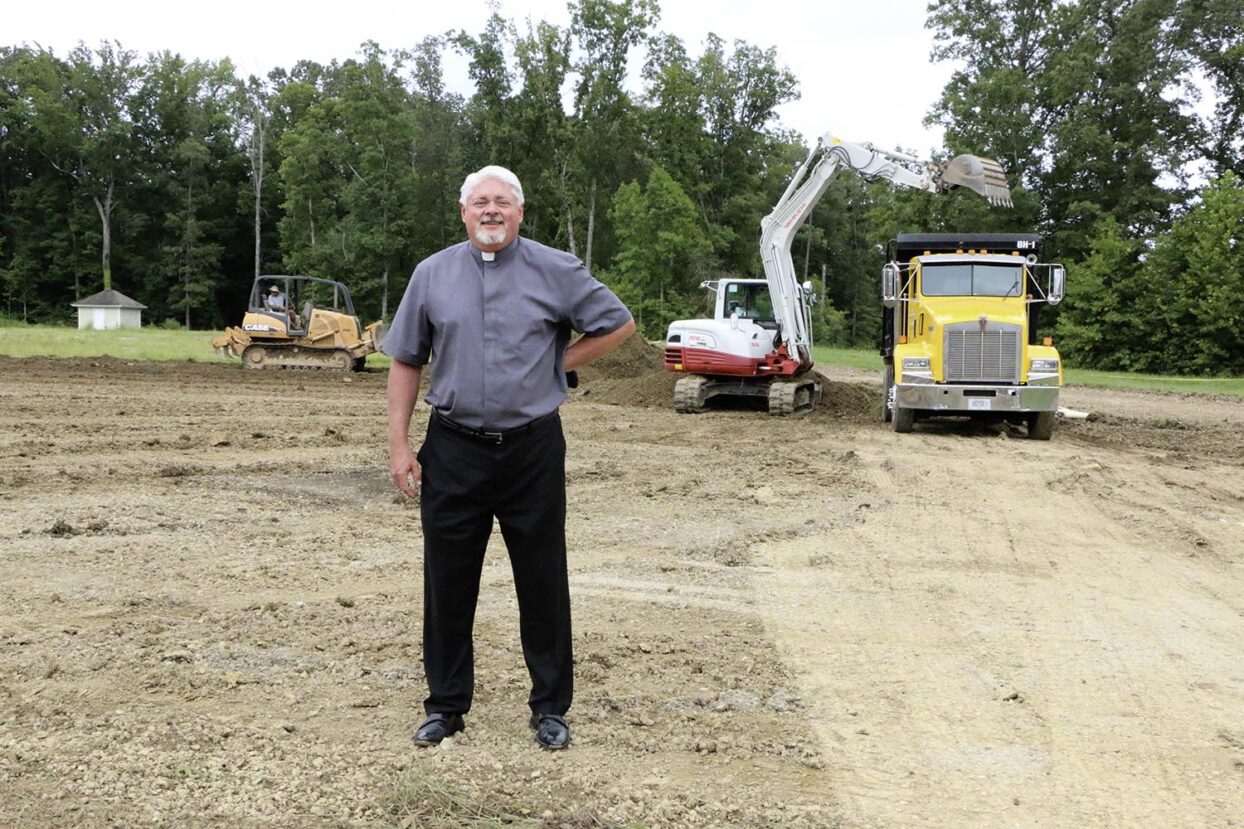
Seftons gift land for new Catholic cemetery
By Dan McWilliams
Longtime diocesan benefactors Alan and Sally Sefton have donated 10.9 acres in the Farragut-Concord area for a new Holy Cross Cemetery with a potential capacity of 3,500 graves, and the couple additionally contributed $1 million to establish a perpetual-care fund for the land, formerly used as a landscaping nursery.
The donation of the Northshore Drive property includes a large one-story building from the nursery and follows a search of several years for a new Catholic burial site as Calvary Cemetery close to downtown Knoxville, maintained by Immaculate Conception Parish, has been close to capacity for a few years. The six-acre Calvary property on Martin Luther King Jr. Avenue was acquired by IC, whose church is about two miles away, in 1869. Calvary is landlocked in a residential area.
To support Holy Cross Cemetery, including an expensive effort to add topsoil to the site, and to be put on a waiting list for a plot, visit cemeteryholycross.com.
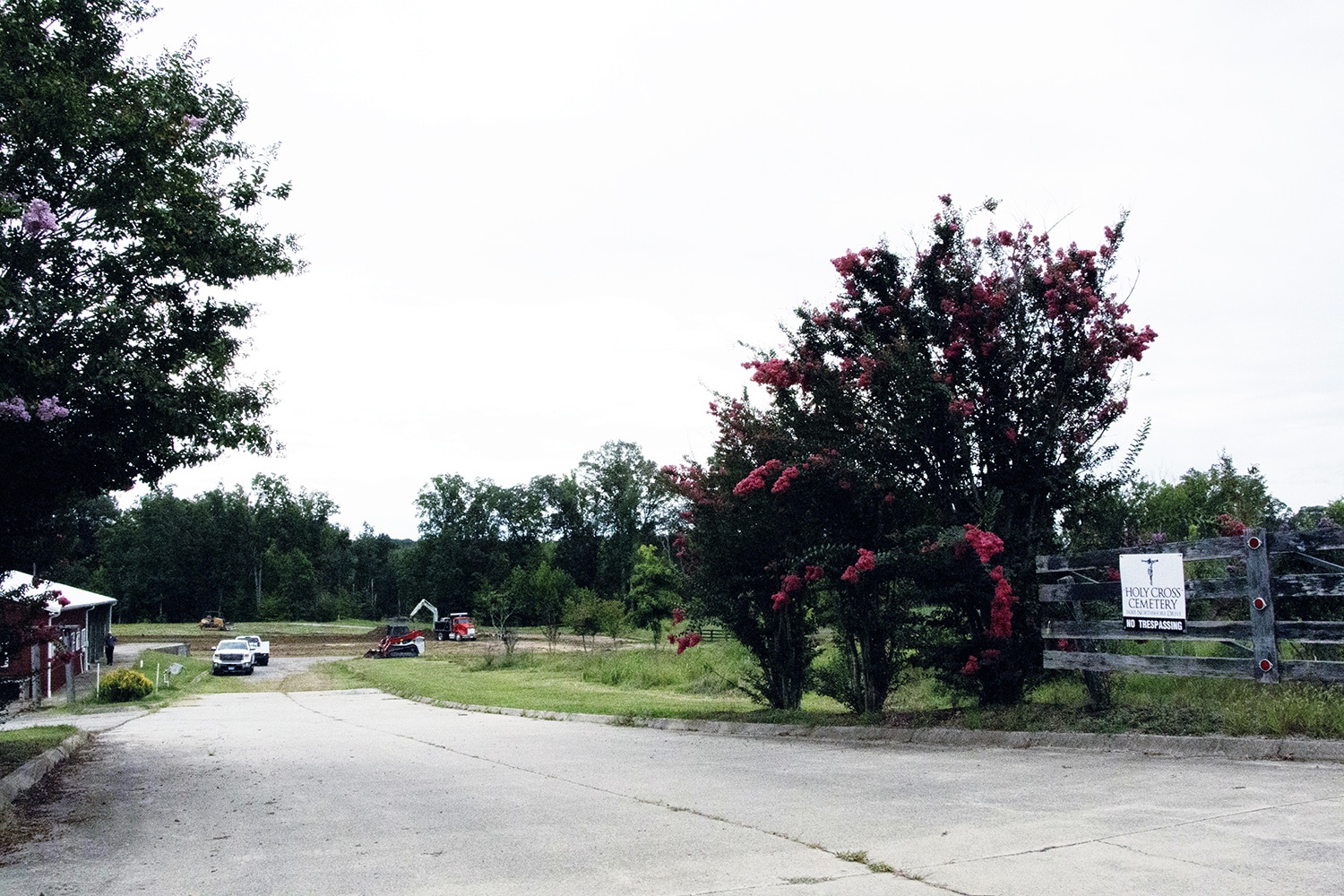
A construction crew readies Holy Cross Cemetery for burial plots as the Diocese of Knoxville prepares to begin offering spaces. The cemetery on Northshore Drive where Knox County joins Loudon County is the third in the diocese along with Calvary in Knoxville and Mount Olivet in Chattanooga. (Photo John Mecklenborg)
The diocese’s other cemetery, Mount Olivet in Chattanooga, was founded in 1886 and is maintained by the Basilica of Sts. Peter and Paul and other Chattanooga Deanery parishes. Mount Olivet covers about 30 acres with another 20 for potential expansion and has columbaria, which Calvary does not.
All three diocesan cemeteries have sections for priest burials. Father Joseph Hammond, CHS, who served in the diocese for 27 years before his Aug. 9 death, was the first person buried in Holy Cross Cemetery, in its priests’ corner, a section that has room for up to 50 graves.
Bishop Mark Beckman and Archbishop Joseph E. Kurtz presided at Father Hammond’s funeral Mass on Aug. 16 at St. John Neumann Church in Farragut, with burial taking place afterward at Holy Cross.
Bishop Beckman expressed his gratitude for the Holy Cross land donation and his thanks to diocesan chancellor Deacon Sean Smith, who has worked behind the scenes for months on securing the proper zoning for the cemetery and on the preparation of the shady, grassy site of Father Hammond’s burial.
“We are so grateful. We have a generous donor who has given us the gift of this land and also a generous gift to sustain its care for the years to come,” Bishop Mark Beckman said at the graveside service for Father Hammond. “I want to thank Deacon Sean Smith in a very special way today. He and others have spent countless hours, mostly Deacon Sean, making sure that this cemetery was ready for Father Joseph’s burial today. So, that’s a true gift that you’ve given us and Father Joseph.”
The Seftons, natives of Great Britain, are parishioners of the Cathedral of the Most Sacred Heart of Jesus. They originally developed the Northshore property as a nursery. After receiving several offers to purchase the land, the Seftons desired to donate it to the diocese for a cemetery.
“They wanted to have a Catholic cemetery out west, and so that’s how we received the gift,” Deacon Smith said.
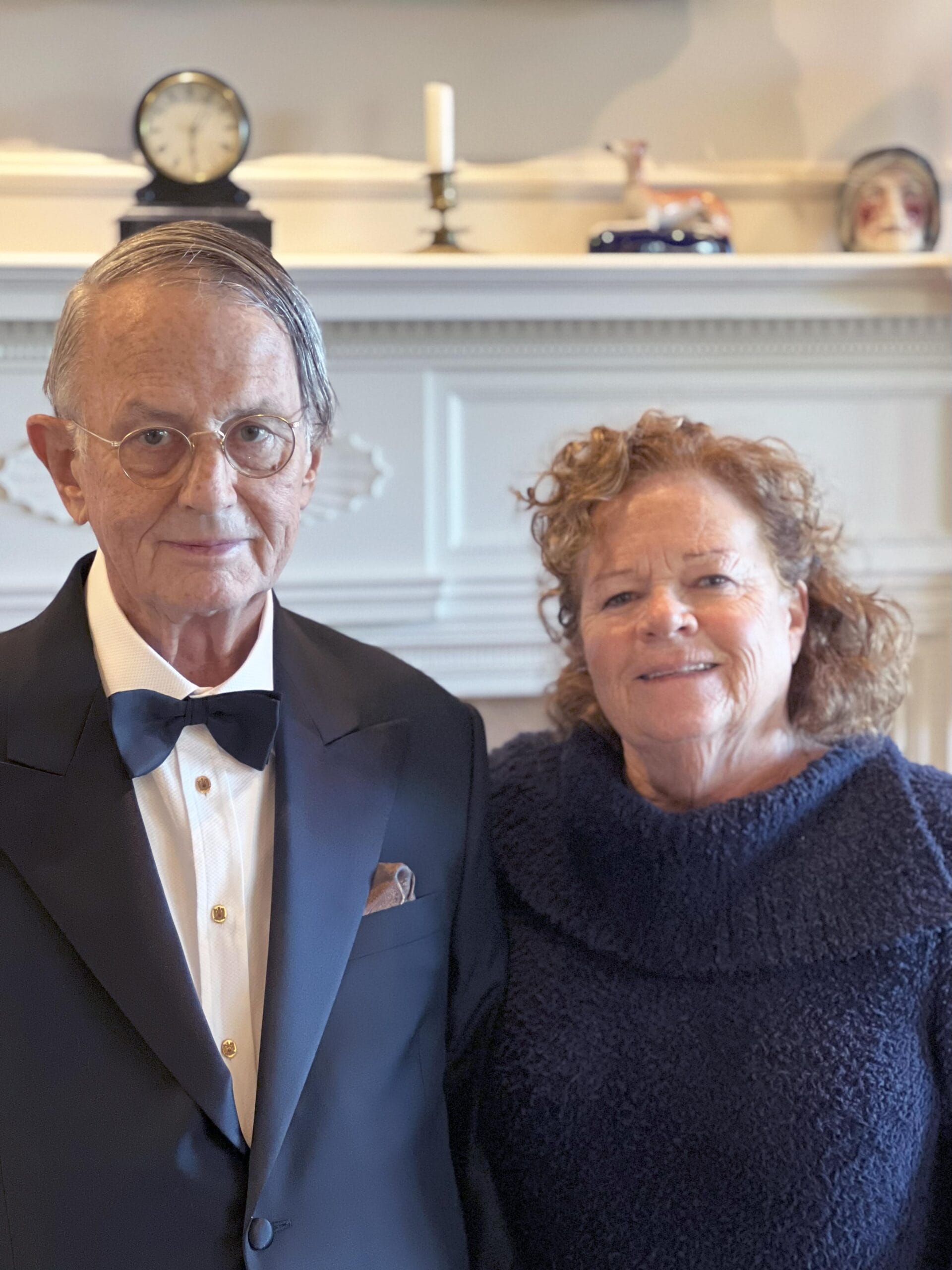
Sally and Alan Sefton are shown. A generous gift from the Seftons to the Diocese of Knoxville is establishing Holy Cross Cemetery, including the resources to maintain the cemetery in perpetuity.( Photo courtesy of Alan and Sally Sefton)
The donation was made last fall, with the deed transfer to the diocese closing on June 1.
“(Mr. and Mrs. Sefton) have given us that 10.9 acres and the building, and so you have to transfer the deed to us. We’re now the owners,” Deacon Smith said.
The large building on the cemetery site is “in excellent shape,” he noted.
“The long-term goal, and when I say ‘long-term’ it may be 10 or 15 years because we don’t have the money to do it now, but the building could have a little memorial chapel but more importantly a place to have a gathering after a burial, such as a reception or a luncheon, because it already has a kitchen.”
“There are three offices in there. I sometimes use one of those offices because I have been out there a lot,” Deacon Smith added. “Then there’s a very large space where you store the lawn mowers and tractors, and the other large place is where we would ultimately do the food.”
The building needs a sprinkler system installed before it can be used by the public, the chancellor pointed out.
Centrally located
The cemetery is in a rural area at 14301 Northshore Drive, just across the Knox County line in Loudon County, and has a Lenoir City address. The property is centrally located between St. John Neumann and St. Thomas the Apostle Parish in Lenoir City.
“The important thing that people should know is that, although it has a Lenoir City address, it is physically on the border of Knox County and Loudon County,” Deacon Smith said, noting that the cemetery is equally close to St. John Neumann and St. Thomas the Apostle. “It just happens to fall on the Loudon County side. Just to the east of it is the Concord traffic circle and the Farragut-Concord area. It’s really physically on the border.”
Deacon Smith since last fall has been putting in yeoman’s work with the Loudon County Zoning Commission and the county Planning Commission, hashing out the details needed to acquire the cemetery land.
“It’s been a long journey,” he said. “We had to get it rezoned because it was zoned for agriculture, and we needed it to be rezoned to a new kind of zone called community facility district, which includes cemeteries.”
Deacon Smith explained that although no one was opposed to the new cemetery, getting the property rezoned required amending an old Loudon County law that said a cemetery could not be developed unless it was a minimum 20 acres. Other counties have similar restrictions.
“Well, it’s only 10.9 acres, and so that would prevent us from ever doing it, right? I worked with the commission representatives for that specific area and sought their help. We actually got the law changed or amended so that if you’re a 501(c)(3) entity—the Church, basically—all you needed was 10 acres. If you were a commercial cemetery, you’d still need 20. But that one amendment allowed us to do it. Therefore, we got it rezoned.”
Going from the zoning board to the planning commission, based at the county seat in Loudon, Deacon Smith eventually obtained the latter group’s blessing.
“We started working on this gift and transfer in November, and it took all this time to go through all that, and then we had to get it re-surveyed,” he said.
The Holy Cross land is a former wooded area, but for the nursery the trees were removed and greenhouses put in, Deacon Smith explained. To support the buildings and a watering system, a tremendous amount of gravel was put down, he added. The buildings, gravel, and many pots for plants all had to be removed upon the completion of the property transfer.
“The very first thing that we had to have done is excavators scraping all that gravel off. They’re not going to get all the rock, but they got the bulk of it. That was step one,” Deacon Smith said.
Paving the loop road in the cemetery was the next step.
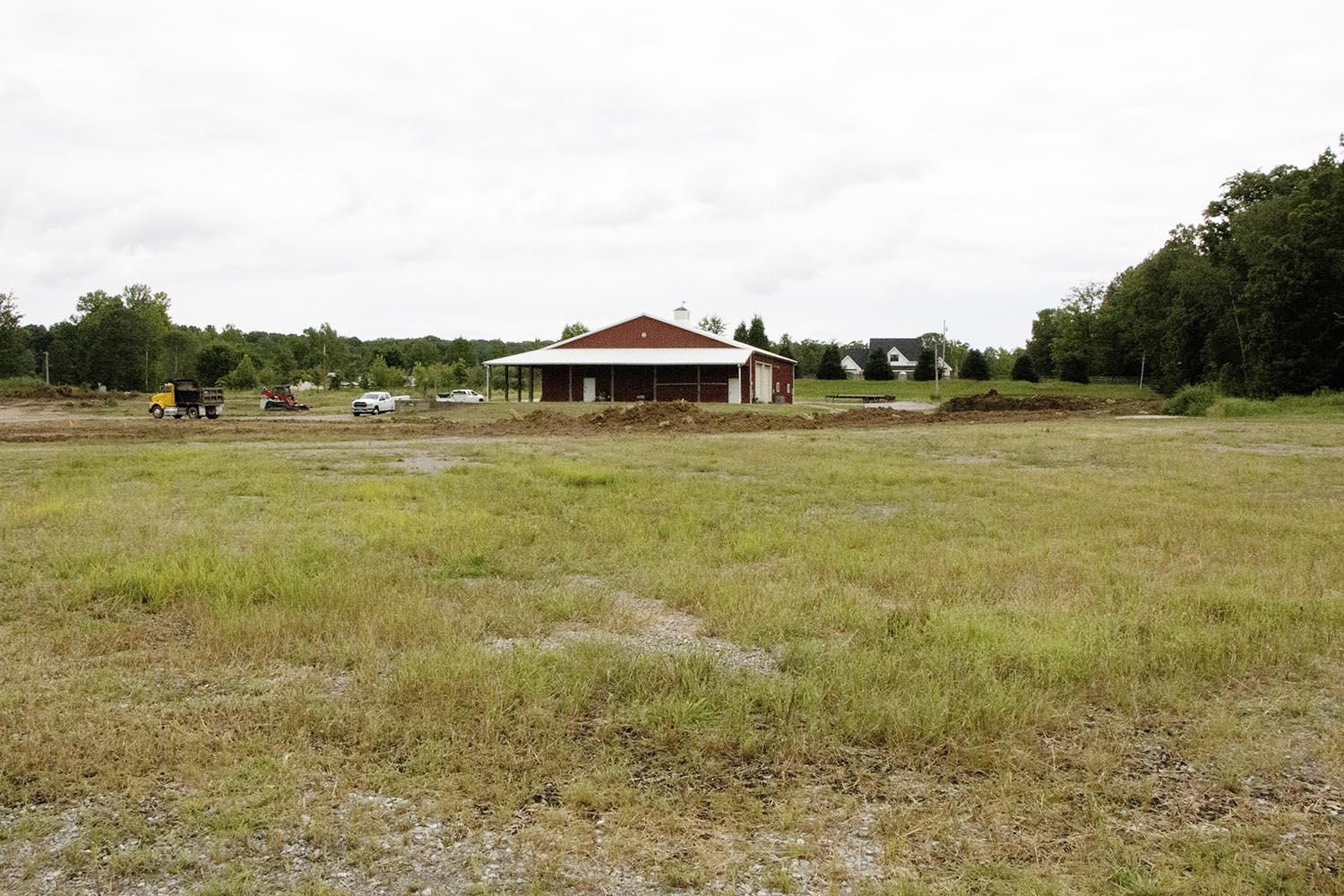
This 10.9-acre tract on the Knox-Loudon County line along Northshore Drive has been designated Holy Cross Cemetery and will be the Diocese of Knoxville’s third cemetery. The land includes a large building, which will be used as part of the cemetery. (Photo John Mecklenborg)
“It’s going to have 6 inches of pressed stone, 2 inches of a certain kind of asphalt, and then 2 1/2 inches of another kind of asphalt,” Deacon Smith said. “Ideally, before we do that, I would try to do at least one or two of the gardens to get some topsoil on there, and we’ll probably do rye grass and a drought-resistant grass combination so that we get at least some grass growing in the winter, and we’re going to continuously seed it.”
At least two gardens are planned for the cemetery, whose only shaded area now is the priests’ corner.
“We’ll get grass seed, a little bit of topsoil, seed it, and we’ll have a few irrigation lines coming from the irrigation pump that sucks it out of a pond there, which was the irrigation source for the nursery, with long projectile spray because you can’t have sprinkler pipes and lines in a cemetery since you’re digging there,” Deacon Smith said.
Adding topsoil and grass is needed before the rest of the cemetery outside of the priests’ corner can be used for burials.
“We need help financially because topsoil is bucks,” Deacon Smith said. “I can’t sell plots until that grass has started to grow.”
When that is accomplished, the cemetery can sell plots to people in the order they registered on the website, the deacon said. The cost for a plot “will definitely be a fair, just, competitive price,” Deacon Smith said.
Holy Cross will use GPS to give each plot its own latitude and longitude, meaning that if paper records are somehow lost the data will still be on the web.
The search for a new diocesan cemetery began as Calvary Cemetery neared capacity. The quest extended to the Halls area of Knox County and to sites beyond Loudon County, Deacon Smith said.
“For all of our parishioners who desire traditional burials with a headstone—not a flat plaque, a headstone—and with all the growth in West Knoxville, we really needed it,” he said. “We’re not going to mandate, but the preference is that there be a tombstone. Most new cemeteries forbid tombstones—you have to have a flat stone, and the reason is for ease of mowing and weed-eating. We don’t want the ease of mowing—we want it to look like a cemetery. They cost a little more, but we want monuments, even if they’re little ones.”
In the name of the Holy Cross
The name of Holy Cross Cemetery was chosen by Mr. and Mrs. Sefton, Deacon Smith said, and the burial ground will not exclude Christians of other faith traditions.
“Even though it is a traditional Catholic cemetery, you don’t have to be Catholic to be buried there. That’s a very important thing to say. Their desire is if you’re a baptized Christian, you could be buried there, even though it’s a Catholic cemetery,” the deacon said.
The cemetery will not charge to bury babies and will charge less for smaller plots needed to bury an urn.
“We will bury babies deceased either through miscarriages, abortions, or whatever for free. There will be no charge for burial plots for babies,” Deacon Smith said. “We will bury cremains. People still want to be cremated, but they want to be buried because the Catholic Church prefers burial. We will bury urns.”
Deacon Smith surveyed the parishioners nearest to Holy Cross Cemetery—from All Saints and Divine Mercy in Knoxville, St. John Neumann, and St. Thomas the Apostle—to ask them their preferences regarding their final wishes.
“I asked every parishioner: did they prefer traditional burial, did they prefer cremation, and did they have an interest in purchasing a plot if we were to have a blessed cemetery? More than half said they prefer cremation because they think it’s cheaper, but 40-plus percent preferred burial, so that was high enough. Even those who prefer cremation just because of the cost of a vault and a casket, they absolutely weren’t opposed to burying an urn in a traditional burial.”
Father Hammond lived at St. John Neumann from 2013 until he died, serving Hispanic ministry in the Farragut parish and others in the area. He desired to be buried near the place of his final assignment.
“He said, ‘This is my home. This is my family here. I want to be buried here, and I want it to be a Catholic, consecrated cemetery, and wouldn’t it be nice if it was one where I’ve served and lived my last days at St. John Neumann?’ Because it really is on the border of Farragut and Concord,” Deacon Smith said. “When I heard that, I said, ‘We’re going to make it happen.’”
Deacon Smith credited Dennis Bridges, owner of Bridges Funeral Home on Rutledge Pike in Knoxville and multiple cemeteries around the country, for his work on the Holy Cross effort. Mr. Bridges and wife Kim, a cemetery designer, are parishioners of Sacred Heart.
“He’s been consulting me from the very beginning, and he’s going to design where the plots will be—all for free,” Deacon Smith said.
Knights of Columbus will take turns mowing and cleaning the new cemetery. A ribbon-cutting with a formal consecration by Bishop Beckman, attended by dignitaries from city and county government, will occur in the coming months.
“The bishop will consecrate the entire cemetery with holy water. He’ll go the whole circumference and interior,” Deacon Smith said.
The name of the cemetery could have been “a really Catholic name” such as one honoring a saint or the Annunciation, but Mr. and Mrs. Sefton wanted something “that all of our Christian friends still could relate to, and he just felt that everybody knows about the holy cross,” Deacon Smith said.
“The name is Holy Cross, but what you will see on the entrance gate is a crucifix. People will know it’s Catholic,” he said.
Comments 1
No mention as to whether Holy Cross Cemetery will accept “natural (GREEN) burials. That is burials of bodies not embalmed and buried directly into the soil (without a cement vault or a non-compostable burial container needed). This was the way burials took place for thousands of years, and was the preferred ” Catholic Church Burial ” method until relative resent times. Though not popular with the mortician industry, it is becoming popular among people of modest means because of the low cost factor and that it allows the mortal remains to decompose quickly into the earth to await the final ‘ Resurrection”. So I do hope that the new Holy Cross Cemetery will consider a ” Garden of Nature ” burials.