

Dr. Kelly Kearse asserts that science has not proven the blood on the Shroud of Turin is that of Christ
By Bill Brewer
Dr. Kelly Kearse wants to set the record straight—again.
After headlines about the Shroud of Turin grabbed international attention in recent weeks with claims that biological material on the shroud is from a Jewish male with type AB blood and is undoubtedly Jesus Christ, Dr. Kearse is putting the brakes on certain assertions made by the “shroud crowd” regarding the bloodstains present on the cloth.
The faithful Catholic, scientist, and former chemistry teacher who lives in the Diocese of Knoxville isn’t making his observations from the sidelines. He finds himself in the middle of the reignited debate that has stirred passions for centuries. The bottom line for Dr. Kearse is that the strength of scientific claims should never be exaggerated or over-hyped to try to sell a particular viewpoint.
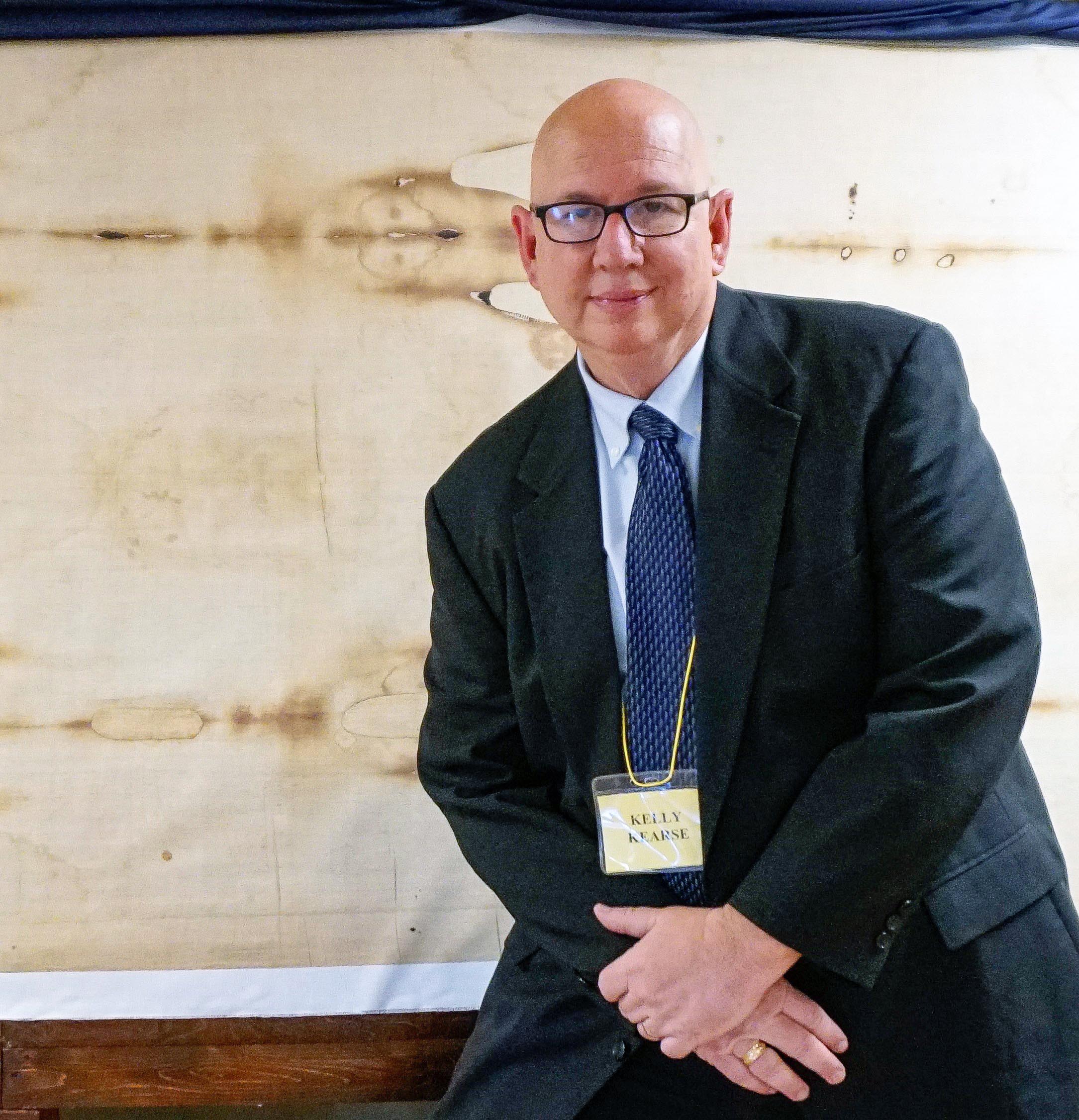
Dr. Kelly Kearse is a researcher into the Shroud of Turin and a former chemistry teacher at Knoxville Catholic High School.
Dr. Kearse was a speaker at the Shroud of Turin 2025 International Conference & Symposium, held July 30-Aug. 3 at the Augustine Institute in St. Louis. His contention based on scientific evidence has been that research and testing on the shroud hasn’t conclusively demonstrated that the blood on the shroud is human and male, much less from the Son of Man.
No scientific evidence exists to conclusively prove that the image on the Shroud of Turin is Jesus Christ. Dr. Kearse also freely acknowledges science hasn’t proven that the image isn’t Jesus Christ either. He is not alone. His view is shared by others in the scientific community, including those who have carefully studied the shroud. And his view is also that of the Catholic Church.
The shroud continues to be one of the most discussed religious artifacts in history. After hundreds of years of observations, conjecture, reviews, studies, postulations, and experiments, mankind still isn’t close to solving the mystery that continues to captivate public attention, according to Dr. Kearse.
But Dr. Jeremiah J. Johnston is among those who very publicly proclaim their belief that science says once and for all the image is Christ. The evangelical New Testament scholar and Baptist pastor appeared on popular commentator Tucker Carlson’s podcast on Aug. 8 and made bold claims about the shroud. He also appeared on popular commentator Piers Morgan’s “Uncensored” talk show in August with similar commentary on the shroud.
“What is unique about this burial cloth, Tucker, is that it has embedded in it the image of a crucified man that has complete correspondence with what we know of crucifixion in the Roman Empire, specifically as it relates to Jesus of Nazareth,” Dr. Johnston said.
When asked what makes him think the image on the Shroud of Turin is that of Jesus, Dr. Johnston remarked, “Because all of it matches the way in which Jesus was crucified, and that’s what’s powerful about the shroud. For example, on the shroud we have blood all over it. And the blood is interesting. It’s been tested. It’s type AB blood, which is Semitic blood. Only 6 percent of the world’s population has type AB blood. And so this is human blood. It’s male blood. It’s not blood of an animal. It’s not a hoax. You would have to actually kill someone if you were trying to reproduce the shroud because we have premortem and postmortem blood all over the shroud. So, that’s interesting. So, this tells us that someone died a torturous death, a death where he was flogged. We see scourges….”
Then on the Piers Morgan show, Dr. Johnston said, “The shroud is fascinating in that we have hundreds of burial shrouds from the land of Israel that wrapped Jewish corpses. We have only one shroud that has the image of a crucified man that corresponds with all the of realities that we read in Matthew, Mark, Luke, and John, and Josephus by the way, of how Jesus was brutally crucified under the hands of Pontius Pilate. That is my area of specialty, so if it’s not a hoax, what is it? Because I’m not irrational, I believe the shroud belongs to the historical Jesus.”
Not so fast, said Dr. Kearse following the St. Louis conference in which he spoke about blood on the shroud. Dr. Johnston also spoke at the Shroud of Turin conference and sat in on Dr. Kearse’s lecture, even asking Dr. Kearse a question.
“I presented on two things. I presented on a kind of state of the union: what’s known about the blood characteristics here in 2025. I had written this paper that covered everything back in 2012 or so, and some things have changed,” Dr. Kearse said. “So, one part was an update on the whole thing. I did another part on studies related to blood transfer to cloth. Both ended up getting picked up in the media.”
Dr. Kearse explained that media coverage of his report on blood transfer to the cloth received “super-hyped” headlines such as “Study proves authenticity of Jesus,” which was way beyond what the study was intended to show.
Sensationalized headlines and conflated commentary on the shroud image have stoked Dr. Kearse’s displeasure with statements he believes are based on emotion rather than intellect.
“He (Dr. Johnston) said it has been scientifically determined that blood from the shroud is from a male, that it is human, that it is type AB, and that it is Semitic blood. These are his claims. And then he said he has read all the scientific articles and found them fascinating because this is what the scientists have determined. He also said there are high levels of creatinine and ferritin that are indicative of polytrauma, a body that has really gone through a lot of torture and stress, and also that the shroud is covered in premortem blood and postmortem blood.”
Dr. Kearse disagrees with each of these statements, and explained, “This is a cloth that is 700-2,000 years old. There is currently no scientific test where you can take a fiber from a cloth that age and test it in a lab to see if it is premortem or postmortem blood. Part of this conclusion was also based on color. These blood stains group into this color and that color. But the author associates all these with different events in the Gospel. There is no scientific test where you can take blood that is 700-2,000 years old and say based on color this has to have been before death and this has to have been after death.”
“When you do an objective study of the blood like that, which you have to do, scientifically you have to separate the blood from any image because the blood is associated with different parts of the body on the image. You have to separate it out from that. I think you also have to separate out any Gospel narrative. You just have to scientifically examine the blood as blood and what can be told. Those studies don’t do that. The one about high levels of creatinine and ferritin proves there was polytrauma, the person in the cloth underwent significant physical trauma, significant physical torture. The study that came out in 2017 said that. What is not mentioned [by Dr. Johnston] is the study was retracted a year later. He never mentions that the story was retracted,” Dr. Kearse added. “Here is what the editors said: they were concerned about the ‘validity of the conclusions and the reproducibility of the results.’ Further, the editors voiced ‘there are not sufficient controls to support conclusions referring to human blood or physical trauma.’ You can look this paper up on the Internet. It will have a huge ‘Retracted’ across it.”
“One of the authors [of the retracted paper] did a follow-up study in 2024 about the premortem and postmortem blood. And incredibly he references the retracted paper in that study and says the same exact thing again. This is what he said, ‘As reported in the cited paper.’ This is the one that’s retracted. ‘The presence of numerous creatinine particles and ferritin confirms at a microscopic level the very heavy torture suffered by Jesus in the holy Shroud of Turin,’” Dr. Kearse said, pointing out that the claims are from a rescinded article.
“He references a retracted paper. It’s incredible. Scientifically, you wouldn’t even think about doing something like this. He makes some statement that he disagrees with the retraction. Of course he does. You hear this exaggeration about polytrauma based on high levels of ferritin, creatinine found on the cloth, but you never hear that the study was retracted a year later. You just hear that first part,” Dr. Kearse continued.
Dr. Kearse acknowledged that he wasn’t one of the observers who pointed out issues with the shroud article. But he read it and came to the same conclusion: “In these papers they will show profiles of elements, and it’s impressive when you see them, but you can take a lot of organic material and, unrelated, get a very similar profile. So, scientifically, it’s extremely exaggerated, which, I think, is why the editors decided to go back and retract it.”
Dr. Kearse, who recently retired after teaching chemistry at Knoxville Catholic High School for more than 20 years, was trained at Johns Hopkins and worked as a principal investigator at the National Institutes of Health’s cancer and immunology branch. He served as an editor for a Methods in Molecular Biology textbook, too.
He also serves as a eucharistic minister.
Dr. Kearse has earned the respect of peers in the scientific and faith communities for his knowledge and beliefs. In fact, in recent months he has published forensic science papers in the Journal of Forensic Science, Medicine, and Pathology and in the Journal of Forensic Science and Research. In an article just published in Forensic Science International reports, Dr. Kearse addresses the blood characteristics described by Dr. Johnston on the Tucker Carlson and Piers Morgan shows point by point. In addition to the issues with the scientific identification of premortem and postmortem blood on a 700-2,000-year-old cloth, he also addresses the claims that the blood has been tested and shown to be human, male, type AB, and Semitic.
While blood type AB has been reported for the shroud as well as on the tunic of Argenteuil, which is a seamless robe, and on the sudarium of Oviedo, a face cloth, that were connected to Christ, Dr. Kearse and other scientists have pointed out that A and B antigens in the rare blood type are not unique to humans. Bacteria cells also have A and B antigens on their surfaces. So, if a sample from those cloths associated with Jesus Christ is contaminated with bacteria, even if it contains no blood at all, it could still show a type AB blood result in tests. Like most Christians, Dr. Kearse would like to believe the shroud, as well as the tunic of Argenteuil and the sudarium of Oviedo, are all connected. But as a scientist, science just won’t let him have confidence in that conclusion.
According to Dr. Kearse, the upshot of the latest controversy is that science still hasn’t proven or disproven the authenticity of the Shroud of Turin despite what a new cacophony of shroud claims maintains.
And digs at the Catholic Church by the shroud-is-real community aren’t helpful, he said.
“This same person (Dr. Johnston), it’s incredible, he said [on the Tucker Carlson show] the Catholic Church is afraid of the Turin shroud. The Catholic Church is ambiguous; it’s indifferent toward the shroud. [Dr. Johnston also said] the Catholic Church is not interested in educating people about the shroud. He thinks the Church is probably afraid of the shroud because it might think that maybe the shroud isn’t real, that’s kind of what he insinuates. Those kinds of remarks … I just couldn’t believe it. I thought it was so disrespectful. It’s such nonsense,” Dr. Kearse remarked. “He had quite a few, I thought, anti-Catholic remarks. He said he has an allergic reaction to Catholic relics.”
“What is his motivation for saying this? He thinks this is proof of the resurrection and it needs to be brought out more because this is an important story for mankind. The Catholic Church’s official position is neutral. It says it is neither pro-authentic nor skeptical. It is not saying it’s real, but it is not saying it isn’t real. The Church is wise. This isn’t its first rodeo. It has been around for 2,000 years. I think the Church is wise and patient. And that is why it maintains its stance of neutrality on the shroud,” he added. “As a scientist, my position is the same as the Catholic Church.”
It’s a position that neither Dr. Kearse nor the Church arrived at casually.
“Honestly, when people say, ‘Hey, do you think the shroud is real?’ or, ‘You think the shroud is real, right?’ I always say, ‘Honestly, I don’t know. I just don’t think enough has been done.’ And that’s how I honestly feel. There really has been only one major investigation of general properties that has ever been done, and that was back in 1978. It was a team of about 50 scientists. It was called STURP, for Shroud of Turin Research Project Team. They went and examined it for about five days straight. There were some other scientists present. That was more than 40 years ago. In 1988, they did the carbon-dating. Those are the only two times it has really been scientifically investigated in any type of detail at all,” he said.
But science has evolved dramatically since 1978.
“The technology has improved so much. You need to go back and look at certain things to decide if we need to follow down this path or do we really not need to worry about that, etc. I just don’t think enough has been done. These guys will talk about it as if it’s so solid, it’s the most studied artifact in human history, etc. But it’s not like a lot of science, where you go back in the lab and work on the original source and say, ‘Let’s figure this out.’ It’s not like that,” Dr. Kearse shared. “I think it’s intentionally over-hyped by those people. It’s their important message that has to get out: This is physical proof of the resurrection.”
Dr. Kearse, who has been studying the shroud since 2010, said they believe that, and they want everyone to know it’s so, and that position is based on emotion, not the science that exists. He is concerned there hasn’t been “rigorous objectivity” applied to the study of the Shroud of Turin.
“With the shroud crowd, if you doubt or try to go on a middle road to be objective and see if there are any other explanations, it’s automatically assumed you are doing harm here. You’re going against what you should be doing. But you need to have more objective scientists who don’t have any skin in the game to look at it just from a scientific standpoint and investigate it. I think that’s what is really lacking,” the scientist contends. “These stories get built on data that isn’t that solid, and they just get echoed and echoed and echoed and echoed. Then you have a guy going around saying that the blood has been demonstrated to be from a male, it’s from a human, it’s type AB, it’s Semitic.”
“I think what it shows is that you have authentic blood components present. I like to say that instead of ‘Well, it’s blood,’ because you don’t really know if something might have been added to it. You don’t really know. But those components you test for, they are there. It’s like hemoglobin, signature molecule [of] blood, there is solid evidence for that. Albumin, abundant protein and blood serum, immunoglobulin, there is good evidence for that. And that has been published in peer-review journals,” he noted. “What has never been published in a peer-review journal is that the blood is human, the blood is male, the blood is AB, the blood is Semitic. Those major claims sound very impressive in these media interviews. But if you go back and trace the data, it’s not there. They are just small glimpses. They are things written in books or a shroud magazine, but not a regular route in a scientific journal that you would expect.”
“As a scientist, it is unimaginable that you would not want to publish in a scientific journal. That is where most of this information is [in non-peer reviewed formats],” he continued.
Dr. Kearse also points out that throughout history as the shroud was viewed, handled, poked, and prodded, those reviewing it typically did not wear gloves, which gave rise to cross-contamination on a microscopic level. And as blood tests on the shroud were performed with antibodies, scientists now know that such antibodies would have also reacted with blood from a variety of animals, including primates, rodents, dogs, cats, and other species.
So, the scientific conclusion from the shroud blood tests is “species unknown.” “I don’t think you can say it if you don’t have the evidence to back it up. That is one of my main messages. That’s what gets me the most about all this. You can write whatever you want in a book or a shroud magazine,” he said.
Dr. Kearse referred to the website for the International Center for Shroud Studies in Turin, which is an authority on the Shroud of Turin and is located near the Shroud of Turin museum and the Cathedral of St. John the Baptist. This is the only center in the world to be officially recognized by the Pontifical Custodian of the Shroud. “This is what they say on their website: ‘The identification of the species of the blood stains on the shroud is still a subject of study.’ That is their official line. That is from the official group even though this guy [Johnston] is saying the blood has been shown to be human.”
As much research and collaboration as Dr. Kearse has put into the Shroud of Turin over the past 15 years, he has come to this conclusion: science cannot definitively prove that the shroud is real. Prove is a very strong word in the scientific arena.
“Science is never going to prove it. You can’t scientifically prove this is the authentic burial cloth of Christ. You can disprove it, and some people say the carbon 14 dating did that. Now, that is controversial, and I think there is good reason that it’s controversial. I think that needs to be redone.”
In the meantime, Dr. Kearse shared a few words of wisdom for those digesting all the content about the Shroud of Turin:
- Don’t believe everything you read.
- Don’t believe everything you hear.
- Do your homework on the shroud.
- Fact-check what is being said and written about the shroud.
- For Catholics, center your faith in the Eucharist, not in a cloth.
And the career-long scientist practices what he preaches—during the week and every Sunday.
“I think there will come a place where science will only take us so far and then faith will have to fill in the gap,” he concluded.