
Synodal participants invited to contemplate and rediscover mystery of Church
By Jim Wogan for The East Tennessee Catholic
If it wasn’t plainly evident that this “Synod thing” was facing headwinds in the United States before I arrived at the Vatican in late October, it became more so on my first evening there—when Pope Leo XIV met with more than 2,000 Synod delegates on Oct. 24.
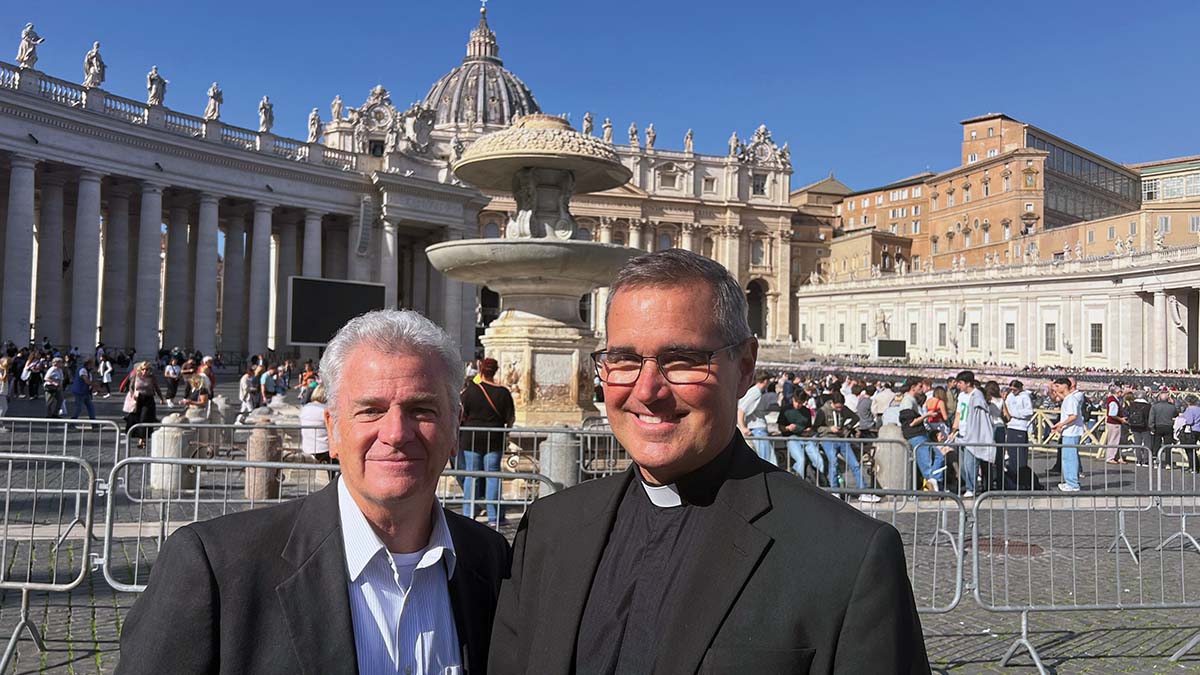
Father Peter Iorio and Jim Wogan prepare for the opening prayer and inaugural session of the Jubilee of Synodal Teams and Participatory Bodies on Oct. 24 as they stand outside St. Peter’s Basilica and the Pope Paul VI Hall in Vatican City. Father Iorio and Mr. Wogan represented the Diocese of Knoxville in the Synod session that included representatives from around the world. (Photo courtesy Jim Wogan)
Father Peter Iorio, pastor of Our Lady of Fatima Parish in Alcoa and vicar general and moderator of the curia for the Diocese of Knoxville, and I attended this three-day Jubilee of Synodal Teams and Participatory Bodies from Oct. 24-26 at the request of Bishop Mark Beckman.
The jubilee weekend was more than a series of discussions and classroom sessions—all of which proved valuable. The Vatican encompasses a large area and classrooms are tucked into halls and buildings that I never knew existed. At times I had flashbacks of sprinting across campus in my college days and arriving at my next lecture completely out of breath. Who scheduled this and what was I thinking?
We learned a lot in the classroom-and-dialogue sessions. But I realized that attending the Synod Jubilee was a reminder of the holy bond that we as Catholics share, especially during our time on earth.
That weekend, the universal Church wasn’t just a concept. Father Peter and I were walking within it. We felt it. It spoke to us. We saw it in the faces and heard it in the words of other Catholics who represented their own dioceses in their own countries and continents: Africa, the Middle East, Oceania, Asia, South America, Latin America, Europe, and North America.
We shared our Catholicism, our love of God, our belief in the redemptive gift of Jesus Christ, our thoughts, our concerns, and our mutual respect for each other in a setting that reaffirmed that together we really are one people in Christ.
But before all that, during our first session with Pope Leo, we were reminded that doubt remains about this particular Synod process.
Following a moving opening prayer and inaugural session led by Vatican Synod secretary Cardinal Mario Grech, the Friday evening encounter-dialogue with Pope Leo included seven representatives of various regions of the world updating the Holy Father and the assembly on how the Synod is progressing in their areas and then asking the Holy Father a question. Each representative went. Africa? Check. Oceania? Check. Other regions? Check. North America? Uh, well, hold on for a minute.
Roughly halfway through the session, Bishop Alain Faubert of Canada spoke on behalf of North America and addressed one of the issues the Synod is facing in the United States, if not elsewhere.
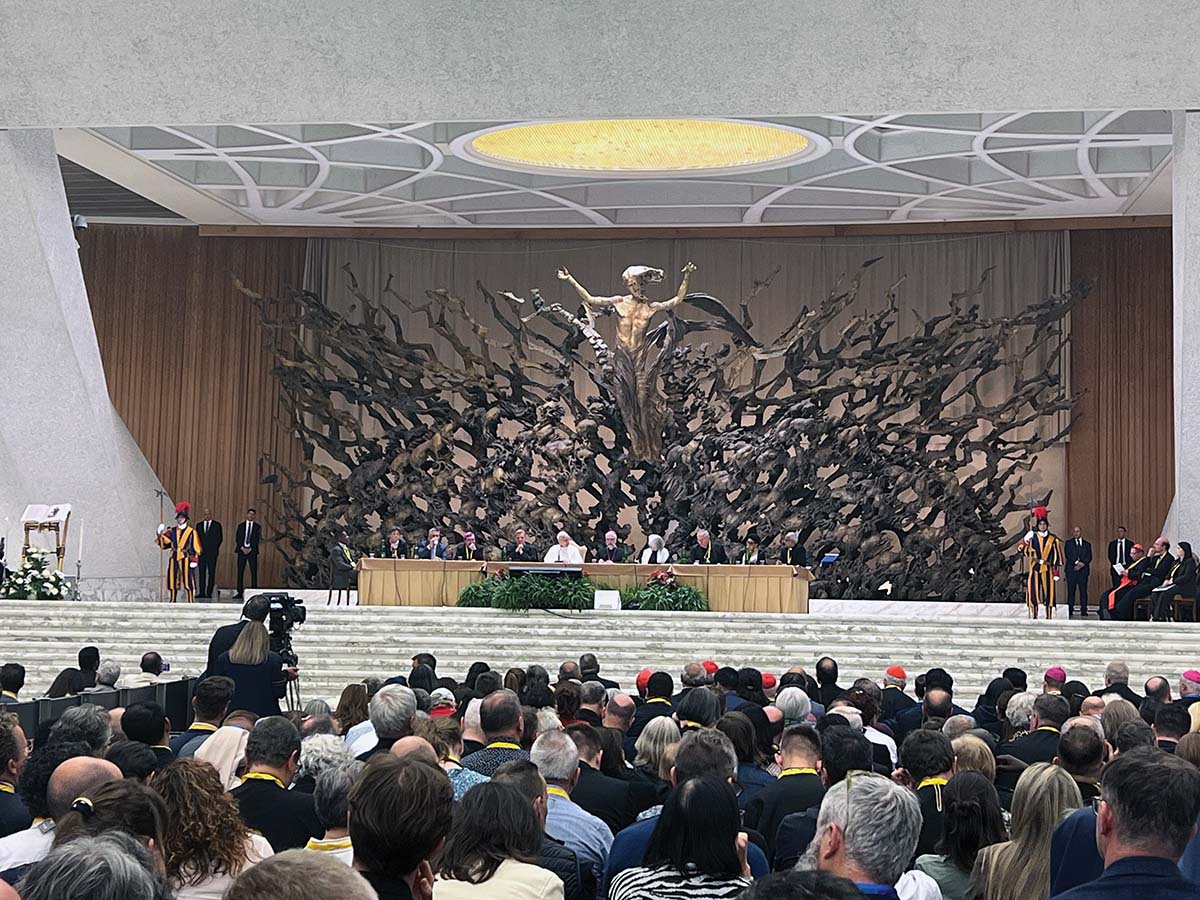
Pope Leo XIV and Vatican leadership listen to presentations from delegates attending the Jubilee of Synodal Teams and Participatory Bodies inside the Pope Paul VI Hall on the opening evening of the jubilee. (Photo courtesy Jim Wogan)
“Holy Father, what would you say to bishops and priests who are concerned that synodality may diminish their authority as pastors? How can we better understand and promote co-responsibility, accountability, and transparency in our dioceses and parishes?” Bishop Faubert asked.
A noticeable level of muttering was heard from delegates in attendance. Pope Leo acknowledged it when answering the question.
“One of the disagreements that apparently many of you experienced—judging by your reaction when the question was asked—is the concern among some pastors or bishops that their authority may be diminished. Apparently, some of you have had that conversation, let us say. I would like to invite all of you, as we were invited during the Synod sessions, to reflect upon what synodality is about, and to invite the priests, particularly even more so than the bishops, I think, to somehow open their hearts and take part in these processes,” Pope Leo said.
Bishop Faubert’s question got attention and Pope Leo’s answer, I thought, captured one of the real issues as we continue to ask: What is synodality? What is this particular synod all about? And how will it impact the Church?
In this context, Pope Francis defined synodality as a journey—walking together in communion as we discuss issues facing the Church. This particular synod opened in 2021—albeit with a cumbersome name—The Synod on Synodality. Dioceses around the world, including the Diocese of Knoxville, conducted dialogue sessions in 2021, and our reports were submitted to Rome for review and discernment.
As a result, the XVI Ordinary General Assembly of the Synod of Bishops produced a report called (the) Final Document, which was later endorsed by Pope Francis on Oct. 26, 2024. It’s lengthy and action-oriented, especially for local dioceses.
Pope Leo has approved the next phase of the Synod: the Implementation Phase, which, based on Bishop Faubert’s question and the assembly’s reaction, will generate even more questions.
The journey Father Peter and I made to Rome wasn’t intended to answer every question. Instead, the gathering of synod representatives first offered us a spiritual boost in various forms, including the jubilee’s opening prayer session led by Cardinal Grech on Friday and a pilgrimage through the Holy Door at St. Peter’s Basilica very early Saturday morning.
I arrived at the Vatican that day walking from my small apartment to the Porta del Purgino just off Via Aurelia as the sun was rising over Rome. The scene was inspiring to say the least. And its inspiration was needed as Saturday proved to be a very long day.
It began with small-group dialogue sessions after the Holy Door pilgrimage. Father Peter attended an encounter focused on “Conversation in the Spirit,” which utilizes prayer, reflection, and discernment to explore and discuss opinions and issues. Listening is essential. Discussion is focused. Prayer is included. Debate is non-existent.
At the same time, I found myself in a large theater-style auditorium with Cardinal Grech and other Vatican Synod leaders who heard statements and took synod-related questions from fellow cardinals, bishops, priests, and laypeople. Four languages were spoken, and similar to video coverage you’ve seen from the United Nations, participants had the benefit of live-translation headsets.
Less spiritual and more practical, one of the chief concerns raised at that meeting was about the time frame set up for dioceses to complete their tasks. Much of the work at the diocesan level will take place in 2026 and early 2027, with an ecclesial assembly set for late 2028 in Rome.
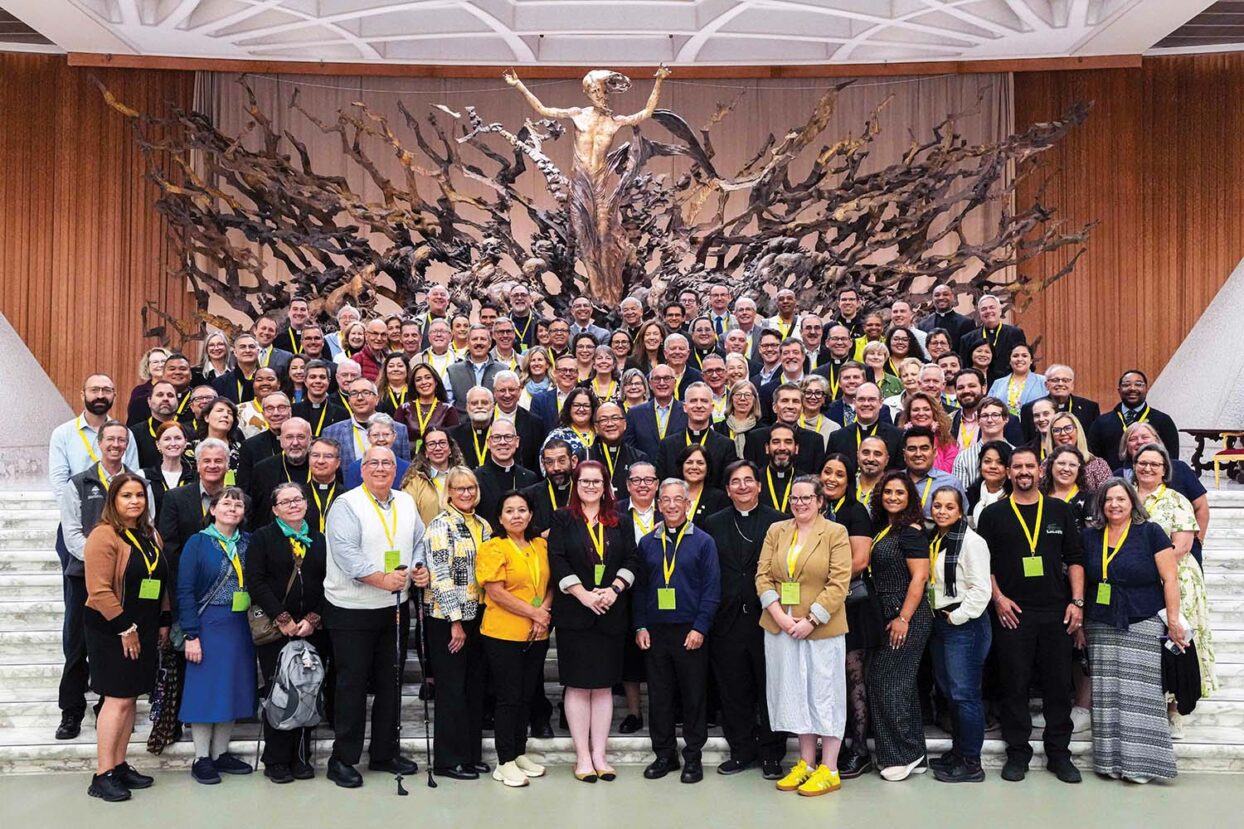
Before lunch, more than 150 members of the U.S delegation gathered for a photo on the steps of the main stage inside the Pope Paul VI Hall. Meeting and sharing our experiences with other U.S. Catholics—priests, bishops, and laypeople—during this brief interlude was rewarding.
Following lunch, the Saturday classroom marathon continued. Father Peter attended two workshops: “A Synodal Church Walks Together—Listening, Sharing, and Growing in Christ,” and “For a Synodal Church That Listens to the Cry of the Poor and the Earth.” My college flashback came when I was surprisingly directed out of the Pope Paul VI Hall and down the street to the Istituto Maria Santissima Bambina. I attended a class on “Nurturing Synodality in the Local Church: Parish Life and Synodal Teams” and another (appropriately) titled “Ecclesial Discernment and Polarity Management.”
Remarkably, the day wasn’t over. That evening, back at the Pope Paul VI Hall, Cardinal Grech offered closing remarks and a synod mandate to delegates. “Synodality is not taught, but caught. It can be contagious. I am hopeful that once we go back home after this splendid ecclesial, synodal experience, it will be also our call to try to not teach but to share this experience; to help our brothers and sisters feel that they missed something not being here,” he said.
Following dinner, delegates were invited back to St. Peter’s Square for a Marian prayer vigil. By then, the weather had changed, and a soft rain was falling. Still, our candles remained lit, and in his homily, Cardinal Grech drew on the example of the Blessed Virgin. “Mary is the image of a Church of synodal style because she meditates and dialogues,” the cardinal-secretary said. “After listening to the Word of God in prayer, Mary measures the events of her existence in her heart in order to discern God’s will. In this, Mary is a teacher of ecclesial discernment, a model of a Church which, beginning with listening, discerns the will of God and puts it into practice.”
It was a profound way to end a long day—15 hours of prayer, discernment, discussion, and learning.

Father Peter Iorio, center, pastor of Our Lady of Fatima Parish in Alcoa and vicar general and moderator of the curia for the Diocese of Knoxville, concelebrated the Oct. 26 Mass that Pope Leo XIV celebrated for delegates to the Jubilee of Synodal Teams and Participatory Bodies. Father Iorio also was selected to serve Holy Communion during the Mass. (Photo courtesy Jim Wogan)
Sunday morning was no less exhilarating. Father Peter and I arrived at St. Peter’s Basilica shortly after 8 a.m. It was sunny and warm, and the square was starting to feel the squeeze of thousands of pilgrims who had journeyed to Rome in this Jubilee Year.
The Holy Father, Pope Leo, celebrated Mass for the Synod Jubilee delegates. Father Peter was a vested concelebrant and was also selected to serve Holy Communion. I was seven rows from the altar, seated in a transept. The pope’s homily, offered in Italian, reaffirmed his commitment to the synodal process.
“Brothers and sisters, as we celebrate the Jubilee of the Synodal Teams and Participatory Bodies, we are invited to contemplate and rediscover the mystery of the Church. She is not merely a religious institution, nor is she simply identified with hierarchies and structures. The Second Vatican Council reminds us that the Church is the visible sign of the union between God and humanity…
“Dear friends, we must dream of and build a more humble Church; a Church that does not stand upright like the Pharisee, triumphant and inflated with pride, but bends down to wash the feet of humanity; a Church that does not judge as the Pharisee does the tax collector, but becomes a welcoming place for all; a Church that does not close in on itself, but remains attentive to God so that it can similarly listen to everyone. Let us commit ourselves to building a Church that is entirely synodal, ministerial, and attracted to Christ and therefore committed to serving the world.”
The Holy Father also included Synod delegates in his Mass prayer intentions and later, at noon, as is custom, he addressed thousands of Catholic pilgrims in his Sunday Angelus prayer and Gospel reflection from a window high above St. Peter’s Square.
After recording our final video report for the Diocese of Knoxville’s Facebook page, Father Peter and I spent time at lunch discussing what had just taken place. We agreed that our biggest challenge now is bringing the spiritual enthusiasm we lived in Rome back to the Diocese of Knoxville—and its parishes and ministries.
For three days, Father Peter and I walked together with thousands of synodal delegates in Rome, and we did our best to represent Bishop Beckman and the Diocese of Knoxville in the continuation of a journey Pope Francis started four years ago.
What lies ahead in 2026 will require a lot of work and an equal amount of prayer. The “Final Document” released by the Vatican remains the framework for action. Understanding what it is, and equally important, what it is not, will be vital. The document is posted on the Diocese of Knoxville website (dioknox.org/synod) with another important document: “Pathways for the Implementation Phase of the Synod,” which I humbly suggest reading first.
Jim Wogan served as communications director for the Diocese of Knoxville from 2014-2024 and is assisting the diocese in implementing the Vatican’s Synod on Synodality programs.