
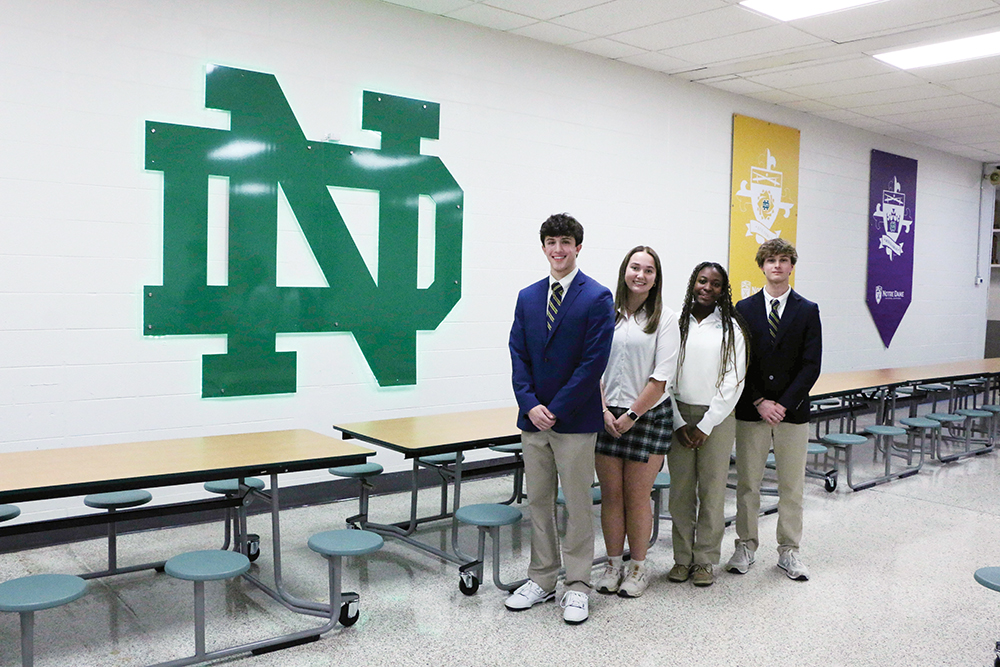
Notre Dame High School commemorates 150 years of educating students
By Dan McWilliams
Notre Dame High School in Chattanooga couldn’t have picked a better day than Jan. 6 to kick off its 150th-anniversary celebration.
That was the day in 1876 when four Dominican Sisters of St. Cecilia Congregation in Nashville arrived—at the invitation of now-Servant of God Father Patrick Ryan, pastor of Sts. Peter and Paul Parish downtown—to begin Notre Dame de Lourdes Academy for girls, the city’s first private school. The Sisters within a couple of years had to close the school because of a yellow-fever epidemic that claimed the life of Father Ryan and thousands of other Chattanoogans, but the school reopened and has remained so now for a century and a half, overcoming challenges that resulted in the closure of many Catholic schools nationwide.
Bishop Mark Beckman celebrated a morning Mass for the student body, Dominican Sisters, and several alumni in the school’s Michael and Eleanor Miller Theater on the anniversary day. Seven priests, a deacon, and current and former school leaders attended, with many Notre Dame alumni among their number. Bishop Beckman is not an alum of Notre Dame but as a transitional deacon taught religion there in the 1989-90 school year. When he was appointed shepherd of the Diocese of Knoxville in spring 2024, the bishop said that “my year teaching at Notre Dame High School in Chattanooga solidified my desire to be ordained to the priesthood.”
“It is so good today that we gather to celebrate this moment on this beautiful community’s birthday, its beginnings, 150 years ago today,” Bishop Beckman said in his greeting at Mass, “and that we have our Dominican Sisters. Your community came from Nashville to begin this beautiful educational ministry in East Tennessee, and it is so wonderful that this institution, this place of learning, is still thriving and growing. For all of these things, we are grateful today to the Lord.”
Proud graduates
Monsignor Al Humbrecht, Father John Dowling of the Notre Dame class of 1968, Father Mike Nolan (’78), Father Peter Iorio (’82), school chaplain Father A.J. Houston, and Father Christopher Manning of the Diocese of Knoxville and Father Joe McMahon (’75) of the Diocese of Nashville concelebrated. Deacon Hicks Armor (’70) assisted. Father Manning served as NDHS chaplain and as a faculty member from 2019-24.
Fourth Degree Knights of Columbus from assemblies 1084 and 3250 in Chattanooga provided an honor guard at Mass.
A proclamation from Pope Leo XIV and anniversary displays depicting “moments in Fighting Irish history” from 1876 to the present were in the hallway outside the theater.
Current head of school Dr. Eric Schexnaildre (’96) and former head of school George Valadie (’71), now the diocese’s interim superintendent of Catholic Schools, spoke before the Mass began.
“It is fantastic to see you guys back at a totally normal day at Notre Dame High School, right, students?” Dr. Schexnaildre said. “I want to first off welcome all our guests: our alumni and friends and supporters of Notre Dame High School as we kick off an incredible achievement . . . to recognize the special place, community, and family that Notre Dame High School is.”
Referring to himself as “a proud graduate,” Dr. Schexnaildre said that “this place changed me. It molded me, with so many other thousands of alumni. It’s very special to my heart. For me to return and serve in the world I’m in, it’s surreal and I’m very grateful for the opportunity.”
The Dominican Sisters taught at Notre Dame for its first 97 years, leaving in 1973, but they returned in 2010 and remain on the faculty today. Six Sisters attended the Mass—Sister Anne Catherine Burleigh, Sister Mary Jude Repinski, Sister Imelda Garrison, Sister Mary Louis Baltz, Sister Victoria Marie Liederbach, and Sister Dominica Bickerton. Dr. Schexnaildre recognized them as well as Kelly Valcarce, director of community engagement for Chattanooga Mayor Tim Kelly, and Betsy Kammerdiener and Jean Payne of Memorial Hospital.
Perry Storey, principal of Notre Dame from 1996-2013, and wife Cindy, who worked at the school for a longer period, including as its director of Student Academic Support Services, also were present at the Mass.
“They worked here for a long time,” Dr. Schexnaildre said. “Perry—nearly 18 years, that’s like 100 years, I think. Perry oversaw unprecedented growth with our enrollment and facilities and whatnot. Perry, I appreciate you being here and Cindy as well.”
The head of school referred to a statistic that 60 to 70 Catholic schools have closed each year since 1960.
“That’s kind of scary and sobering, but I think what it does is bring home the importance of Notre Dame High School and who we are,” he said. “It is so great to see our alumni here. There are many, many here already. It is truly a special place, and for our students it’s pretty awesome that you get to be here, whether you’re a freshman or a senior. You get to be here as a part of this.”
A number of anniversary events are planned through this school year and into 2027, Dr. Schexnaildre said, as the first school year for Notre Dame was 1876-77.In introducing Mr. Valadie, who served Notre Dame as a teacher and coach and in admissions advancement before his later leadership duties, Dr. Schexnaildre said “he’s checked all the boxes.”
“It’s an honor to be here to get to celebrate our school’s 150th jubilee,” Mr. Valadie said. “Is it an anniversary? Or a birthday? I’m not sure it matters. But we know it happened a long time ago, and let’s be honest, you’re still here 150 years later. It’s an accomplishment few institutions can match. However you look at it, today marks our day.
“As the planning has progressed, we decided we want to have more than a one-day birthday. We wanted a yearlong birthday. So, we’re using 2026, all of it, beginning now and going all the way through next fall, to be celebrated as our 150th jubilee year.”
Mr. Valadie said that “no matter how hard you try, it’s virtually impossible to imagine life in 1876” when Notre Dame began. “Light bulbs hadn’t been invented yet, so imagine torches and lanterns throughout the building. Electric fans didn’t exist, much less air-conditioning, nothing to circulate the air inside, so the building most likely would have had a different sort of aroma, if you know what I mean. Indoor plumbing was rare, too, if you want to imagine that lunch-period rush.”
No sports for the early students, no vinyl records, and no drinking straws, bottlecaps, zippers, cotton candy, fly swatters, Band-Aids, paper towels, or cheeseburgers existed in 1876, he added.
Mr. Valadie then mentioned the University of Tennessee at Chattanooga and the Erlanger Hospital system and made a playful dig at three of Notre Dame’s fellow private schools and sports rivals in Baylor School, McCallie School, and Girls Preparatory School.
“UTC didn’t exist. Erlanger didn’t exist. Neither did Baylor … or McCallie … or GPS,” he said.
Father Ryan’s parish, now the Basilica of Sts. Peter and Paul, operated a one-room school in the church basement in the 1870s, Mr. Valadie pointed out.
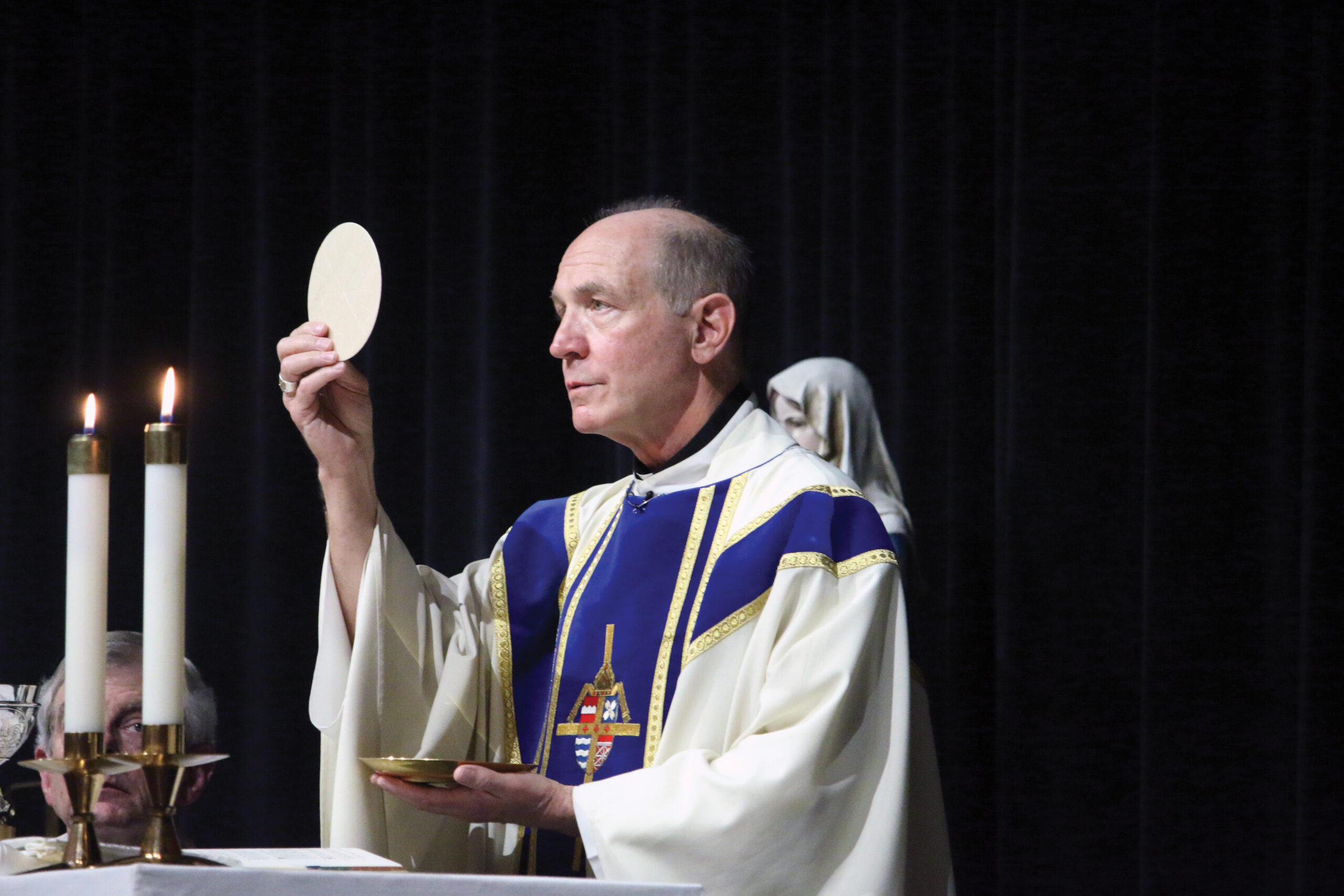
Bishop Mark Beckman celebrates Mass at Notre Dame High School on Jan. 6 to mark the 150th anniversary of the school. (Photo Dan McWilliams)
“Father Ryan knew it was an OK school at best, but he dreamed of something better. So, he sent a letter, a lot of them actually, to the Dominican Sisters of St. Cecilia, the very same order that’s still there today and still teaching with us today, and he asked them to come begin what he called a ‘select school’ here in Chattanooga,” Mr. Valadie said. “And so on this date, Jan. 6, 1876, the feast of the Three Kings, four sisters arrived in Chattanooga and immediately set about planning this new school while at the same time taking over leadership of the other one.”
The yellow-fever epidemic was “a disaster,” the superintendent said.
“There was no cure. If you survived, it was God and luck. Taking no chances, fearing for their lives, 80 percent of the Chattanooga population moved out of the city, but not the Sisters and not the pastor. Of those Chattanoogans who did stay, 20 percent of them died, including the pastor of the church. In all, some 20,000 people died,” he said.
Notre Dame closed for two years, but during that time “these same Sisters, teachers by trade, stayed to nurse the ill and the dying and because of the unexpected need, they turned the school buildings into orphanages for the children who suddenly had no parents,” Mr. Valadie added.
The school became coed in 1896 and changed its name to Notre Dame School. Monsignor Francis T. Sullivan in 1917 envisioned a new school building, according to one of the displays outside the theater. That building on Eighth Street near the future basilica opened in 1926 and was used through spring 1965, serving students in kindergarten through high-school grades. The school in 1963 also became the city’s first to integrate.
“In 1925, Monsignor Sullivan built what was the fourth Notre Dame, and it still stands today downtown, up the street from Sts. Peter and Paul. If you’re old like me, we call it ‘Old Notre Dame,’” Mr. Valadie said. “The school opened and operated there for 40 years before this building, the one we live in today, was opened in the fall of 1965.”
When the current campus on Vermont Avenue opened and the name Notre Dame High School debuted, K-8 grades continued at the old building as Sts. Peter and Paul School. St. Francis Parish, a black parish founded in 1948, operated a school from 1951 until both the parish and school were closed in 1972. St. Francis parishioners then began attending the city’s other Catholic churches, and Sts. Peter and Paul School took on most of the St. Francis students and was renamed All Saints Academy before it closed after spring 1985. The ASA building still stands, with its sign covering the old Notre Dame School sign.
The NDHS campus in 1965 was quite smaller than it is today, with the John Varallo Athletic and Wellness Center among the additions since then.
“This theater we’re in today wasn’t built until 15 years later. The library wing wasn’t built for 40 more after that, and Varallo came after that,” Mr. Valadie said. “But all of that brings us to why we gather in a special way this morning. When you celebrate such a rich history, you have to give thanks to and for those who brought you to life. After all, imagine just for a second where you would be today if you weren’t here.”
Thanking God and Notre Dame’s founders
Numerous people deserve gratitude upon the school’s anniversary, he continued.
“We thank God every day, but a big part of today is honoring the founders of our school, the Dominican Sisters, and the thousands and thousands of donors through the years who have given their resources because they believed you are worth it,” Mr. Valadie told the students.
He closed by mentioning cake and ice cream that would be served later at a reception in the cafeteria.
“Until then, I invite everyone here to offer your morning Mass in thanksgiving for all who came before,” he said.
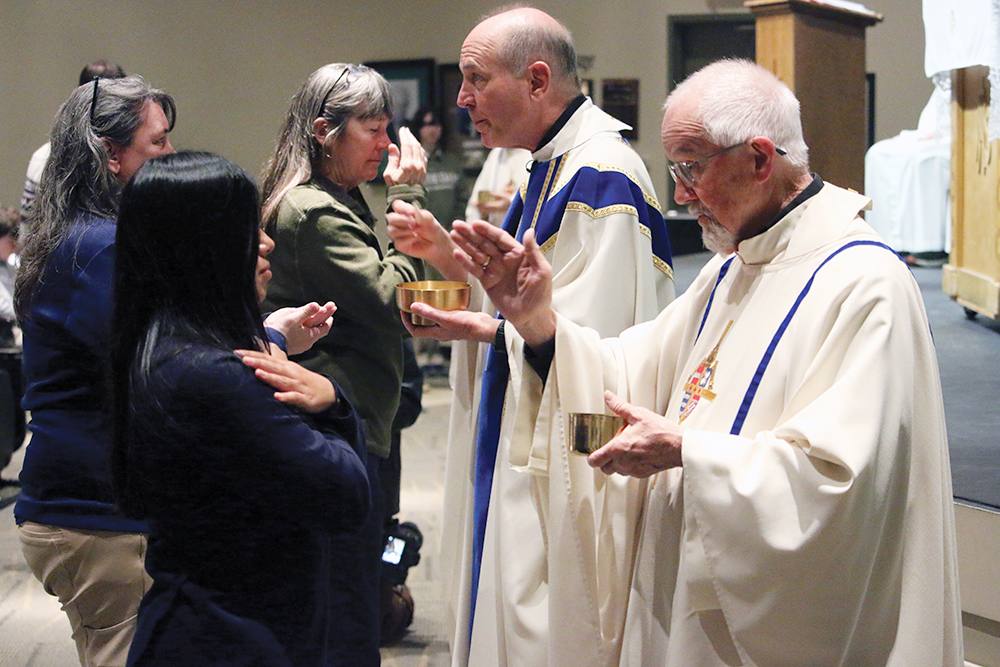
Bishop Mark Beckman and Monsignor Al Humbrecht distribute Communion and give blessings to Notre Dame High School students on Jan. 6 during the 150th-anniversary Mass. (Photo Dan McWilliams)
In his homily, Bishop Beckman referred to the day’s Gospel from Mark 6, telling of Jesus feeding the 5,000, and the first reading from 1 John 4.
Earlier in Mark 6, Jesus tells the Apostles to “come away by yourselves to a deserted place.” The bishop compared the city of Chattanooga in 1876 to such a location.
“It makes me think of that great journey those Sisters made down to Chattanooga. When I think about the description George gave so beautifully, of how Chattanooga was much simpler in those days, I suspect if we could go back in time and stand here and look around, we would see mostly trees around us, so it was a very different place,” Bishop Beckman said. “This would be in those days ‘a most deserted place.’”
But a great multitude awaited Jesus when they arrived in the “deserted place.”
“The Sisters who arrived here knew that a community waited for them,” the bishop said. “It’s very interesting: the first thing Jesus does, He begins to teach them. The Word of Life is what they most desperately need, and that great teaching of Jesus, the light of the world, has continued here at Notre Dame for 150 years,” Bishop Beckman continued. “When those Sisters arrived in this deserted place, the United States of America was only about 100 years old, a new nation in the world. And here in East Tennessee, the people waiting on this shore were hungry for the Word of God.”
The reading from 1 John “beautifully captures in a nutshell the great truth that we most need to remember: that God Himself is love and that all of us have been so loved by God that God desires us to live with Him forever,” the bishop said. “Thus, He sent His own beloved Son to die for us, and once we know that, we must love one another as God loves us. Is that not the heart of the Gospel? This first reading is the reading being proclaimed all over the world today in the Catholic Church and today’s Gospel likewise. We are part of something very big that has its roots going back to Jesus Himself. All the teachers here at Notre Dame in these last 150 years have continued to teach as Jesus taught.”
In Mark 6:35, “the day begins to grow late, and the Apostles say, ‘This is a big crowd. They’re hungry. What now?’” Bishop Beckman said. “And we see the concern of Jesus for their whole person, not only to teach them but to care for their bodies, to feed them and nourish them with bread and fish. And Notre Dame has done more than just teach the minds of students over these last 150 years; it’s also cared for our students’ whole persons. Body, mind, soul, and spirit—all of you matter to the Lord, and your whole self matters to the Lord. That’s why we believe in the resurrection of the body and life everlasting. The great gift of the Lord’s love for us touches every part of the human person.”
Jesus proceeded to feed 5,000 with very little.
“There’s also a third element to the Gospel today that really strikes me, and that is that they don’t have a lot of resources: five loaves and two fishes,” the bishop said. “Notre Dame has done remarkably well in 150 years, over many of those years with very scarce resources. And yet all the Lord asks is that we bring what we have to Him and we let Him use it for something bigger. So many people here in Chattanooga in the last 150 years, some of them here today, have given generously of your resources so that the students of this generation can continue to learn the saving Gospel of Jesus Christ. What a gift.
“And what does the Lord do with those limited resources? He takes them, He blesses them, and He gives them to the disciples to feed the hungry multitude. There is a task in today’s Gospel for all of us. I especially want to speak now to you who are students at Notre Dame right now. You are the next generation who will graduate from this beautiful place, and you will carry the good news of Jesus into the world wherever you go, in whatever vocation the Lord calls you to do, and wherever you end up in this beautiful world that God created.
“The Lord is inviting you to continue that chain of love that began with the Lord made flesh. You share in His life wherever you go. The Lord wants to involve you. Bring to the Lord your gifts, your talents, the gift of who you are as God created you, and let the Lord bless you and pray over you and allow you to be a partner with Him in spreading the good news of Jesus in the world today. God is love, and we must love one another even as we have been loved by Him.”
The next 150 years
Bishop Beckman asked his audience “are you all ready for the next 150 years at Notre Dame?”
“It’ll be interesting to see what happens in the future. May the graciousness of God who has willed this community continue to bring it to great fruition through Christ our Lord,” he said.

Fathers Joe McMahon, John Dowling, Christopher Manning, Peter Iorio, Mike Nolan, A.J. Houston, and Monsignor Al Humbrecht concelebrate Mass at Notre Dame High School on Jan. 6. (Photo Dan McWilliams)
Father Houston spoke at the end of Mass and thanked the bishop, the priests, Deacon Armor, the Dominican Sisters, the students and other Mass musicians, the servers, and all who organized the jubilee celebration.
“Wow, what a wonderful day, amazing decorations in the hallway, this wonderful community gathered in here, so many good things happening today,” the chaplain said. “I’d just love to give lots of thanks, so many thanks to give today. First of all, thank you so much to our Almighty God for gathering us together, for all of the blessings we enjoy every single moment of our lives, and especially for the blessing of Notre Dame High School. Thanks to our Blessed Mother in heaven, Our Lady of Lourdes, who has prayed for us every single day from the start—150 years ago, every single day since then, and many more years into the future.”
Father Houston’s thanks to the Sisters drew a round of applause.
“Thank you so much to the Dominican Sisters of St. Cecilia who made the trip here to Chattanooga both 150 years ago and today, for all they’ve done for this school and for this community. Thank you for the love you’ve shown to each and every one of the students over the years,” he said.
Father Houston then asked the bishop to bless rosaries that were custom-made to commemorate the anniversary and were available after Mass.
“Blessed be God, our God and Father, who has given us the mysteries of His Son to be honored with devotion and celebrated with faith. May He grant us, His faithful people, that by praying these rosaries we may with Mary, the mother of Jesus, seek to keep His joys, sorrows, and glories in our minds and hearts,” Bishop Beckman said in the blessing.
Priests including Father James Driscoll, Father Lawrence Maxwell, and Father John Patrick Connor served as principal of Notre Dame before Jim Phifer became the school’s first lay principal in 1974. Mr. Phifer, a TSSAA Hall of Fame member as a golf coach, is Notre Dame’s longest-serving principal, retiring in 1993.
Perry and Cindy Storey are basilica parishioners. Mr. Storey, the school’s second-longest-serving principal, oversaw the renovation and updating of the school’s science labs, the dedication of the Jim Phifer Gym and a baseball field, and an Alumni Chapel.
“Seventeen in years as principal is a lifetime in the principal business, but I think one of the things is, and Eric said it very well this morning, is that a lot of people gathered around our school, and a lot of people helped us,” Mr. Storey said after Mass.
“A lot of these people have gone on to their reward in heaven. These benefactors really helped us through many, many times—good times and when things were tough, and the families, the families who stick with the school and send their kids here to have that faith formation. That’s always been a real core basic that we follow—we want to give those families and those students the best education but also build their spiritual development.”
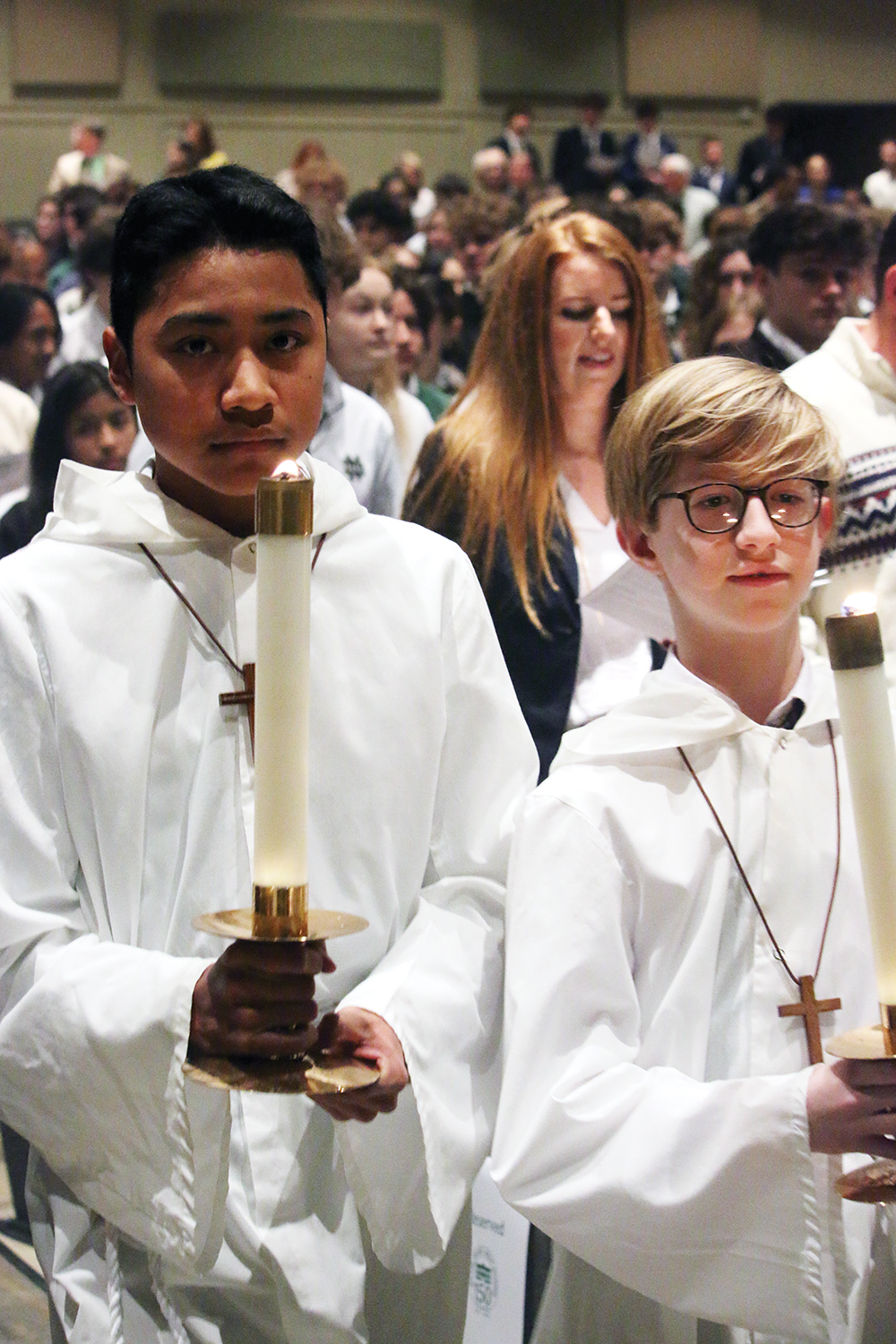
NDHS students take part in the procession as Mass begins. (Photo Dan McWilliams)
Mr. Storey mentioned the longevity of Notre Dame “because there were a lot of Catholic schools that were formed about the same time, and they’re no longer in operation, so we are so blessed. There were schools all around the country that were struggling that didn’t make it through some of the things that we have made it through.”
He added that NDHS has “celebrated milestones with the community” as well in its 150 years.
Father Nolan, now pastor of St Thérèse of Lisieux Parish in Cleveland, said he is greatly indebted to his alma mater.
“Frankly, I owe Notre Dame High School and the community—the teachers before us, the spiritual directors I had before anyone had ever heard of that term—an awful lot,” he said. “It’s part of my extended family. Frankly, I was moved to tears many times today—tears of gratitude and joy. I pray that God may continue to enter the hearts of these children and their parents and all those we need to support Notre Dame.”
The high school “positively” influenced his priestly vocation, Father Nolan said, but he added, “I probably spent more time trying to make it go away rather than embracing it. I wish I had embraced it more now. It was Father Mike Johnston, who was the chaplain here at the time, who I went to after a SEARCH weekend and said, ‘Tell me a little bit about this seminary stuff.’ It was the first time I’d really talked about it publicly, but I fought it for a good number of years after that.”
Father Johnston of the Diocese of Nashville served as vice principal of Notre Dame and as principal of Knoxville Catholic High School. He is also a mentor of Bishop Beckman.
“But the one I owe a lot of allegiance to is Moira Tingle, a former Dominican Sister who stayed and continued to teach at Notre Dame,” Father Nolan said. “She was my first spiritual director, and I didn’t even know that’s what was going on. She was a real vessel of God’s grace.”
Father John Baltz was the founding pastor of St. Francis Parish and influenced the desegregation of Notre Dame in 1963, Father Nolan said. Father Baltz and St. Francis students took part in a reunion at NDHS in 2003.
“(Desegregation) was done peacefully. When it became a mandate, a law of the government, other schools in the school system came to study how Notre Dame did it. They were innovators in many ways,” Father Nolan said. “Father Johnny Baltz, I believe, had a lot to do with it, questioning how come his parishioners were not attending Notre Dame. It might not have been against the law, but it was against the practice.”
Father Iorio is pastor of Our Lady of Fatima in Alcoa and came to the Notre Dame celebration after his own parish recently marked its 75th anniversary.
“I think this is exciting, having just gone through an anniversary year at my parish. This is double that number of years,” he said. “It’s exciting for me as both an alum and as a former faculty member. I was chaplain for four years from 1995 to 1999.”
Many changes to the current Notre Dame campus occurred after Father Iorio’s time there.
“It was not as extensive as it is now. There’s always a great family feel and a wonderful welcoming attitude. People know each other. It’s great. There are some changes physically, but the faith and the love that are generated in this Catholic community are very palpable,” he said.
Two future monsignors influenced his vocation “very much” as he “interacted with the priests on the faculty back in the day,” Father Iorio said.
“Father Al Humbrecht and then Father Pat Garrity were definite influences for me, and now they’re my good friends and brother priests,” he added with a laugh.
In his closing remarks at Mass, Bishop Beckman said that it is “a true blessing that we are together today. May the Lord continue to pour out His goodness upon Notre Dame.”