
Lent 2026 is here, and Catholic faithful around East Tennessee are readying for Holy Week
The East Tennessee Catholic and OSV News
It has been just over a month since the feasts of Epiphany and Baptism of the Lord marked the end of Christmas.
And now in 2026, Lent is upon us.
Ash Wednesday on Feb. 18 begins the 40-plus days of Lent leading to Easter Vigil on Saturday, April 4, and Easter Sunday on April 5.
Priests around the Diocese of Knoxville greeted long lines of youth, young adults, adults, and senior citizens as they distributed crosses of ash of burned palm fronds from Easter 2025 on foreheads during Masses on Feb. 18.
While Ash Wednesday is not a holy day of obligation, Ash Wednesday Masses are among the most well-attended celebrations of the liturgical year.
Just as anyone is welcome to receive a blessing in the Catholic Church, anyone can receive ashes on Ash Wednesday.
Lent is a time of spiritual preparation, self-examination, and penance leading up to the celebration of Easter. Catholic faithful use this time to imitate Jesus’ 40 days of fasting in the desert.
It is an opportunity for the faithful to deepen their relationship with God, seek forgiveness for sins, and grow in spiritual discipline. Catholics focus on self-denial, prayerful reflection, and charitable acts as a means of drawing closer to God.
Bishop Mark Beckman is leading the diocese through Lent into Holy Week and the Triduum. He will celebrate the annual Chrism Mass at 4 p.m. on March 31 at the Cathedral of the Most Sacred Heart of Jesus, a Mass where all the priests of the diocese gather to renew their priestly vows and the bishop consecrates the sacred chrism for use in each parish over the next year for baptisms, confirmations, and holy orders.
The bishop will then celebrate Easter Vigil Mass at the Cathedral of the Most Sacred Heart of Jesus, one of the most sacred and solemn Masses celebrated in the Catholic Church.
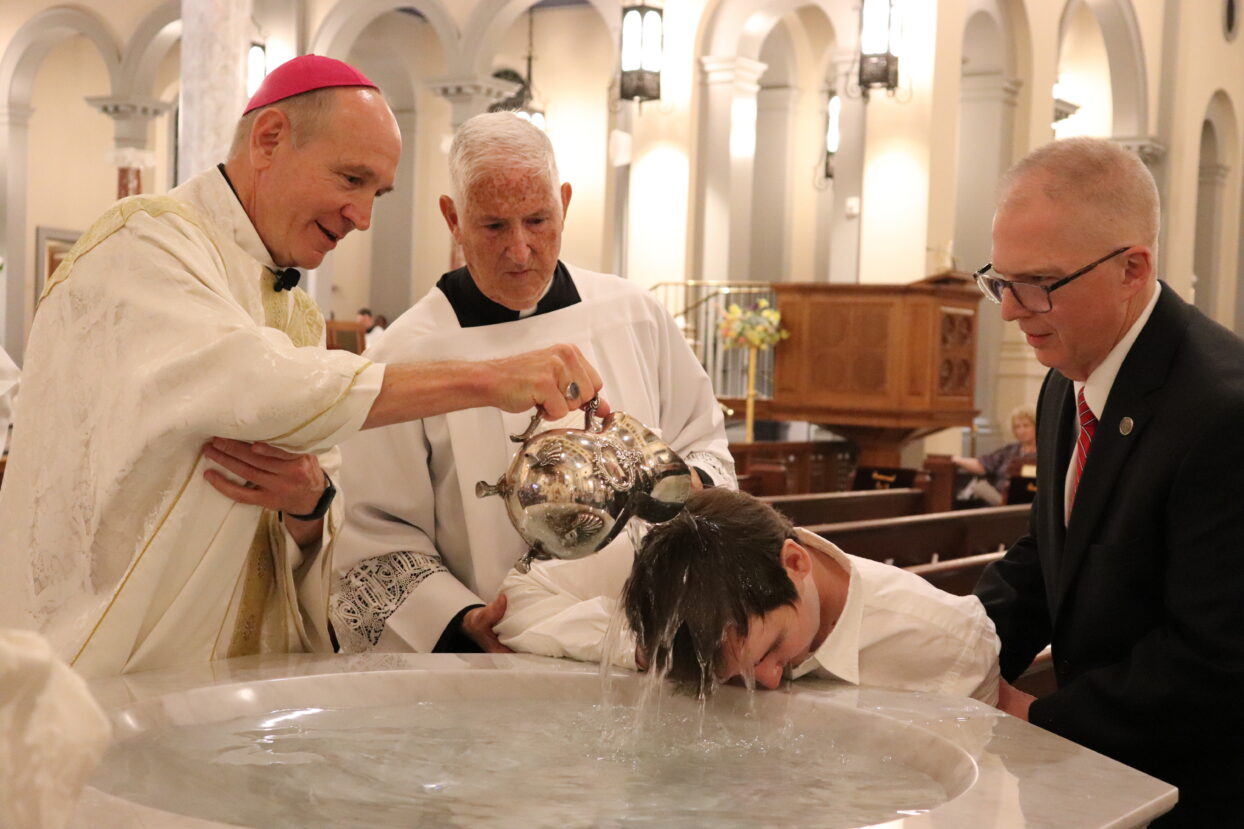
Easter Vigil Masses also will be celebrated in each parish, where diocesan priests will welcome the Catholic Church’s newest members—catechumens and candidates who joined through the Order of Christian Initiation of Adults (formerly RCIA).
Important dates, times, and locations during Lent in the Diocese of Knoxville include:
- Ash Wednesday, Feb. 18 at each church, diocesan school, and university Catholic student center.
- First Sunday of Lent, Feb. 22.
- Palm Sunday, March 29.
- Holy Week, March 29-April 5.
- Chrism Mass, 4 p.m. on Tuesday, March 31, at the Cathedral of the Most Sacred Heart of Jesus, 711 S. Northshore Drive, Knoxville.
- Holy Thursday, April 2.
- Good Friday, April 3.
- Easter Vigil, dusk on Saturday, April 4.
- Easter Sunday, April 5.
As part of the Lenten observances are weekly Stations of the Cross at local churches.
Stations of the Cross is a 14-step Catholic devotion commemorating Jesus Christ’s Passion and death, typically prayed during Lent and on Good Friday. During the Stations, the faithful, led by a priest or deacon, meditate on scenes from Jesus’ condemnation to His burial and join in prayer.
The Living Stations of the Cross is reenacted at a number of parishes in the diocese. During Live Stations, parishioners act out Jesus’ Passion, from condemnation to crucifixion and resurrection.
And then there are the fish fries.
Fish fries (and soup suppers) are a staple at many churches around the diocese and are enjoyed by parishioners each Friday during Lent.
The fish fries are coordinated by Knights of Columbus, Councils of Catholic Women, Society of St. Vincent de Paul conferences, and other lay ministries.
Fish fries offer up delicious meals that enable parishioners to abstain from meat on Fridays during Lent, are a popular social time, especially before or after Stations of the Cross, and provide a valuable fundraising activity for parish activities.

Father Julius Abuh, pastor of St. Joseph the Worker Parish in Madisonville, welcomes catechumens and candidates into the Catholic Church during the Easter Vigil Mass in 2025.
Holy Week, between Palm Sunday and Easter Sunday, is the most sacred period of the year. During this special time, Catholics enter into the passion of Christ—His crucifixion, death, and resurrection—through liturgical celebration and personal conversion. While the season of Lent is a very important time in the Church, it is helpful to remember that Lenten practices (prayer, fasting, and almsgiving) are meant as preparation for the three days of the Triduum.
The three days of the Triduum are counted as the Hebrews counted their days, from dusk to dusk. Lent officially ends and the Triduum begins at dusk on Holy Thursday and continues through dusk on Easter Sunday.
Because the Catholic faithful cannot separate Jesus’ death from His resurrection, the Church teaches that the Triduum is really one celebration that lasts for three days. Parishioners do not spend all of the three days in church, of course, but at various times during these days they are called to gather together at church to celebrate and remember the saving action of Christ.
The evening Mass on Holy Thursday begins the sacred Triduum. On this night, the faithful remember the Last Supper and celebrate the institution of the Eucharist and the sacrament of holy orders.
At the end of the liturgy, the sanctuary is stripped clean in preparation for the most somber of feasts, Good Friday.
The spirituality of the Triduum is centered on the accounts of the Paschal mystery in the Gospel of John. In John’s Gospel, the Last Supper is not the Passover meal; rather, Jesus is crucified at the same time the lambs are being slaughtered for Passover, as a sign that He is the Lamb of God, sacrificed for all of humanity.
The last meal that Jesus shares with His Apostles in the Gospel of John is marked by the washing of feet. Jesus gets down in the dirt and washes the feet of His disciples, and in this way connects the holy Eucharist with service to others.
Most Holy Thursday liturgies include a modern-day experience of foot washing. This recalls Jesus washing the feet of His Apostles and is a powerful example of how His people are called to serve and care for one another. Holy Thursday is also referred to as Maundy Thursday, meaning “a new mandate.” It refers to the mandate put forth by Jesus in John 13:34, “Love one another as I have loved you.”
Good Friday is a somber remembrance of Jesus’ crucifixion and death on the cross. It is a day of fasting and penance and a time to examine all of the places in our lives where the faithful fail to follow Christ and fall into sin.
Good Friday is not only a commemoration of a historical event; rather, Christ’s sacrificial death on the cross, along with His glorious resurrection, comprise the heart of the Christian faith.
The Church is bare on Good Friday, the altar stripped of ornamentation and the tabernacle left open and empty. Good Friday is a day of mourning.
Traditionally, there is no music (other than chanting) on this day, and the prayer of consecration is also omitted from the service as a sign of what Christ’s sacrifice on the cross truly means. Good Friday is not a Mass; the holy Communion that is given out has been consecrated on Holy Thursday and kept in the tabernacle for adoration.
This service is divided into reading of the Passion, veneration of the cross, and reception of the Eucharist. Christ’s Passion is read from the Gospel of John and concludes with the prayers of the faithful offered for the unity of the universal Church.
Veneration of the cross is a time for the faithful to individually revere the cross and ponder the enormity of Christ’s salvific act. Holy Communion is then distributed, and the priest, along with the entire congregation, departs in silence.
Many parishes offer Stations of the Cross on Good Friday. Meanwhile, fasting is required on Good Friday. Catholics are to take in only one full meal (smaller than a regular meal and often substituting fish for meat) in solemn remembrance of the faithful’s hunger for Christ and His everlasting sacrifice on the cross.
The Easter Vigil is the restoration of the early Church’s tradition as the great celebration of adult baptism and confirmation. It is the high point in the Church liturgical year.
The Vigil begins in darkness at dusk (usually outside), and the long procession of candlelight that enlivens the church reminds that Jesus is the light of the world who has conquered all darkness and death.
The Paschal candle that is lit at Easter Vigil will remain in the church throughout the year as a sign of Christ’s death and resurrection.
Those who are coming into full communion with the Church receive the sacraments of initiation at Easter Vigil, and the community of believers participate in this initiation by renewing their own baptismal promises.
The communion of believers recommit themselves to Christ by once again rejecting sin and accepting the freedom that comes from living as children of God. They pray and welcome the newly initiated as the catechumens and candidates receive the oil of chrism and “share in the outpouring of the Holy Spirit” at confirmation.
The white garments given to the newly initiated represent Christ’s everlasting victory over death.
The Vigil concludes with reception of the Eucharist. As the newly confirmed receive the final sacrament of initiation, the body and blood of Jesus, Easter is ready to be celebrated. The tomb is empty. There is light in the darkness. Alleluia, Christ has risen!
The Triduum is the culmination of the entire liturgical year and the three most sacred days in the lives of Catholic Christians. The single celebration that comprises the Triduum commemorates the fullness of the Paschal mystery—the Passion, death, and resurrection of Jesus Christ.
Because Jesus was willing to die for the people’s sins and was resurrected, death is no longer the end of life for His communion of believers. It is the beginning of new life.
His people gather together during Holy Week, then, to remember His saving act, to celebrate the miracle of His resurrection, and to embrace His promise of eternal life.