
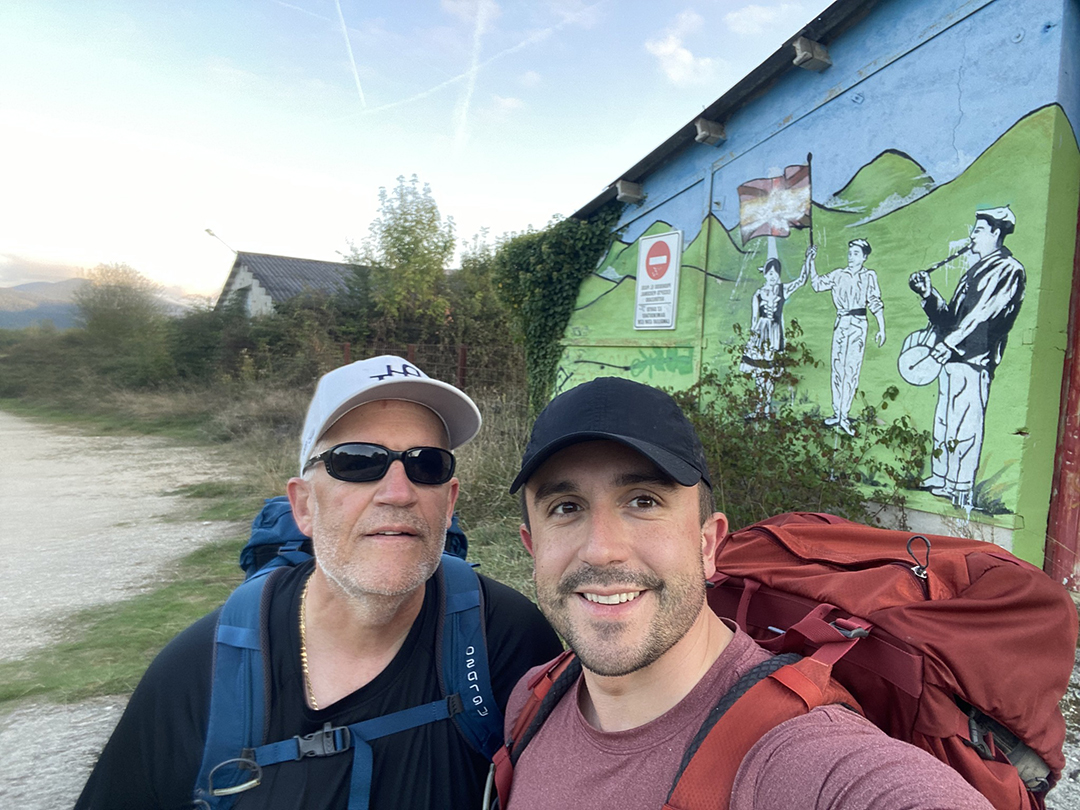
Father Danny Herman and Deacon Joe Herman take on historic trek in the footsteps of St. James
By Bill Brewer
The Camino de Santiago has many stories to share over its more than 1,000-year history. Now add to those a unique father-and-son, Father-and-Deacon pilgrimage.
The clerical combination is Joe Herman, father to Danny Herman, with the twist that Father Danny Herman is an associate pastor at the Cathedral of the Most Sacred Heart of Jesus and son to Deacon Joe Herman, who serves at St. Anthony of Padua Parish in Mountain City.
The familial/vocational tandem made a return visit to the Camino on Sept. 25 for a weeklong trek along part of the multi-route journey in the footsteps of St. James the Apostle.
It was a matter of settling unfinished business.
In their first walk along the Way of St. James, Father Herman and Deacon Herman, with son and brother Josh Herman, set out to complete the 500-mile route that began in Saint-Jean-Pied-de-Port, France, and was to end in Santiago de Compostela, Spain.
The trio initially took on the Camino in 2019, when Deacon Herman was in his second year of diaconate formation for the Diocese of Knoxville and Father Herman was studying at St. Meinrad Seminary and School of Theology.
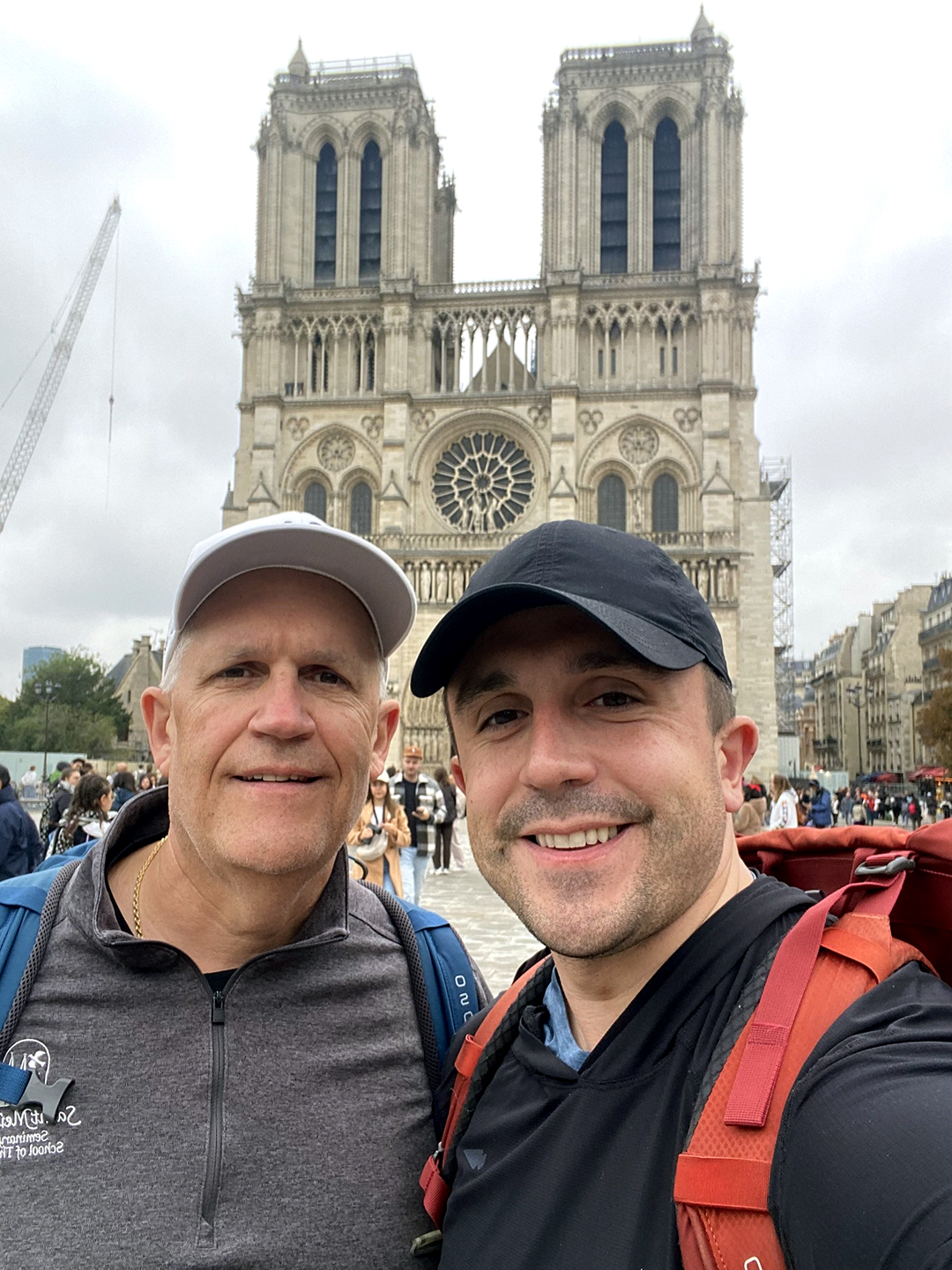
Deacon Joe Herman (left) and Father Danny Herman stand in front of Notre Dame Cathedral in Paris on the day they arrived in France from the United States.
“He was in discernment and I was still in discernment. And this was something he wanted to do, so Father Danny and my youngest son, Josh, and I went. We did that in June of 2019. It was a good experience for the most part. But I got really bad blisters about two weeks in. I took a day or two off hoping they would heal, but it wasn’t enough time for them to heal,” Deacon Herman recalled.
Deacon Herman decided to end his pilgrimage early, and he and Josh returned home after two weeks. But Father Herman completed the 500-mile journey solo.
Deacon Herman explained that Father Herman was gone about six weeks on that first trip.
Memories of that incomplete adventure gnawed at Deacon Herman for six years and enticed him to return.
“I don’t know if that was a good thing. But I felt like it was a little bit of pride because I had gotten the blisters. I kind of felt like I had gotten whipped,” the deacon said, laughing. “I wasn’t as well prepared on the first trip as I should have been. My blister issues were because I didn’t have the right shoes, plus I was between 20 and 30 pounds heavier at that time.”
Last spring, Father Herman asked Deacon Herman about a return pilgrimage.
There was no hesitation—Deacon Herman was in.
The trio became a duo as Josh was unable to make the trip.
And the father-son/Father-Deacon team departed from Knoxville, flew into Paris, and took a train to Saint-Jean-Pied-de-Port, where they would retrace their steps but not go the entire 500 miles. This time, the journey would end in Pamplona, Spain, due to time constraints.
Deacon Herman, who is 57 and was ordained to the diaconate on June 11, 2022, said he trained for the second pilgrimage, noting that his son enjoys staying in shape.
The do-over was a success.
“It was great,” he remarked, pointing out that the first excursion was done in summer temperatures while the second go-around was made in cooler weather. “This last time, Father Danny said, ‘Let’s enjoy it more. We were gung-ho the first time.’ The first day was a really nice day and a nice evening.”
On their most recent journey, Father Herman, who is 33 and was ordained to the priesthood on June 8, 2024, and Deacon Herman enjoyed experiencing the Camino community, meeting the strangers who were also on pilgrimage, walking along the way. Some of them were Catholic, some were of other faith traditions, and yet others did not practice any faith.
“I can say I did it. I really wanted to do it again because I felt like I got whipped. I was part of the reason. But this time I got to complete our pilgrimage with my son, which was very special. It was very spiritual, too. The spirituality part of it was the biggest reason I wanted to do it,” Deacon Herman said.
Every day the Hermans walked the Camino de Santiago, they were able to attend Mass, which they agreed was most important to them.
Deacon Herman was moved by the life lessons the Camino pilgrimage taught. Among them was taking care not to carry anything that wasn’t needed.
“I knew from the first time just take what you need. Isn’t that how our life is? How much do we carry on our backs the things that we really don’t need, whether they are burdens, sins, or afflictions? Just the junk we carry around in our lives. I thought about that a lot, whether you are passing somebody or they’re passing you, all carrying a backpack of different weights,” Deacon Herman shared. “It reminded me that we are all carrying something in our life.”
On their second go-around, the Hermans learned to travel light. Along the route, each carried a 15- to 20-pound backpack. They frequently saw fellow sojourners discard excess weight at the end of a day to make their trek lighter.
From a practical standpoint, Deacon Herman said on the second pilgrimage he carried less clothing, using only one additional pair of pants and shirt. One item he didn’t cut back on was socks. In fact, he would change socks in the middle of the day to cut down on moisture, which contributed to his blisters on the first trip.
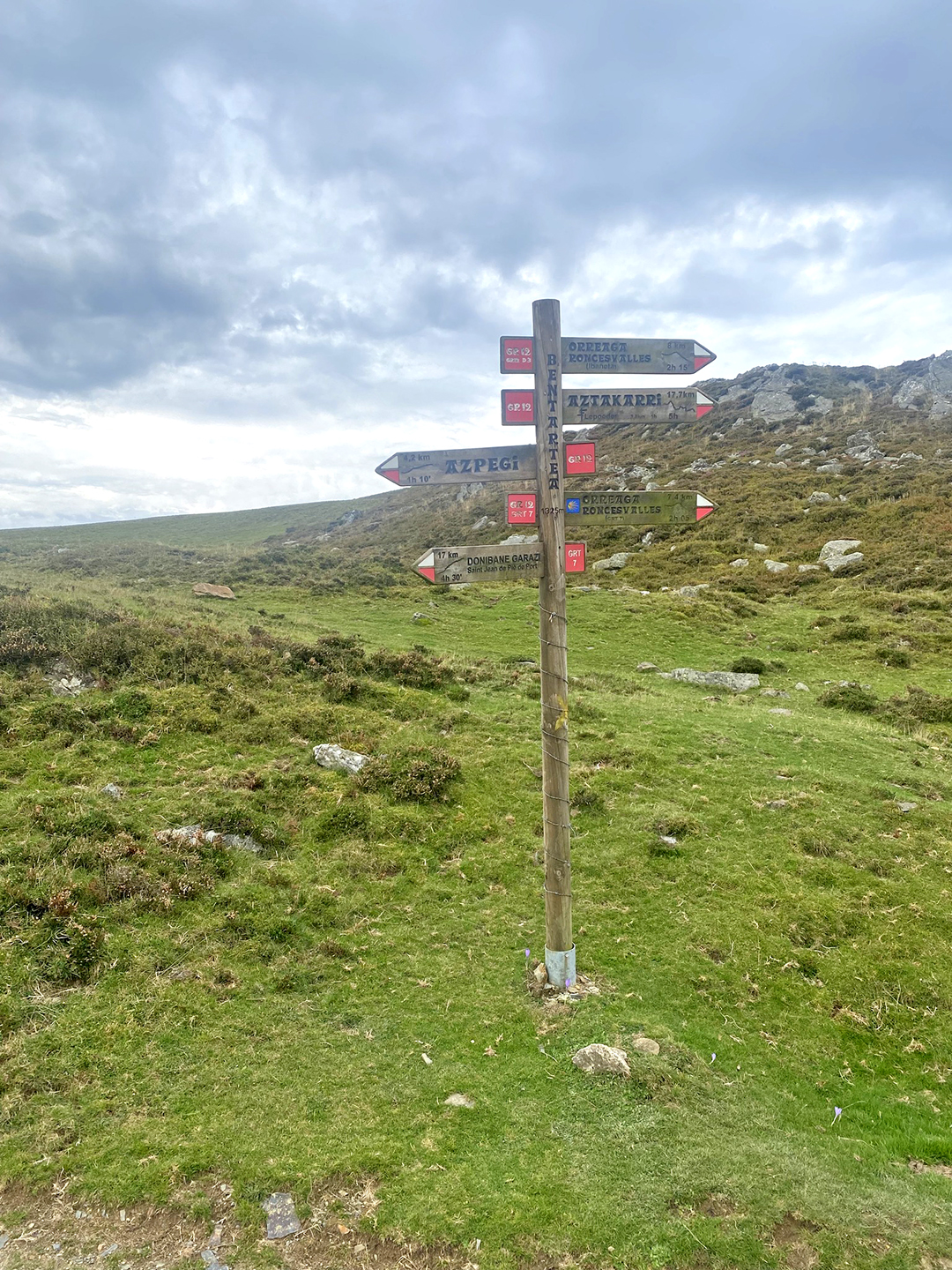
A fingerpost along the Camino walk indicates the distances in kilometers and travel time to Roncesvalles, Saint-Jean-Pied-de-Ports, and other stops.
The pilgrimage was not conducive to wearing clerics (black or gray formal shirts with clerical collars that priests and deacons typically dress in). So, to fellow pilgrims their vocations were not apparent. However, in conversations with others, the Hermans would share their vocations and their stories of faith.
And rather than carry a Bible and a breviary in his backpack as he did the first time, Deacon Herman carried a digital Bible and breviary via his phone on the second trip.
He acknowledged carrying more than 20 pounds in his backpack and an extra 20-plus pounds around his waist on the first excursion.
At the end of each day, the Hermans stayed in hostels or albergues (specialized hostels for pilgrims), which were all along the way.
They walked together most of the time, but Deacon Herman noted that there were times when Father Herman walked ahead. “Of course, he had mercy on his old dad. If I got too far behind, he would stop and wait on me.”
While Father Herman had youth on his side for the challenge, he also had the advantage of military training. Prior to seminary, he spent more than two years in the Navy preparing to be an aviator. When it was time to receive his Naval aviator wings, he instead chose to answer God’s call.
According to Camino de Santiago facts, the Camino primarily goes through three main countries—Spain, Portugal, and France—as part of its most popular routes. While the vast network of over 51,500 miles of routes stretches through 29 different countries, the majority of traditional pilgrim paths (such as the Camino Francés, Portugués, and Norte) are confined to the Iberian Peninsula.
Key geographical pilgrimage points include Spain, the destination for all routes, featuring the main hubs, particularly the final destination of Santiago de Compostela in Galicia; France, the starting point for the most famous, traditional route, which is the Camino Francés (French Way), often beginning in Saint-Jean-Pied-de-Port; and Portugal, the starting point for the Camino Portugués (Portuguese Way), which runs from Lisbon or Porto to the Spanish border.
Deacon Herman said he especially enjoyed the pilgrimage because he was able to detach from the world for a short time.
“That walk was much like our pilgrimage here on earth—it has its uphills and it has its downhills. I think everyone in life goes through something, maybe big, maybe small. And those you meet along the way are pretty friendly, pretty open. Everyone was walking the same path. It didn’t matter if you were wealthy, if you were poor, or somewhere in between,” he said.
“Why can’t we all be like the Camino community? Regardless of your condition on the Camino and in life, during the ups and downs, God is always with us,” Deacon Herman observed.
Father Herman cherishes the pilgrimage he made with his dad, acknowledging those shared opportunities are rare.
“Walking the Camino with my father was a great gift, one I did not take lightly. Few people have the time, health, or means to make such a pilgrimage, and I was keenly aware of that grace from the beginning. Having already walked the entire Camino in 2019, I came with the advantage of experience. I knew how to avoid the rookie mistakes that can turn a pilgrimage into an endurance test rather than a prayer,” Father Herman said.
He echoed his father’s sentiment that the repeat performance was more about quality, not quantity.
“This Camino was different. It was less about miles and more about presence. To walk beside the man who first taught me how to pray, how to work, and how to persevere became, in itself, a form of prayer. There was something deeply humbling and quietly consoling about sharing silence, meals, fatigue, and laughter with him, without the need to explain or impress,” the priest said as he acknowledged the challenges of the first trek.
“Six years earlier, we had not been so gentle with ourselves. Mistakes piled up: packing too much, walking too far and too fast, misunderstanding the rhythm of life on the Camino. Frustration set in, and eventually my father and brother had to return home early. This time, experience gave us freedom. We let go of excess, respected our limits, and moved through the days like old pros, unhurried and attentive,” he added. “The Camino slowed us just enough for gratitude to surface naturally. As we walked, I became more aware that God had been at work in our relationship long before I ever set foot on Spanish soil. The pilgrimage did not create that grace; it simply gave us the space to recognize and enjoy it.”
Father Herman’s expectations for their Camino II were simple, and the pair were intent on maintaining simplicity.
“Above all, I hoped for good prayer and greater detachment. I wanted space to listen to God more attentively and to loosen my grip on the things that clutter my heart. The Camino has a way of stripping life down to what is essential: walking, eating, resting, and praying. That simplicity created room for God to speak to us,” he shared.
Despite the challenge of flying to another continent to travel for days by foot over foreign ground, relying largely on individual resources, Father Herman had no concerns about making the pilgrimage with his dad. It was all about faith.
“No, never. From the beginning, there was a deep sense of peace. The Camino has always felt less like an undertaking and more like a response. You simply put one foot in front of the other and allow God to take care of the rest,” he said.
And there is no doubt. Spending time with his dad as they shared a spiritual journey was the high point of the trip for Father Herman.
“On this most recent pilgrimage, the greatest highlight was time with my father. Seeing familiar places through new eyes as a priest also stood out. Churches, relics, and moments of prayer carried a different weight now. I was no longer just a pilgrim seeking direction but a priest entrusted with souls, including the one walking beside me,” Father Herman remarked.
Walking the Camino de Santiago can affect pilgrims in different ways, and the Hermans certainly were no exceptions. Words of the prophet Isaiah about children leading come to mind.
“The Camino reminded me that I am not an island. I am someone others depend upon. Walking with my father shifted my focus outward. My attention was no longer on my own pace or endurance, but on his safety, his health, and his needs. Spiritually and vocationally, this was deeply formative. It reinforced the truth that priesthood is fundamentally relational and paternal. My life is not my own. It is given for others,” Father Herman pointed out.
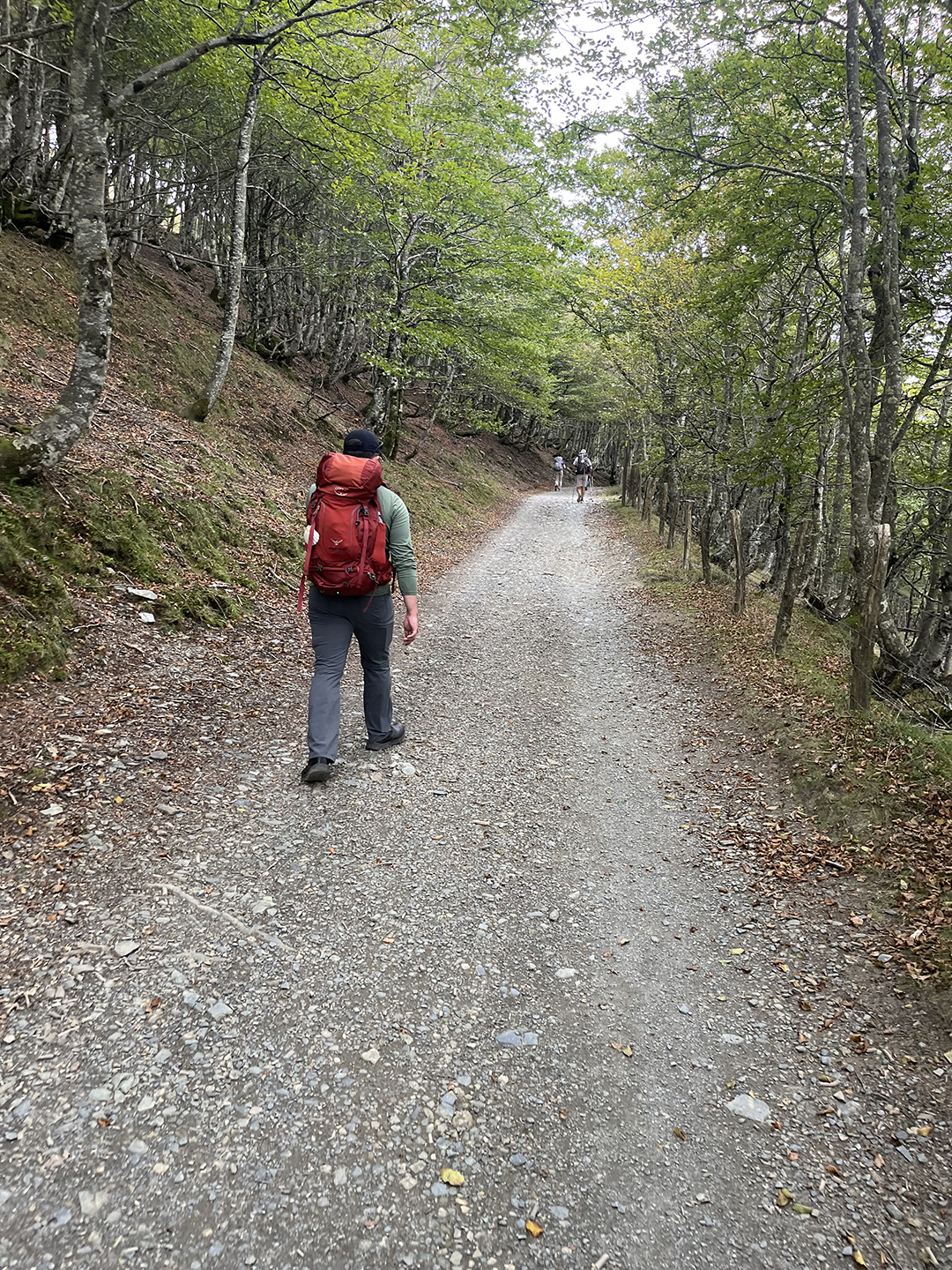
Father Herman and other pilgrims walk ahead of Deacon Herman on the Camino going from Orisson, France, to Roncesvalles on day two of their walk. The Camino is a 500-mile route that begins in Saint-Jean-Pied-de-Port, France, and ends in Santiago de Compostela, Spain.
The Sacred Heart Cathedral priest believes it was God’s will and a blessing that his dad and brother ended their 2019 pilgrimage early, leaving him to complete it on his own.
“In 2019, I completed the Camino in 35 days. That pilgrimage was marked by freedom and interior openness. My brother and father had to leave on day 12, and it was after that point that I received significant clarity about my vocation. I was discerning priesthood, and the Camino helped me listen without distraction,” Father Herman said.
“In 2025, the experience was very different. We only had four days of actual walking, and I did not finish the Camino. The pace was more relaxed, and my attention was less personal and more paternal. I was focused on keeping my father safe and healthy. As a priest, I experienced the Camino not as someone searching for his path but as someone responsible for others on the path. There was also a note of sadness this time. Many people now approach the Camino as a vacation rather than a pilgrimage,” he added.
“When we would stop in at albergues and hostels, we would meet people and hear their stories, and when they asked us our stories, they were surprised that our goal was to reach Compostela to reverence the remains of St. James. Seeing the effects of secularism along a path meant to be sacred was painful. My heart was broken at times by how easily the spiritual meaning of the Camino can be lost. It encouraged me to be more evangelizing in my everyday life.”
The 2019 and 2025 pilgrimages have inspired the Hermans and serve as a revelation that their pilgrimage is ongoing.
“I look forward to continuing the Camino with my father sequentially, section by section, as life allows. There is no rush. The Camino teaches patience, fidelity, and perseverance, lessons that are learned over time, not in one long stretch,” Father Herman said. “I believe that each time we go back, we will learn new lessons like how to accept limitations with humility, how to walk at another’s pace, how to find God in repetition, and how holiness is often built quietly through consistency rather than intensity.”