
Speaker offers advice on growing the next generation of Catholics in East Tennessee
By Bee Goodman
In a growing trend, the U.S. Church is seeing an overall increase in the number of members, and the same can be said for the Diocese of Knoxville.
Last year, a survey conducted by the diocese revealed a positive number of active members across its 51 parishes and one mission. A recent meeting of diocesan priests reveals their plan to continue the growth for the Church of 2050: the next generation of Catholics.
During the most recent study day for the priests of the Diocese of Knoxville, keynote presenter Katherine Angulo Valenzuela, who is director of pastoral enrichment programs at the University of Notre Dame, spoke on the topic “Call to Serve the Church of 2050,” which focused on youth and young-adult ministry and the changing demographics of the Church in the United States.
Bishop Mark Beckman and many priests attended the talk, including Father Peter Iorio.
“Katherine was giving us a picture, based on what data and research we have, of what the Catholic Church will look like around the world 25 years from now. It was actually good news; the Church is growing,” Father Iorio said.
“Africa grew 3.1 percent at the end of 2021, according to the Vatican, and then the Americas had 48 percent of the world’s Catholics. Brazil has a great number of those. Of course, there were a lot of questions regarding Hispanics, and one of the questions (from priests) was of the focus on immigration and deportation in this country. Will that affect the number? And her answer was no,” Father Iorio added.
“The majority of those (Hispanic Catholics) are U.S. citizens; they were born here, so they’re first- and second-generation Spanish heritage, sometimes Spanish-speaking, sometimes bilingual,” Father Iorio noted.
As Catholic populations grow nationwide, the most significant increases are occurring in the South, including East Tennessee. In the Diocese of Knoxville, that growth is driven by a rise in young families and new Catholics as well as an influx of people relocating from northern and western states.
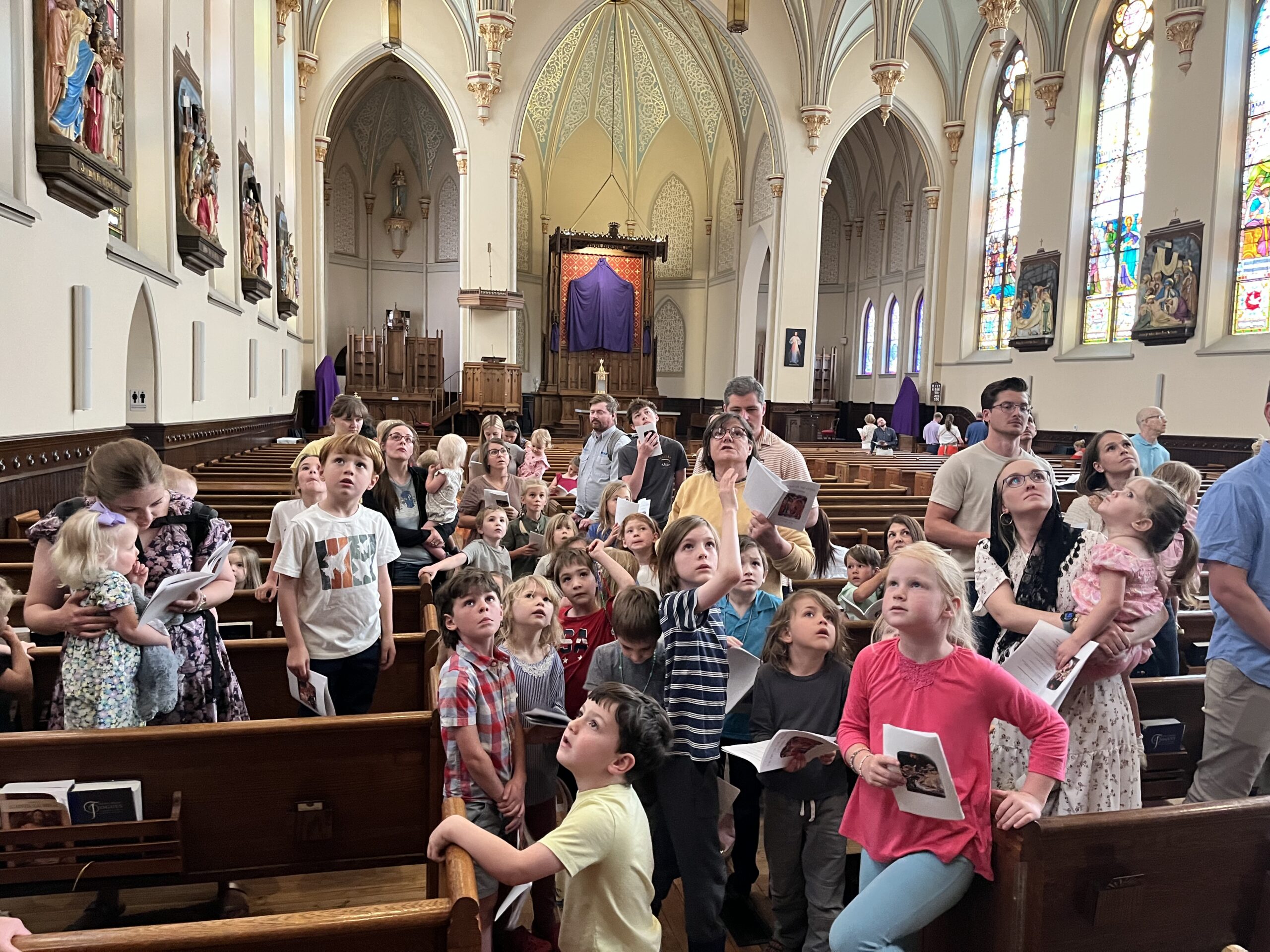
Children and their parents follow the Stations of the Cross in the Basilica of Sts. Peter and Paul in Chattanooga on Good Friday, April 3. Diocese of Knoxville leaders are planning for the future of the Catholic Church in East Tennessee, which involves ministering to youth and young adults. (Photo courtesy Clare Collins)
“Bishop Beckman is already focusing on engagement of youth and young adults, and how to grow them. And Katherine talked about the path of adulthood and how it is. I’m part of the older generation now, and before (the path to adulthood) was always high-school graduation, college, job field. Now it’s kind of a different path for young adults,” Father Iorio explained.
“Not so necessarily graduating from high school and going right to college. There may be a gap year; you may travel abroad to broaden your experience and whatever, do an internship. Young people who are together who may or may not become their spouse. So, it’s not linear anymore but is a different type of reality,” he continued.
Ms. Valenzuela also shared that this newer generation differs because many are coming from families who chose not to baptize their children as infants because they felt “the children should be able to choose when they are older.” This creates a domain where the teachings of faith skip a generation.
This is where Ms. Valenzuela shares the importance of grandparents.
She calls this the “abuela effect,” which comes from the need of seeking believers in the older generation, typically a grandparent, or a person who fills that role.
Young adults have begun approaching the “grandparent generation” to discuss their beliefs. Ms. Valenzuela has advice for young adults who are questioning generational differences: act in “finding the believers in their parish and ask questions. They should ask why they continue serving, why they continue to be a part of the mission.”
Grandparents can live what they believe, and for the young adults this is a large part of what leads them to or from the Church.
“They are coming into a parish with questions. They (younger generation) are coming and asking, ‘Can you show me someone who believes what you are teaching me?’” Ms. Valenzuela explained.
“Abuelita theology” is a framework termed in the Latin community that focuses on the role of grandmothers as leaders of faith along with culture and theology. Abuelitas, or grandmothers, stand as pillars of faith in the family and are sometimes referred to as “live-in ministers.”
In some of her previous work with the Archdiocese of Atlanta, Ms. Valenzuela served as editor of The Mark, a Catholic teen magazine. In the magazine was a column she wrote called “Ask Abuela,” where readers could write questions and receive responses from abuelas and other faithful who volunteer answers. Some columns featured questions about bullying and what to do when someone doesn’t like you, as well as faith-related questions like why Catholics go to Mass and confession. They are questions that can be best answered by someone who commits to living their life according to the faith, someone teens can identify as authentic.
An authentic believer is exactly what any religious candidate seeks to find within the Church, and the interaction of the older and younger generations is a major factor in leading the new generation to the Church.
Father Iorio pointed out that young adults don’t follow the lifestyle plan from previous generations. These plans can be part of what they believe as well in addition to the ability to connect and understand the importance of not only knowing the sacraments but also how to live them.
In a reality where virtually everything is done online and where many people are left to determine if what they see is AI fakery or legitimate content, there is a large detachment in a faith-filled lifestyle. Outreach in a physical sense grows increasingly difficult.
Ms. Valenzuela shared that when working in groups with teenagers, they typically play an introduction game because many of them don’t know how to introduce themselves. They are accustomed to gathering information from an online profile, but in real life they can’t determine who a person is based on a 150-character self-written bio.
Ms. Valenzuela believes teens and young adults are experiencing an increasing rate of panic attacks because of social anxiety. Along with anxiety, rates of depression have increased dramatically among them, partially due to pressures caused by social media. Youth ministry not only has to connect to their groups but also show them how to connect with each other.
Despite increasing anxiety in young-adult and teen culture, Ms. Valenzuela said, “Since COVID, we’re seeing a growth of young people, especially teens and young adults, globally.”
Father Iorio was excited to talk about the increasing numbers as well and shared his gratitude for the work within the diocese and the mission presented to priests.
“It’s probably universal in the Catholic Church of the United States. I believe that we are on the right track with what we are doing through the vision of Bishop Mark. I’m very impressed with the work of Amanda Henderson, our director of the Youth, Young Adults, and Pastoral Juvenil Office. We are growing that office quite a bit, which is a great thing. Having worked with her, I know what the structured plan is, and it’s in good, prepared hands,” said Father Iorio, who is pastor of Our Lady of Fatima Parish in Alcoa and serves as vicar general and moderator of the curia for the Diocese of Knoxville.
“We will continue to grow with some of the strategies they (Diocese of Knoxville) have been working on for the strategic plan to grow the youth ministry, to have more engagement with the parishes and at the diocesan level. I think we’ll see some wonderful things,” he added.
Father Iorio then shared, “I have been in my parish for six and a half, coming to seven years, and I have seen an explosion—and I am deliberate on using that word—of families, young families coming into and joining the parish. Of course, the pandemic years changed things, but it surprised me how fast and how much we have young families coming in.”
“Being older now, and a spiritual father, I don’t have children or grandchildren like married people my age do. I love to see growth in people and transformation in different ways,” Father Iorio continued, sharing his love of seeing young families in church.
Another focal point of the talk with priests was the changing demographics of the Church, both globally and locally.
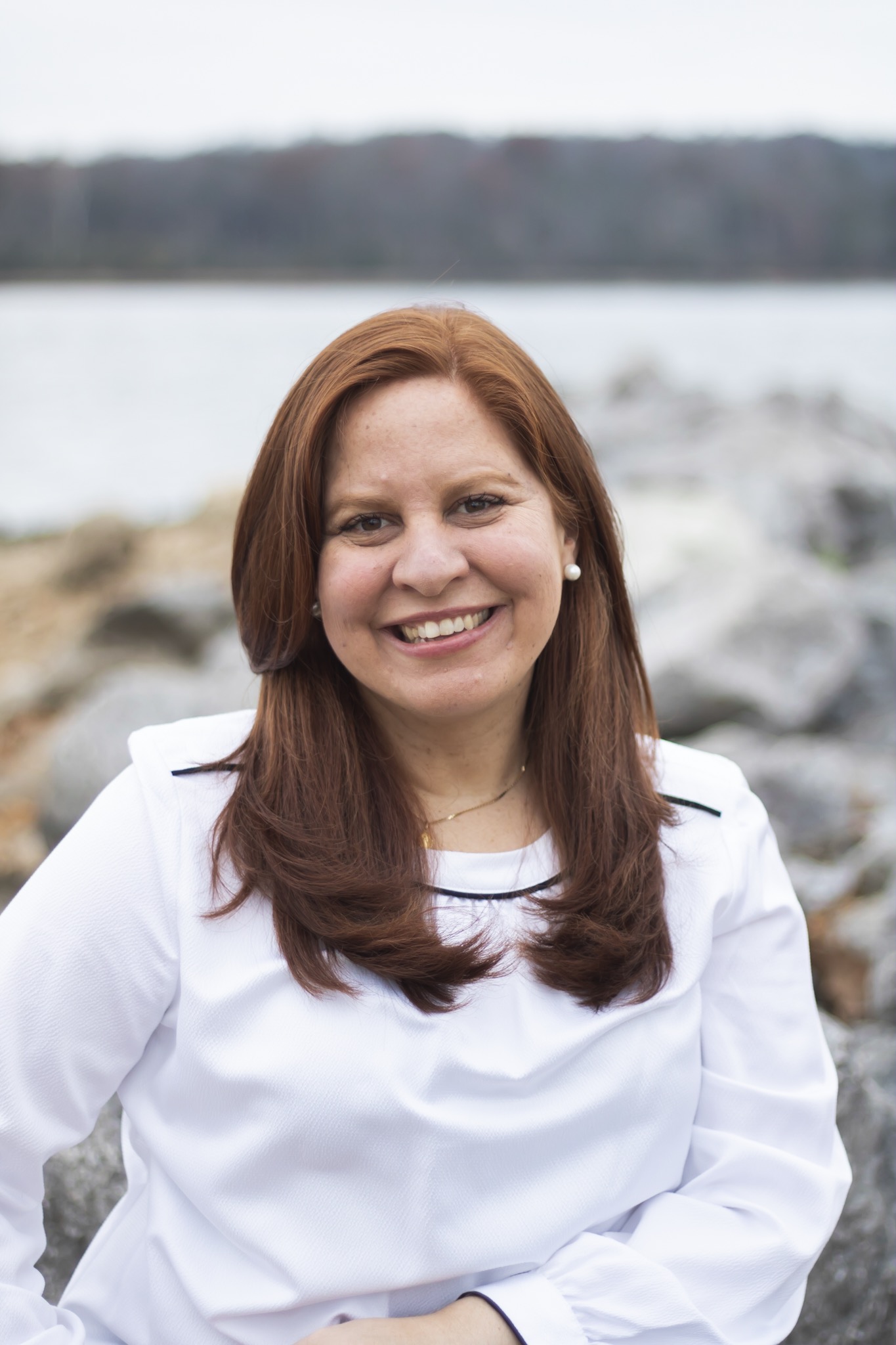
Ms. Valenzuela
Ms. Valenzuela revealed that diocesan priests wondered how the changing numbers of immigration would affect the future of the Church. Many would assume that with current deportations and the treatment of immigrants, the number of Catholic adults would decline, but data reveals the opposite for the nation and Knoxville.
The Knoxville Diocese has a large number of legal immigrant Catholics, meaning deportations aren’t having a large effect on numbers, so the culture around them will continue to expand. This is important for Church leaders to know so the immigrants can connect with their parishes, which can then plan for growth.
Ms. Valenzuela said diocesan leaders must be “proactive in the way we minister.”
Being proactive requires priests to integrate with incoming cultures.
Father Iorio noticed a difference in the Hispanic community, noting that the Hispanic culture identities differently with the image of the crucifix.
“One thing that Katherine did share that surprised me was that the crucifix is different for different-cultured Catholics,” the pastor said.
Hispanic communities identify more with the suffering of Jesus, while Anglo-Saxon culture focuses on the risen image of Christ. Ms. Valenzuela touched on this point as well, pointing out that Hispanic congregations relate to the suffering of Jesus as He was punished for His identity, similar to what the Hispanic community currently faces.
“She shared that in Asia, oftentimes, you see the crucifix surrounded by a communion of saints. It means they identify with Christ—crucified and risen—with a nuance of emphasis,” Father Iorio said.
Ms. Valenzuela touched on another aspect of bringing younger people into the Church: space.
Sometimes when someone is considering joining the Catholic faith and learning about it, he or she feels bombarded with information but doesn’t have time to process the information and allow it to become meaningful. Even if the information is learned, it doesn’t always come with the knowledge required to carry out Catholic beliefs.
Being given that much information but being unable to process it may lead people to become overwhelmed and turn away. When the Church provides a comforting space, candidates for Catholicism can dive deeper into their faith. The space also provides an opportunity for fellowship and communication.
That sense of connection is important because it allows the candidates to feel God working through them. It also means the stranger sitting next to them in a pew becomes a person with whom they can share the presence of the Lord.
As the Diocese of Knoxville continues to grow, the focus remains not just on increasing numbers but on forming authentic, lasting faith in the next generation. Through intentional outreach, cultural awareness, and stronger connections among generations, priests and ministry leaders are working to meet young Catholics in their own environment.
While challenges such as social anxiety, shifting life paths, and digital culture continue to shape how young people engage with faith, leaders remain optimistic. With expanding youth-ministry efforts and a renewed emphasis on community, the diocese is positioning itself to support what many see as a promising future for the Church.
“The Church is alive, and it’s growing,” Father Iorio said. “If we continue to engage and walk with young people where they are, I think we’re going to see even more good things in the years ahead.”