
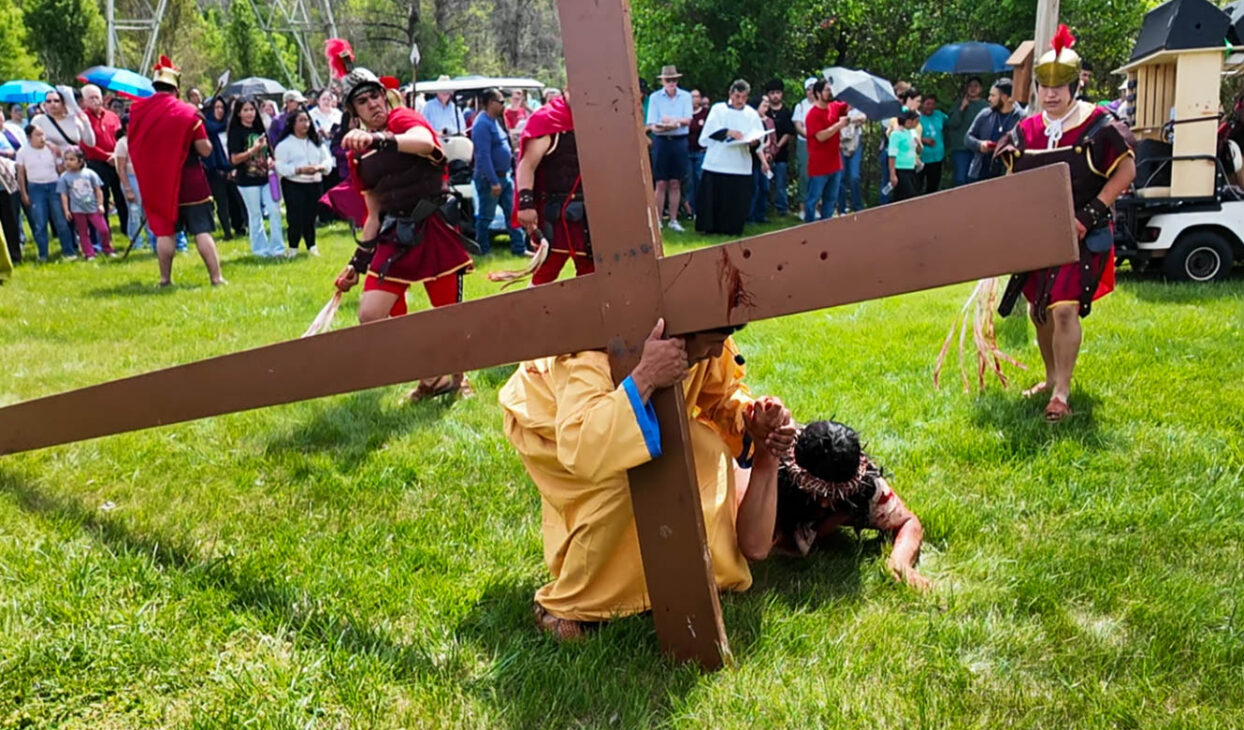
Simon of Cyrene did not go looking for the cross; it was placed upon him
By Bee Goodman
It’s hard to be a bystander, just passing by. Most of us simply want to mind our own business and stay out of other people’s way—neither to be a bother nor be bothered. We keep our noses clean, hoping for a little peace. Is that really asking so much?
Simon of Cyrene was doing exactly that. He was just passing by, on his way back from the fields, minding his own business. He wasn’t looking for trouble or meaning. He was simply living his life, like anyone else, expecting an ordinary day.
And then, without asking for it, along comes life. His peace is disturbed, his hands get dirty, and he is thrust into something he didn’t ask for or want to be a part of. Suddenly, he is faced with something he cannot ignore, something he has to do something about.
There is something deeply human about that desire. This world often feels loud, chaotic, and demanding; the idea of simply going about your day unnoticed can feel like a kind of refuge. We wake up with our plans, our schedules, our responsibilities, and we hope the day will unfold according to those plans. We hope for predictability. We hope for calm. We hope, in a quiet way, to be left alone.
And then, without asking for it, along comes life.
Your peace is disturbed, your hands get dirty, and you’re thrust into something you didn’t ask for or want to be a part of. Suddenly, there’s something you have to do something about. It may be small at first—a moment you could easily ignore, a situation that doesn’t technically involve you. But something about it lingers. It presses on your conscience. It refuses to let you pass by as easily as you intended.
In those moments, the role of the bystander becomes uncomfortable.
Bystanders sometimes just stand around and “watch the show.” As long as they mind their own business, a certain morbid curiosity can take hold. It is easier to observe than to intervene. It is easier to remain distant than to step in. We tell ourselves that someone else will handle it, that it is not our place, that getting involved might make things worse.
We wonder how a young woman can be assaulted in the middle of a party, and yet nobody saw anything, said anything, or did anything. We read stories, watch videos, and shake our heads in disbelief. How could that happen? How could so many people stand by?
More often than we would like to admit, bystanders simply pretend “not to see.”
It is not always out of cruelty. Sometimes it is fear. Sometimes it is uncertainty. Sometimes it is the quiet, persistent desire to protect our own comfort. To step in is to risk embarrassment, conflict, or even harm. To step in is to disrupt the invisible boundary we place between “my life” and “someone else’s problem.”
Simon of Cyrene found himself in exactly that position.
Jesus is on His way to His death, sentenced by Pilate to be crucified, carrying His cross out of the city—the same city He entered so triumphantly, as we recall on Palm Sunday. The crowds that once shouted “Hosanna” have either fallen silent or turned against Him. The shift is stark, almost jarring. What was once celebration has become condemnation.
He is clearly struggling, and the Pharisees do not want Him to die along the way—not out of compassion, but because they want to see Him breathe His last breath on a cross, theological proof that He was cursed by God (Deuteronomy 21:22-23). Their concern is not for His suffering but for what His death will signify.
But after a night of horrific physical abuse, a morning trial, a beating that left many men dead, and a brutal mockery of the “king” game, Jesus just might expire along the way. His body, already pushed beyond endurance, begins to fail under the weight of the cross. Each step is a struggle. Each movement is an act of sheer will.
The road to Calvary is not just a physical journey; it is the visible unfolding of sacrifice, humiliation, and love.
Just as Jesus is in the midst of the central act of human history, there comes a passerby on his way back from the fields: Simon of Cyrene. The same man we met at the beginning—the one simply trying to pass by.
Scripture says he was pulled from the crowd and commanded to carry the cross alongside Jesus. There is also a belief that he may have volunteered from the crowd, moved by what he saw. The Gospel accounts leave room for both interpretations, and perhaps that ambiguity invites us to see ourselves in him. No matter.
Hurrying or tarrying along the road, two men came together. One, the Son of God, carrying the weight of the world’s sin. The other, an ordinary man, carrying the weight of his own daily life. Their paths intersect in a moment neither could avoid.
Seeing their reeling prisoner, the executioners looked around and saw a bystander who appeared fit for the job. Simon’s choice was to obey the orders or face a violent fate. There is a certain starkness to that reality. This was not a polite request. It was a command backed by force.
Stepping beside Jesus, Simon encountered Christ during His time of need. He found himself staring at the One for whom he was to “take up His cross and follow” (Mark 8:34), though he could not have known it fully at the time.
There is something powerful in that encounter.
Christian tradition holds that Simon, at first reluctant, was changed beneath that gaze, from unwilling participant to voluntary servant of the Lord. Whether that transformation happened in an instant or unfolded over the course of that walk, the tradition points to something deeper than obligation. It suggests that proximity to Christ, especially in His suffering, has the power to transform the human heart.
It would be easy today for a believer in Christ to step in and volunteer to carry the cross for Jesus because we know who He is. We have thousands of years of accounts telling of God’s plans for His Son. We have Scripture, preserved and proclaimed across generations. We have the teachings of the Church, guiding and interpreting those truths.
We have firsthand accounts of miracles attributed to saints who encountered the Holy Spirit. We have stories of conversion, of sacrifice, of lives radically changed by an encounter with Christ. We have art, music, theology, and tradition—all pointing us toward understanding. We have our evidence.
What did Simon of Cyrene have?
Nothing.
He didn’t have the Church spreading teachings across the globe. He had no Bible to read, no catechism to study, no homilies to listen to. He did not have centuries of reflection to help him make sense of what he was witnessing. Nothing.
On the way to His death, Jesus had yet to fully prove His identity as the Lord’s Son in the way we now understand it. He had yet to conquer death and return to give us eternal salvation. The resurrection, the cornerstone of Christian faith, had not yet taken place.
Simon didn’t know who Jesus was, but upon seeing His face, he changed.
The moment was simple, brief, and yet profound, speaking to the mystery of encounter. At times it is not knowledge that moves us, but presence. Not certainty, but recognition. Something in that encounter with Christ, battered and burdened, reached Simon in a way that words alone could not.
While tradition tells us that Simon and his sons became some of the first Christians, we cannot say with certainty what became of him after that day. His story, at least in the pages of Scripture, is brief. But from that day he no longer was a bystander, but a symbol of faith. He reached out his hand to Jesus before Jesus had been revealed to us.
We know this man was not of significance or power. He was not a ruler, not a priest, not a person of influence. He was, by all accounts, ordinary. And yet, he was chosen, or compelled, to take part in an extraordinary moment.
Beyond tradition, he faded back into the crowd from which he came.
Still, this was a choice, the choice of a passerby who came across the suffering of another that Good Friday. Whether forced or freely embraced, it required action. It required stepping out of the role of observer and into the reality of participation.
At that moment, Simon, patron of passersby, had a choice—forced yet free—and entered history. There is a paradox in that phrase: forced yet free. It reflects the complexity of many moments in our own lives, when circumstances push us into situations we would not choose, yet within those situations we still retain the freedom to respond.
Almost 2,000 years later, we remember the name of a man who was “coming in from the fields” (Luke 23:26). A simple detail, almost incidental, and yet it grounds the story in the ordinary. He was not seeking out greatness. He was simply on his way home.
No matter how much we may want to stand aside, along comes Life (John 14:6).
Simon’s actions are admirable, whether forced upon him by soldiers or offered voluntarily. They teach us a lesson: do not be afraid to be changed.
That lesson is not always easy to accept.
How often do we see someone suffering? How often do we cast judgment before offering a hand? It is easier to analyze than to assist, easier to form an opinion than to enter into someone else’s pain. We create distance through assumptions, through labels, through quiet rationalizations that allow us to move on without engaging.
Whether it is an immigrant struggling with English, a homeless man sitting on the street corner, or Jesus too weak to bear the cross—we have the opportunity to be changed by that person. Each encounter carries within it the possibility of grace if we are willing to see it.
And yet, too often we become distracted by our routines and selfishness. We convince ourselves that we are too busy, too tired, too preoccupied. We avoid those in need because we fear losing our comfort. We fear the inconvenience, the emotional cost, the uncertainty of what might be asked of us.
We return, again and again, to the safety of being bystanders.
But the Gospel does not leave much room for comfortable distance. Again and again, Christ calls His followers into relationship, into service, into love that is active rather than passive. “Take up your cross and follow me” is not a metaphor for convenience; it is a call to participation.
Simon of Cyrene did not go looking for the cross. It was placed upon him. And in that moment, he could no longer remain uninvolved.
Neither can we.
Life has a way of placing crosses in our path—moments that interrupt, challenge, and invite us into something deeper. We may not recognize them at first. They may not look significant. They may even feel like burdens we would rather avoid.
But within those moments lies an invitation. It’s an invitation to step closer instead of walking away, an invitation to see rather than pretend not to see, an invitation to carry, even if only for a short distance, the burden of another.
It is there, in those unexpected encounters, that we meet Christ.
Not always in ways that are obvious or comfortable, but in ways that are real and transformative. And like Simon, we may not fully understand the significance of what we are doing at the moment. We may not see the full picture. We may not feel ready.
But we are still called to respond.
It’s hard to be a bystander, but perhaps we were never meant to be.
Bee Goodman is a multimedia journalist for the Diocese of Knoxville who writes for The East Tennessee Catholic. She is a member of the Cathedral of the Most Sacred Heart of Jesus.