
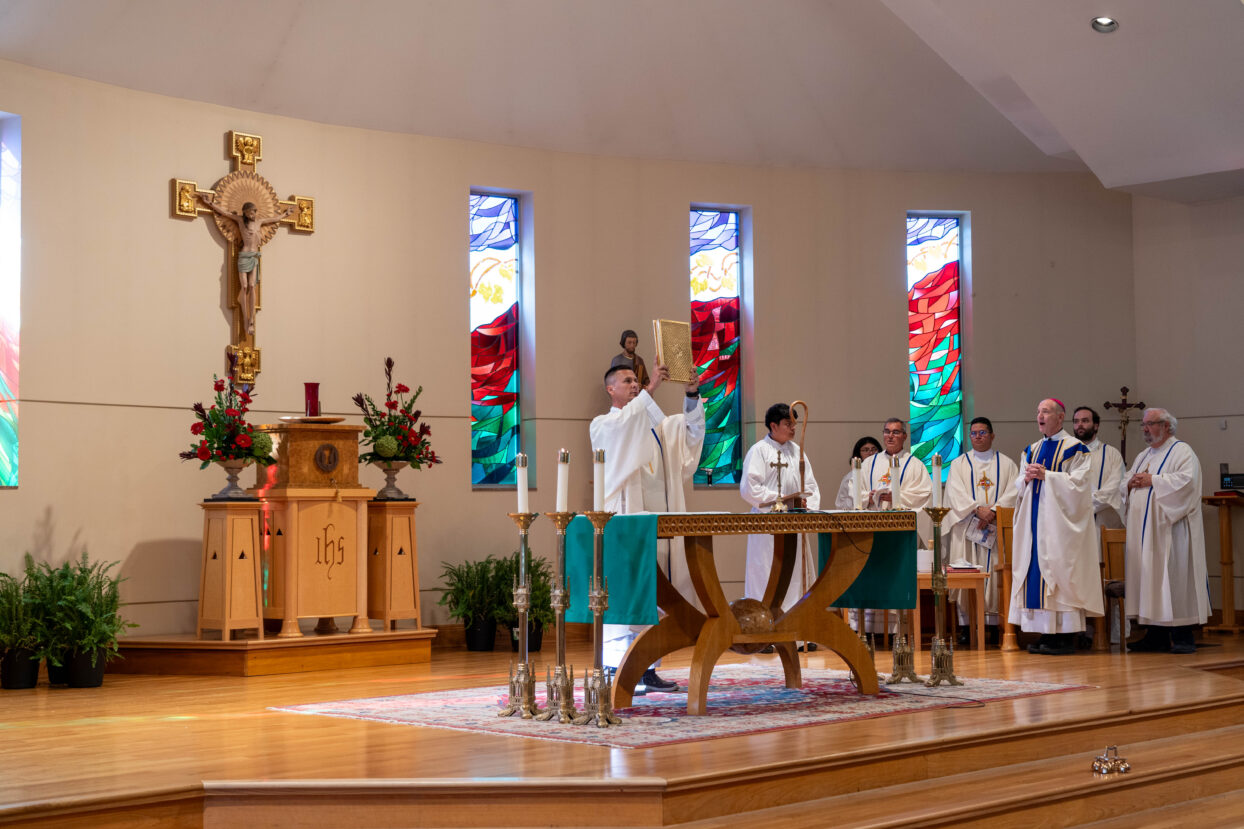
Ecological retreat, Mass led by Bishop Beckman launch Care of Creation Commission
By Brett McLaughlin
Long before young Mark Beckman was consciously discerning his future, he was being tugged into a relationship with God the Creator as he explored the fields and forests of his native Lawrenceburg, Tenn.
Now, as bishop of Knoxville, he is inviting the faithful of his community to develop Creation Care Teams in every parish of the diocese. He wants to join hands in carrying forth the call of Pope Francis’ 2015 encyclical Laudato Si’ to hear “the cry of the Earth” and “the cry of the poor” and to “respond by rediscovering our responsibility to be true stewards of God’s creation.”
“In the spring, there would be wild roses growing in the ditches; in the summer, we would pick blackberries from the same ditches,” Bishop Beckman said, recalling his childhood during a Mass and ecological retreat on May 27 at All Saints Church in Knoxville.
“As young boys, we would follow the creek through the pine forests that were all around us. … In some ways I was extremely blessed to grow up in Middle Tennessee surrounded by fields, flowers, and farmland,” he continued.
An awareness of God’s creation as “a supreme gift” developed, and he told those gathered that his heart, mind, and body became open to the wonder of that creation. That wonder, he explained, continues today as he wakes each morning, aware of the breath God has given him as he prays: “Thank you God for my breath that I now breathe back to you.”
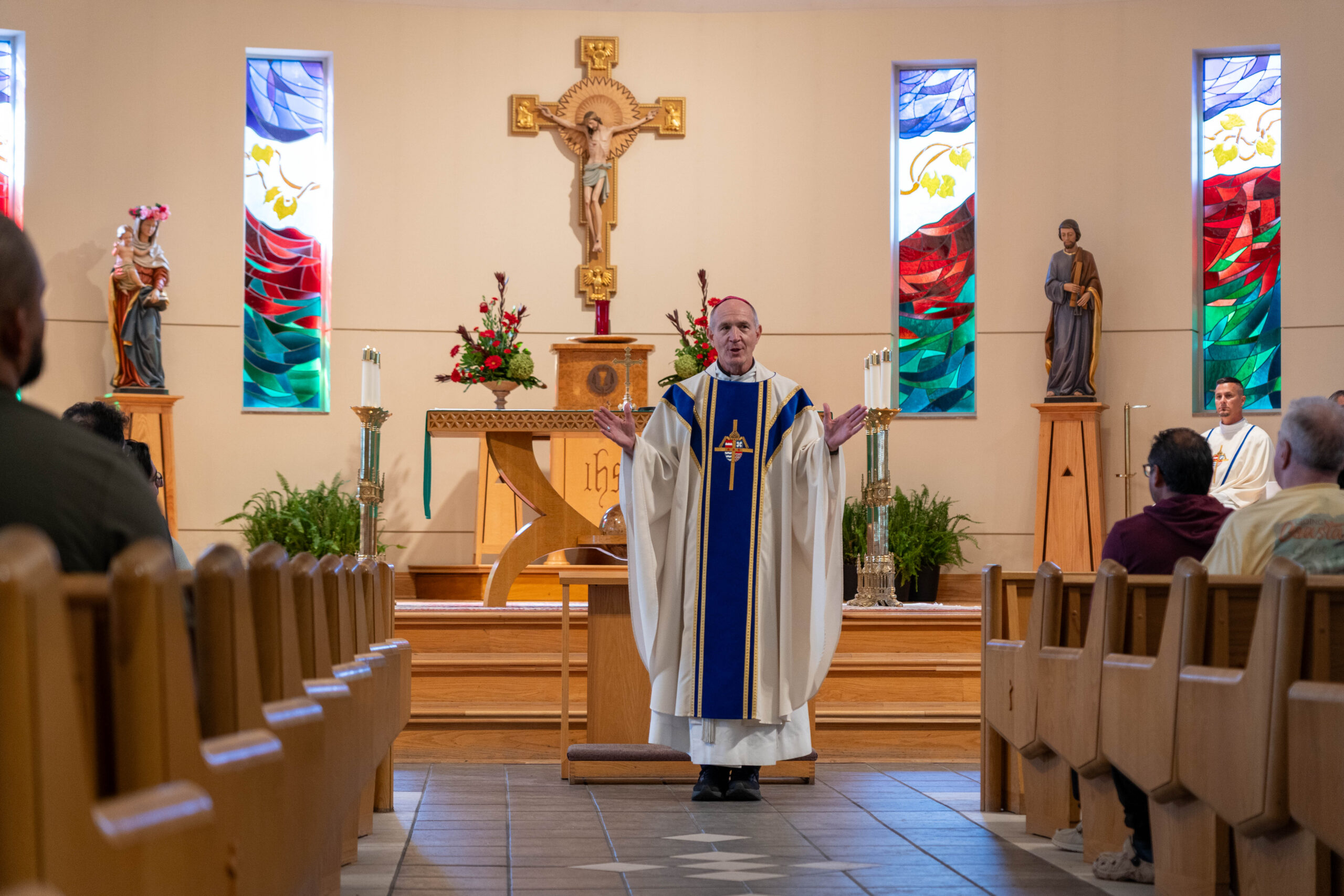
Bishop Beckman gives the homily during the Care of Creation Mass. (Photo John Mecklenborg)
The bishop’s comments came on the heels of a May 15 letter he wrote to the faithful announcing the establishment of a new diocesan Care of Creation Commission as part of the Diocese of Knoxville’s commitment to environmental sustainability.
Guided by Laudato Si’, the bishop asked the entire diocese to commit to a new relationship with God’s creation. He specifically referenced how truly blessed we are by the beauty of our mountains, streams, forests, and wildlife in East Tennessee, and stressed our spiritual responsibility to be faithful stewards of these gifts.
“Since the release of Laudato Si’, many dioceses around the globe have adopted Care for Creation principles. Some of our parishes in the Diocese of Knoxville have also begun similar initiatives, which I commend,” he wrote.
“As a diocese, we commit to environmental sustainability with a newly formed diocesan Care of Creation Commission. I also invite each parish to develop Creation Care Teams, and for each parish and school to develop action plans according to the unique abilities and resources of each community,” his letter continued. “I invite individuals and families to devise ways to live more simply and sustainably as we mindfully live out our Christian faith, protecting life and beauty. We are a Catholic people of hope!”
Specifically, the bishop invited each parish to:
- Hold a parish listening session or other consultation with key advisory bodies to parish leaders;
- Develop a Creation Care Team; and
- Enroll in the Laudato Si’ Action Platform and submit an action plan.
Prior to the Mass on May 27, attendees gathered in the All Saints parish hall for a series of three short talks offered by members of the newly formed commission.
Juan Alarcon, a physical chemist, focused his comments on the science of climate change and what faith asks of us. Rebecca Harman, a Tennessee native and conservation scientist, spoke of her own personal journey and a relationship with the earth centered on the sacred elements that move through it, and Deacon Chad Shields, permanent deacon assigned to Christ the King Parish in Tazewell, shared comments focused on how his family practices ecological education through sustainable and regenerative practices on their family farm located near Tazewell.
‘Care for creation is not optional’
“This (statement from Laudato Si’) is not a political statement,” Mr. Alarcon said. “It is a moral one, rooted in the conviction that the earth is a gift, that we are its stewards, and that how we treat it reflects how we treat one another and our Creator.”
He went on to offer a basic explanation of global warming, adding that it is not speculation but, rather, measured science.
He pointed to visible effects in East Tennessee such as hotter and more humid summers, increased flooding risks, movement of species that are living in the Smoky Mountains, and the impacts on fish and water quality in the Tennessee River.
“When the air warms, water cycles change; when water cycles change, soil and forests change; when forests change, wildlife changes,” he said. “When all of that changes, the communities that depend on stable land, water, and food are affected, especially the most vulnerable among us.”
Physical changes in the atmosphere are measured facts, he said. Legitimate debate only belongs in determining how we choose to respond to those facts, he added.
“Understanding what is happening is the first step, but faith does not stop at understanding; it requires us to act,” he said, adding that the response begins with noticing the world, paying attention, and making small, concrete choices in how we live and care for creation.
The living world as communion
Using what she referred to as her own “circuitous journey,” Ms. Harman said she was able to “recover a way of knowing the earth that begins and ends with radical love—seeing the living world not as backdrop or resource but as communion.”
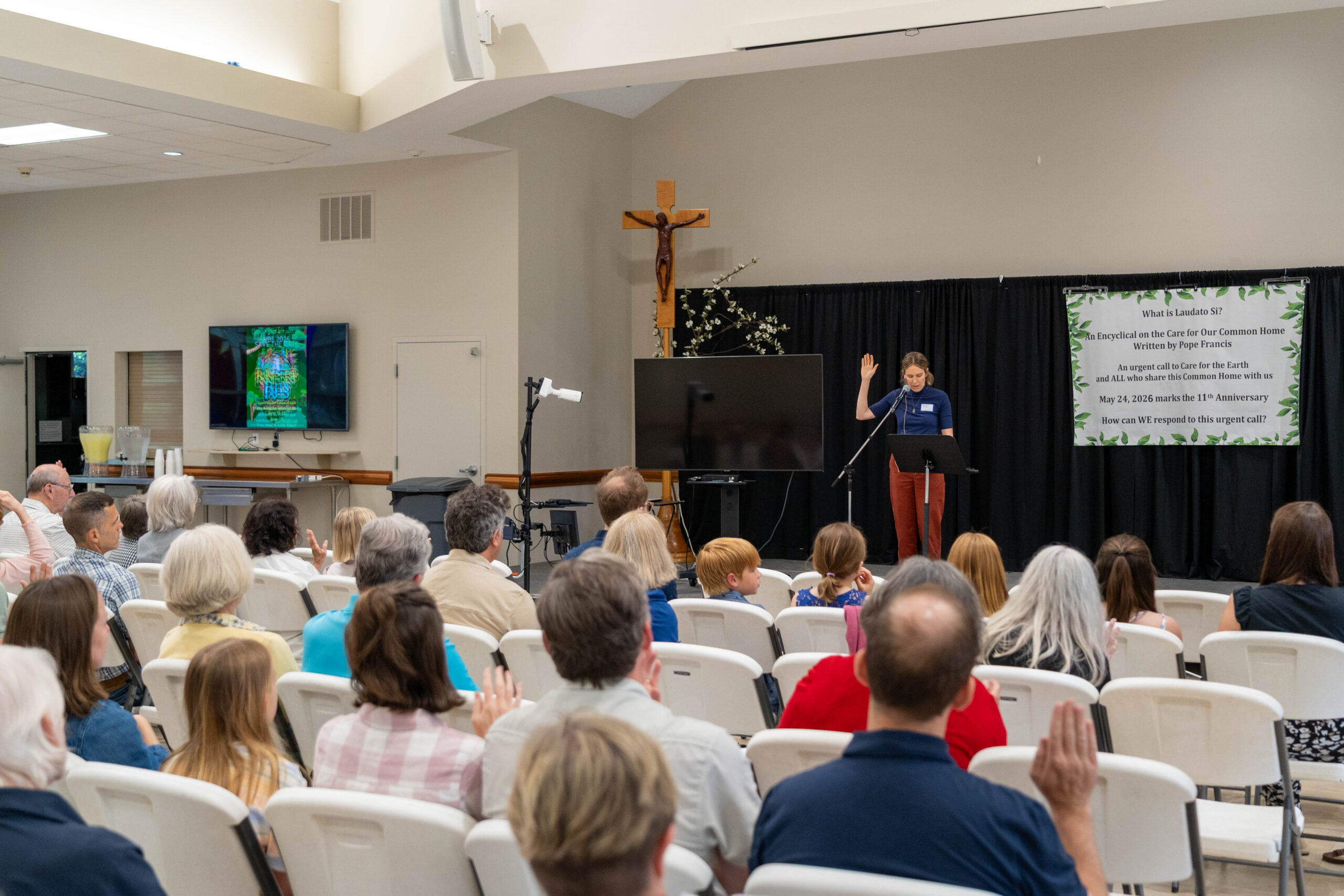
Rebecca Harman, a Tennessee native and conservation scientist, gives a presentation related to Laudato Si’ during the May 27 ecological retreat in the All Saints parish hall. (Photo John Mecklenborg)
Science, history, faith, her life in Southern Appalachia, and the rich contemplative tradition of the Church all contributed to that journey, she said, occasionally with emotion.
Calling on the witness of St. Francis, natural history, cosmic theology, and the contemplative insights of modern spiritualists, she invited attendees to walk with her into a fundamental shift in perception—“from observer to participant, from consumer to giver, from isolation to connection.”
“The coarseness of this world—its hardness, its loss, its sorrow, its unrelenting demand—is not the obstacle to communion with God. It is the medium of it,” she said. “When we learn to see the living world through the eyes of the heart, stewardship ceases to be obligation and becomes, simply, the natural expression of love. We are not observers of the living world. We are the living world, remembering itself.”
Ecology put into practice
Deacon Shields believes that some knowledge comes only through experience, and creation is like that, too.
“We can read, study, and quote documents, but ecological education becomes real when we live differently,” he told the assembly.
For him, “differently” means accepting that creation has a lot to teach, something he is still learning as he evolves from suburbanite and former military detachment commander to farmer.
“People ask if I grew up on a farm. Nope … straight suburbanite gone wild,” he said, adding that in the military he was used to being in charge, making decisions, and having resources.
“I had a steep learning curve,” he said. “The farm humbled me. The land doesn’t care about résumés; animals don’t care about rank and the weather … well, the weather doesn’t care about plans.”
He shared many of the sustainable and regenerative practices that he and his family use on their farm, many of which revolve around biodiversity.
“You cannot monocrop or run only one species and expect long-term resilience, Eventually, you reach capacity,” he explained. “We learned to grow differently. When the cattle reached pasture capacity, we added sheep without reducing capacity because they graze differently.”
Diversity, he said, means more stability. More species produce more natural regulation. The farm uses no chemicals or sprays.
“All I had to do was build a few birdhouses,” he quipped, noting that a pair of nesting swallows can consume thousands of insects daily.
“Maybe creation is not disordered. Maybe we have forgotten how to live within its order,” he suggested. “Creation is very patient, but it is not indifferent. On a farm, if you take more than the land can give, it does not argue, it simply stops producing … if you ignore its limits long enough, reality tells the truth.”
Deacon Shields closed by saying, “The invitation is not simply to think differently; it is to begin living differently.”
The retreat event concluded with a reception hosted by the All Saints Creation Care Team and members of the newly created Care of Creation Commission. Those members are available to support and help parishes and schools create teams and provide ongoing support. Information and resources are available on the Care of Creation website, dioknox.org/care-of-creation.