
East Tennessean illustrates book on life, martyrdom of Servant of God Shahbaz Bhatti
By Bill Brewer
Jordan Holt is accustomed to his artistic creations being embraced by youth and young adults. His artwork has been appreciated at comic conventions around the country.
It never occurred to him at first that his most important work to date would have a dangerous undertone and be unwelcome in the country in which it is set.
But that’s the reality of Blood & Water: The Life and Martyrdom of Shahbaz Bhatti, a book that Professor Holt has illustrated detailing the life and assassination of one of Pakistan’s most widely respected and popular figures.
Professor Holt was unfamiliar with Shahbaz Bhatti until a chance encounter introduced the Lee University fine arts instructor to the martyr whose cause for sainthood is in the hands of the Vatican.
His name is now on a new book about Servant of God Shahbaz Bhatti that brings to life the Pakistani’s story of faith and courage in the face of intense religious persecution.
Professor Holt and his wife, Sarah, live in Cleveland and attend St. Thérèse of Lisieux Church with their five children. His professional focus is graphic design and illustration, and he also does professional illustration as a sideline from his home studio.
The 36-year-old artist’s medium of choice is comic illustration, and he covers topics from religion and history to mythology, literature, and games.
In 2020, he began creating graphic novels and self-published some works while also doing projects for publishers. He explained that a graphic novel is to a comic book what a feature film is to a TV show.
Graphic novels are single stories that are illustrated similarly to a comic book, with panels and word balloons. They are a combined visual and text medium and are especially accessible to youth and young adults. And they’ve grown in popularity in recent years.
Professor Holt’s artwork attracted the attention of writer Matt Yocum while both were attending a comic convention in Charlotte, N.C. That chance meeting among two Christians at a secular convention led to a creative partnership that was consummated in the fall of 2023.
That’s when Blood & Water: The Life and Martyrdom of Shahbaz Bhatti began to take form.
Professor Holt, who has a master’s degree in fine arts and has been teaching full time at Lee University since 2015, agreed to illustrate the book detailing Mr. Bhatti’s influence in Pakistan.
“Shahbaz’s story is one of those that is both tethered to a particular time and a particular political context. But it is one of those that is timeless,” he said.
The Shahbaz Bhatti story is new in the context of world history. The government minister was assassinated on March 2, 2011, in Islamabad, Pakistan, at the age of 42. He was a graduate of the University of Punjab and was a member of the Pakistan Peoples Party. He was born on Sept. 9, 1968, in Lahore, Pakistan, and was Catholic.
He was serving as the Pakistan government’s federal minister of Minorities Affairs when he was shot to death by the Pakistan Taliban while in his car shortly after leaving his mother’s residence.
And on March 2, 2016, on the fifth anniversary of his tragic assassination, Mr. Bhatti’s cause for beatification was formally opened by the Roman Catholic Diocese of Islamabad-Rawalpindi.
“It’s pretty recent history. The shaping this story has had on me even makes me look at political context and religious context today with a more sensitive eye, a more sensitive ear,” Professor Holt said.
“Shahbaz, coming from Pakistan, he was a political activist. That is how he is known globally. But the more intimate story, which is covered by the graphic novel, encompasses that period of his life, but he starts off as this young Pakistani Christian. He grows up in a small, Catholic community in a village called Khushpur, Pakistan,” Professor Holt explained.
Khushpur is located in the Punjab region of northern Pakistan.
“It’s somewhat isolated. The majority of Pakistan is Muslim. That is by far the majority population. In fact, Pakistan is one of the few countries that is founded particularly as a Muslim government, an Islamic government,” Professor Holt observed. “However, there were caveats placed in the nation’s founding documents—its constitution, etc.—that made allowances for religious minorities. But Pakistan has not done a good job in preserving minority religious rights.”
The more research Professor Holt did on Mr. Bhatti, the more the Servant of God has resonated with his East Tennessee illustrator.
“Shahbaz’s situation was really unique because he grew up in this Christian context. He didn’t realize in his earliest years just how separate they were from the rest of Pakistan. This really crystallizes him when he goes off to college. That is when he encounters his first persecution,” Professor Holt said.
The art professor gave examples of this persecution at an early age when young Shahbaz Bhatti was not allowed to use the same tea sets as Muslim students and he was beaten when he tried to establish a Christian group.
“For a lot of people, these would have a tempering effect. For Shahbaz, this just crystallized the mission. He looked at the context he was in and realized this was shared by tons of other Pakistani Christians, again not a huge population but enough of them as well as other religious minorities within Pakistan. So, his life became about creating unity among those groups so they could have a political voice together and work toward social change and political change together,” Professor Holt said.
Mr. Bhatti was most outspoken against Pakistan’s controversial blasphemy laws, relentlessly campaigning against the misuse of these laws and Sharia legislation, which he argued targeted, persecuted, and carried the death penalty for vulnerable religious minorities.
He also was a vocal critic of all human rights violations, hate speech, and violence against these vulnerable groups. Despite repeated death threats from extremist groups like the Taliban, Mr. Bhatti fearlessly led efforts to defend individuals falsely accused of blasphemy and he worked for interfaith harmony.
Mr. Bhatti’s voice and all the voices he represented began to carry throughout Pakistan, enough so that political forces within the country’s ruling party took notice.
“Eventually he becomes so important as a religious minority voice that the president of Pakistan, who was replacing a previous president who had been assassinated who was a friend of Shahbaz, invited him to become a minister in the government. He (Shahbaz) used this position to rally support internationally for Pakistani religious minorities. Ultimately, he became such a potent voice that he attracted a lot of negative attention,” Professor Holt explained.
“If you listened to the way he talked, and there’s even a video on YouTube where he discusses his imminent death at one point just a month before he actually was killed, he knew that this was probably going to end with his martyrdom. But he continued to push through,” the professor continued. “His perspective on it was I’m just following in the footsteps of Jesus. I’m just following Christ. He said these things explicitly. This was his mission.”
Mr. Bhatti’s public expressions were prophetic and led to the silencing of a leading religious-freedom voice in the world. But the assassination also amplified Mr. Bhatti’s cause.
“Ultimately, he was gunned down by essentially the Taliban in Islamabad, right outside his mother’s apartment. We just passed the 15th anniversary. This, of course, was a tragedy in and of itself, but it has had an effect that people like Shahbaz managed to have, even in death, which is to motivate a continuation of their efforts,” Professor Holt said.
Mr. Bhatti’s mission continues, but those who have taken up his mantle have had to flee Pakistan so that these activists won’t fear for their lives.
“Shahbaz’s brother, Peter, has carried the torch since then. He is a character featured within the graphic novel. And also, his nephew, Peter’s son, David, is actually working in Canadian politics now, trying to make ground,” Professor Holt noted.
Peter Bhatti migrated to Canada and became a resource for his brother outside of Pakistan to help get refugees out of that country, according to Professor Holt.
“He (Peter Bhatti) has been very successful in doing that and commands enormous respect among the community of Pakistani, Iraqi, Iranian, and Christian refugees who have been pulled out of the Middle East and West Asia thanks to Peter’s work,” he said.
“The fight continues, and the graphic novel is there to not just be an epitaph for Shahbaz, but rather to create and foster that motivation that has pushed Peter along and has pushed David Bhatti along, and provide that inspiration that you can work toward peace, and that even when the way is incredibly difficult, even when you know that violence and resistance will be the consequences of your efforts toward peace, there is still value in doing that,” he added.
Peter and David Bhatti are based near Toronto.
Professor Holt detailed how Shahbaz Bhatti had a friend in the U.S. State Department, Knox Thames, and the two communicated frequently. Mr. Thames is part of the narrative in the book. The Servant of God’s allies outside of Pakistan have helped to further his mission.
“Shahbaz actually came to the U.S. just about a month or two prior to his assassination in order to meet with American leaders. He was there for the 2011 International Prayer Breakfast. He met with Secretary of State Hillary Clinton. He had meetings all over the place. Knox set those up for him. There is a photo in the back of the book that I did an illustration from of him (Shahbaz Bhatti) meeting with the U.S. Catholic bishops. He is standing in front of their mural, a beautiful green mural of angels,” Professor Holt pointed out.
According to Professor Holt, Mr. Thames has continued to promote his friend’s life and work and even received a grant from Pepperdine University in Los Angeles related to religious persecution. The idea behind the grant was to create content about Mr. Bhatti, and a movie about his life was first discussed but ultimately considered too expensive.
Mandi Hart began working with Mr. Thames on the project. Ms. Hart produced the acclaimed animated short film “The 21” about the brutal murders of the 21 Coptic martyrs in 2015. The film was named to the Academy Awards shortlist in 2024.
Ms. Hart suggested that a graphic novel would be a good option for the Shahbaz Bhatti story because it could be a gateway to other media avenues.
She suggested Matt Yocum as the author for Blood & Water: The Life and Martyrdom of Shahbaz Bhatti. The chance encounter at the Charlotte comic convention would produce creative dividends for Professor Holt and Mr. Yocum. It was during the convention that Professor Holt and Mr. Yocum realized that each practiced the Christian faith.
“My eyes lit up when I realized I was meeting a brother in Christ in a context where you don’t see a lot of them. We struck up a conversation based on that and we exchanged cards and then went our separate ways,” Professor Holt recalled. “I didn’t think about it much more after that because you meet a lot of people at those events.”
A few months later, Mr. Yocum contacted Mr. Holt and told the Lee University faculty member that he was looking for an artist to illustrate the story about Shahbaz Bhatti.
“I had never heard about him (Mr. Bhatti). The story would be set in Pakistan and would be recent history. It was really outside of my typical work. A lot of what I had done up to that point had been young-adult comedy and Greek mythology stuff,” Professor Holt shared. “He (Mr. Yocum) had read my books. I was kind of confused, and I asked him, ‘You know the kind of stuff I’ve drawn. This really isn’t quite within that realm. Are you sure you want me to do it? Shouldn’t you get a Pakistani artist who knows the culture really well?’”
Professor Holt was caught off guard by Mr. Yocum’s response.
“He said for one, a Pakistani artist couldn’t do it because, frankly, it’s just too dangerous for most of them in Pakistan to really do much related to Shahbaz because his name is very controversial there. It could be dangerous, so they decided we won’t take that route,” Professor Holt explained.
“But also, Matt had read my work, and he said, ‘I know that you know how to tell a story well. That is really our biggest concern. Can this story be told well?’” he added.
Professor Holt agreed in the fall of 2023 to illustrate the book, which led to months of research and preparation for the book.
He wasn’t able to visit Pakistan, but he studied video of the country in addition to reading about Pakistani culture—past and present—to get a proper feel for his drawings.
“I tried to get as much fidelity to it as possible because there is a real tendency among western media, particularly American, to use west Asia and the Middle East as kind of this one big sepia-toned thing that is mostly made of concrete and dirt. I know that no culture is fully represented by that kind of portrayal. So, I wanted to dig into the artistic culture of Pakistan, try to understand it, and see some of that beauty in it that Shahbaz clearly saw. He spent his life defending this people and this place. This is a place that has culture and depth and history, and it has a broad range of religious representation,” Professor Holt said.

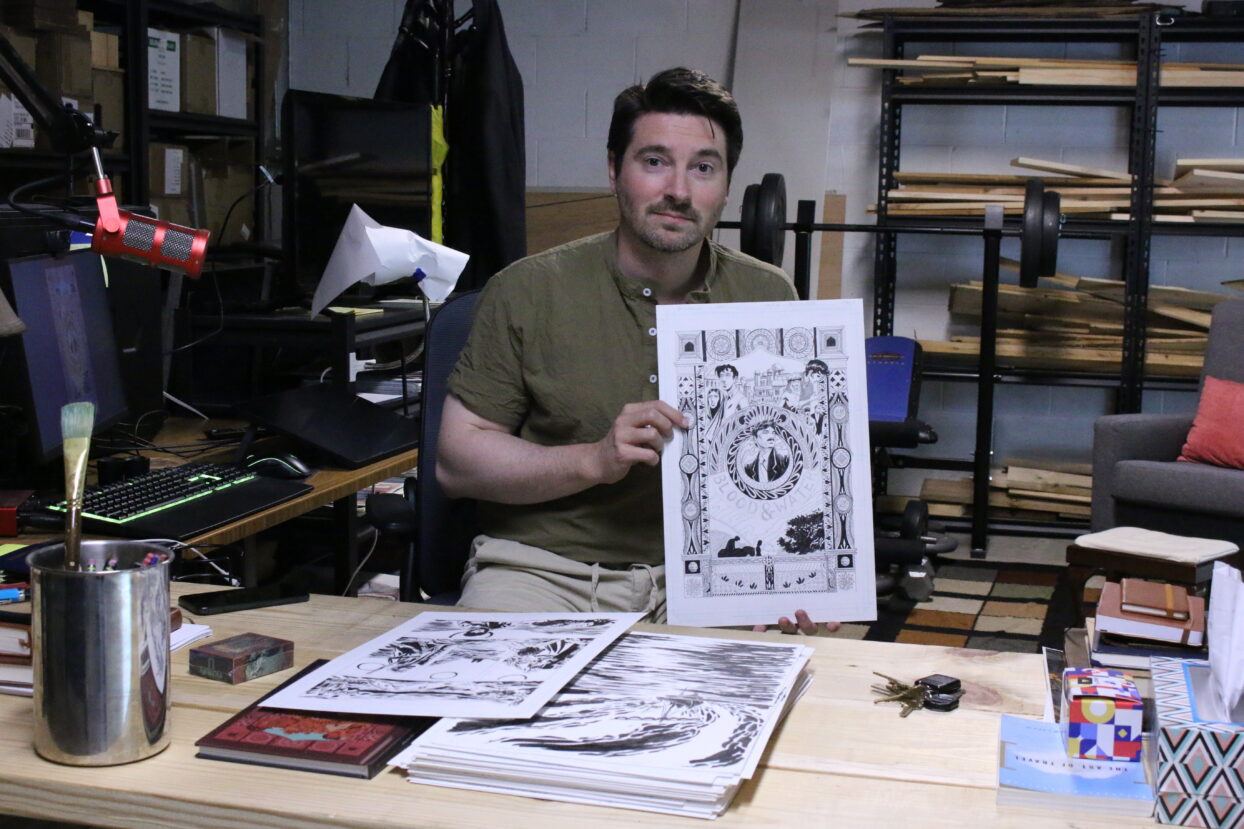
Jordan Holt, a parishioner of St. Thérèse of Lisieux in Cleveland, shows the graphic novel Blood & Water: The Life and Martyrdom of Shahbaz Bhatti, which was written by Matt Yocum and illustrated by Mr. Holt. In the photo, Mr. Holt is shown in his home studio. The book has been published by Ignatius Press and Magnificat. (Photo Bill Brewer)
The project took him about a year to illustrate because it is more than 100 pages and he was carrying a full teaching schedule at the same time.
“It was quite time-consuming and stressful. But we produced the book, and it was a great team to work with, very harmonious. We finished it at the end of 2024. We then spent a year getting it prepped for print and set up with Ignatius Press so they could put it out right at the 15th anniversary of his death,” the illustrator shared.
The 15th anniversary was March 2, and the book was released on March 15 by Catholic publishers Magnificat and Ignatius Press.
Professor Holt believes Ignatius Press’ interest in the book was divinely inspired, just as with the handshake between the creative teammates at the Charlotte comic convention.
And the project has provided more inspiration for his Catholicism.
Professor Holt converted to Catholicism with his wife, Sarah, during Easter Vigil 2023 at St. Thérèse of Lisieux, where Father Mike Nolan is pastor. Their five children, ranging in age from 14 to 1, then joined the Church in 2024. The East Tennessee native’s conversion occurred just weeks before he met Mr. Yocum.
Response to the book has been positive, he noted, pointing to reviews in Aleteia Magazine and from a Baptist organization.
Professor Holt is unsure if the book will be released in Pakistan. Regardless, he is intent on keeping alive the mission of Mr. Bhatti, who never married, possibly out of concern for his family’s safety.
“I knew so little about Shahbaz. As I studied his story, one of the things that struck me is how naïve he seemed even though he wasn’t naïve at all. He had this absolute unabashed belief that you could foster harmony within a society where you have a bunch of different people who all believe different things. He understood just how impossible that seems, but he continued to push through it,” Professor Holt said.
Professor Holt points to the many struggles Mr. Bhatti faced in his life, not the least of which was the persecution and assassination of friends and colleagues.
“Yet he continued with that utter faith that this was a possible thing to do, to create a society of harmony. I look at that with a little bit of cynicism. I know human nature is what human nature is. But the way he pursued that reality in spite of all the difficulty has genuinely inspired me to rethink my position on this and to have more faith that we can have harmony,” Professor Holt acknowledged.
“His experience has taught me that I am thinking too simply and I’m not having enough faith,” he added.
This book project and the research that went into it has had a profound impact on Professor Holt’s Christian faith, giving life to the stories he has spent a lifetime reading in the Bible and humanizing the works of so many who have given their lives defending the teachings of Jesus Christ.
“As I was working on this, I could not shake the sense that this was like the life of a saint. It has elements that are remarkably similar to the tales of saints that you tell the kids. Like when Shahbaz was a kid, he was already reaching out to the marginalized within his own community. He’s bringing them food and doing these small actions that then build to greater actions. One of the highlights of it is when you work on something like this and then you read the stories of the saints, they seem more real to you because they don’t feel like they’re sequestered to the past. It feels like they’re still happening and that Shahbaz is one of those examples. There are others out there,” Professor Holt said.
He believes Mr. Bhatti’s story will be powerful for a long time regardless of whether he is canonized by the Vatican. The artist has faith that the Catholic Church will make the right determination.
“As to whether or not that happens for Shahbaz, I’m perfectly willing to let that simply happen as it will. Instead, I think this story is just one of those that is good and ought to be promoted either way,” he said, emphasizing that stories in the Gospels mirror moments in Mr. Bhatti’s life. “It’s just a universal Christian story.”
Blood & Water: The Life and Martyrdom of Shahbaz Bhatti is available in hardcover at Ignatius Press, ignatius.com, for $17.99 plus shipping. The book also is available at the online Magnificat Bookstore, bookstore.magnificat.net, at the same price. The book is recommended for those age 13 and up.