
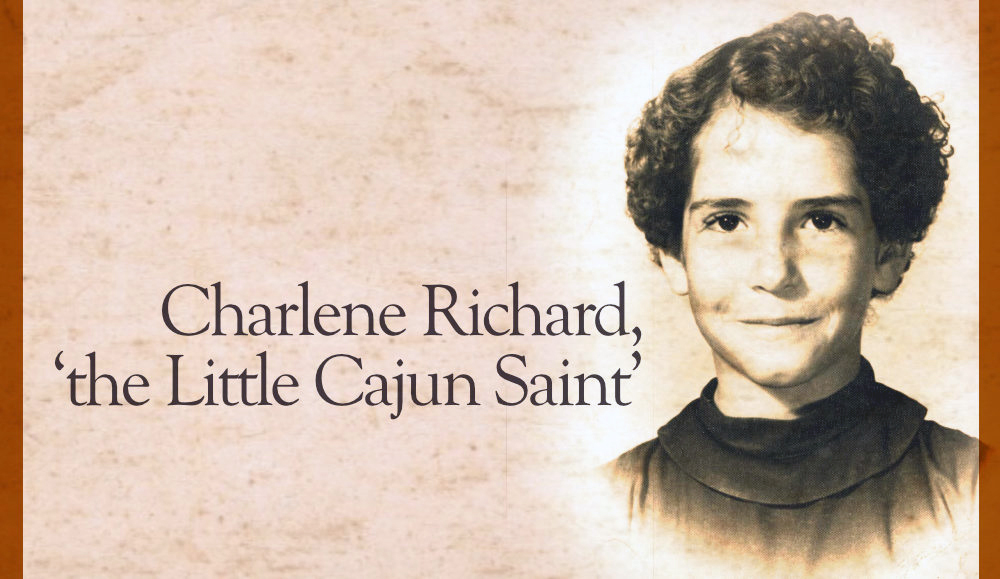
Servant of God Charlene Marie Richard: suffering offered and miracles found
By Bee Goodman
She was 12 years old, dying, and in tremendous pain. Yet instead of praying for herself, she prayed for others. That is the story of Charlene Marie Richard, a simple Cajun girl from Louisiana whose extraordinary faith in her final days inspires thousands around the world.
It is the story of an ordinary child, in an ordinary town, who chose to love God and others with steadfast determination, even as her own life was ending.
Charlene was born on Jan. 13, 1947, in Richard, Acadia Parish, La., the second oldest of 10 children born to Joseph Elvin and Mary Alice Richard. Her father was a sharecropper and later a state highway worker, while her mother was a nurse’s aide for homebound patients.
The family home had only two bedrooms shared among 10 children, and the house lacked electricity; yet by all accounts, it was kept clean, orderly, and full of life. The children spoke French at home, and Charlene’s father never learned English.
Within the Cajun community, there was nothing unusual about the little girl or her family. They were hard-working people strongly devoted to their Catholic faith in a culture where deep religious devotion was simply a way of life. As was common in Cajun culture, the boys were altar servers at Mass and the girls sang in the choir. The family would attend Mass three times a week in addition to Sunday.
Charlene grew up attending Catholic school and then Richard Elementary School through sixth grade. She was known as a diligent student who rarely missed classes and participated in school plays and summer programs at nearby St. Edward Church.
She excelled enough in basketball to captain the girls team at Acadia Parish Middle School. She did chores that included picking cotton and bringing in the sweet potato and corn crops. She rode horses into the woods near her home, which backed up to Bayou Plaquemine Brulé.
Her brother, John Dale, recalled fondly: “She could give me a hard slap. She was feisty but she was fair.”
The New York Times once described the girl as “exuberant, loyal, and generous.” She nightly prayed her rosary, which she kept on her bedside table alongside the Bible. She was, in every sense, an ordinary Cajun girl. Such ‘ordinariness’ is precisely what makes her story so powerful.
The seeds of something deeper were planted in May 1959. Charlene read a book about St. Thérèse of Lisieux. After reading it, she told her grandmother she wanted to be like St. Thérèse and asked if she, too, could become a saint by praying like her. Her grandmother answered simply, “All we can do is our best.” The girl replied quietly, “Then I will do my best.”
Within weeks, she would be given a chance to live out those words in ways no one around her could have imagined.
Her final days
Not long after, Charlene began to feel unwell. She had a strange set of encounters around this time. A woman dressed in black with a bonnet covering her face blocked her path twice. Her brother, John Dale, was with her on one occasion but did not see the figure himself.
Since Charlene was known to be honest, those around her believed her account. She addressed the figure directly: “What in the name of God do you want?” The figure then disappeared beneath an old tree. Her teachers noticed she was no longer her energetic, joyful self.
Her mother took her to a physician. Only two weeks before her death, she was diagnosed with acute lymphatic leukemia and hospitalized at Our Lady of Lourdes Hospital in Lafayette, La. At the request of her family, a hospital chaplain and newly ordained priest, Father Joseph Brennan, was asked to tell her she was going to die. He introduced her to the Catholic doctrine of redemptive suffering.

he Charlene Richard Foundation has been established to preserve and promote the legacy of Charlene Marie Richard, who is a Servant of God and whose cause for sainthood is under consideration by the Vatican. (Photo courtesy of the Charlene Richard Foundation)
Father Brennan told her, “When it’s time, a beautiful lady will come to you and take you with her.” Charlene then replied, “I know, and I’ll tell Our Lady that Father Brennan says hi.” From that moment forward, rather than focusing on her own suffering, the sick girl offered her daily aches and pains for the conversion of specific souls and for the healing of family, friends, and members of her community. She even made a strenuous visit home during her hospitalization to meet her newborn godson.
Though the illness was painful, she remained cheerful, accepted her fate, and offered her suffering to God. Father Brennan was deeply impressed by her faith and visited her daily. While dying, Charlene prayed for other individuals to be healed or converted to Catholicism. The director of pediatrics at the hospital, Sister Theresita Crowley, OSF, also witnessed her calm acceptance of suffering and prayers for others.
Both Father Brennan and Sister Theresita testified that those for whom she prayed recovered from their illnesses or became Catholic.
Father Brennan later reflected on what he witnessed: “She was a faith-filled little girl. I see Richard as a witness for people of all ages to the power of resignation and acceptance of God’s will. She wasn’t different in any way except that when the crisis came in her life, and it came very early, she accepted it with faith and trust and love.”
Twelve-year-old Charlene died on Aug. 11, 1959, and was buried in Richard, La. Her suffering had lasted just 13 days.
Miracles attributed to her
The letters began arriving almost immediately. Letters from those Charlene had held in prayer overwhelmed the Richard family’s mailbox after her death, marveling at impossible healings, unlikely conversions, and answered prayers. Word spread through the Cajun community, then across Louisiana, then across the country, and eventually around the world. The Diocese of Lafayette now holds more than 1,600 testimonials of miracles attributed to Charlene’s intercession, and an estimated 10,000 people visit her grave each year.
In 1987, Jean Marcantel was diagnosed with a high-risk pregnancy and gave birth at a hospital in Lake Charles, La. In the delivery room, the attending obstetrician identified the baby as having Down syndrome, pointing out the common features to the medical team. Ms. Marcantel prayed to St. Jude and to Charlene Richard for a miracle. When she awoke, her pediatrician was confused—the baby no longer showed any signs of Down syndrome. Her obstetrician reportedly burst into tears. Ms. Marcantel did not leave her baby’s side for weeks, afraid the condition might return. That child, named Angelique, later became a nun in Tanzania.
Donald Leger, an Army sergeant, shattered both heels in an accident. Doctors told him he would never walk again. After praying to Charlene, within weeks he was not only walking but running. He credits “the little Cajun saint” entirely with his recovery.
Tara Roy developed colon cancer at age 21. She and her parents visited Charlene’s grave on several occasions seeking a miraculous recovery. On her final visit, she traced the letters of Charlene’s name with her fingers. She felt better almost immediately and soon learned her cancer had gone into complete remission. She went on to finish college, earn a master’s degree, and become engaged.
More recently, a Catholic family from New York flew to Louisiana to visit Charlene’s grave after receiving a devastating prenatal diagnosis for their unborn baby. Doctors had told them abortion was “the merciful option.” The family prayed a novena to Charlene. Their baby was later born completely healthy, with no signs of the previously diagnosed condition.
Another family brought a prayer cloth and a picture of Charlene to place on the chest of a newborn who was not expected to survive. Within days, the little girl’s health began to improve.
These are only a handful of the thousands of accounts that have poured in from across the United States and around the world over more than six decades. In 1999, the television series “Unsolved Mysteries” featured Charlene’s story and the accounts of people who claimed to have been cured through prayer to her, bringing her story to a national audience.
The path to sainthood
The Catholic Church moves slowly and deliberately in matters of canonization, and rightly so. But Charlene’s cause has advanced steadily and with remarkable support at every level.
As early as the late 1960s, prayer cards marked “for private devotion only” bearing Charlene’s photograph, a prayer to her, and a prayer for her beatification were already in circulation. A 1975 series of articles in the newspaper of the Lafayette diocese spread her story further and were republished in a booklet in 1979. By 1989, devotion to Charlene had spread well outside the Cajun region, with hundreds of people each week visiting her grave, which was illuminated so that visits could continue into the evening hours.
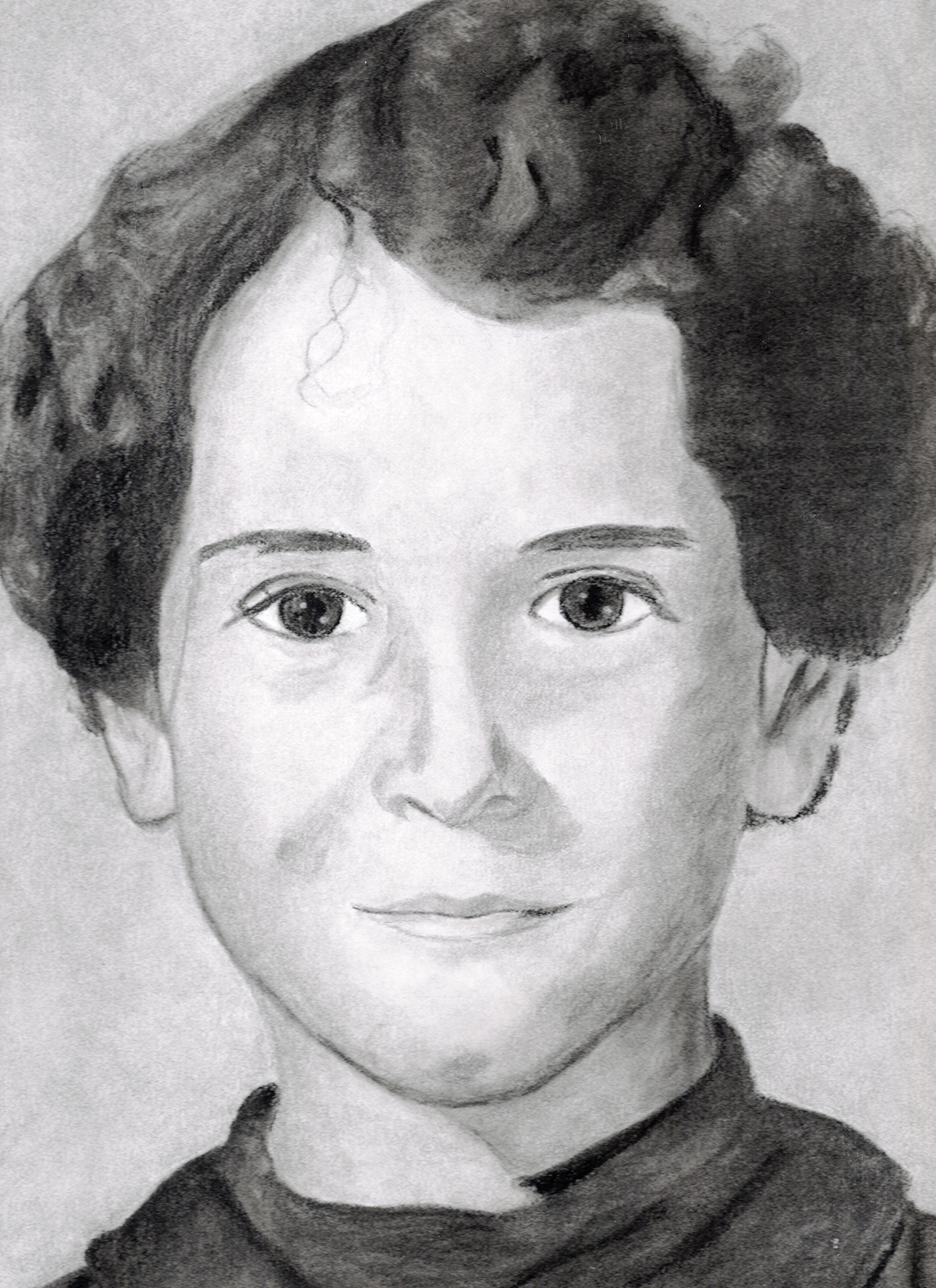
Drawing of Charlene Marie Richard by Mallory Louque, who currently is working in the Diocese of Knoxville as part of Notre Dame University’s Echo Program.
On the 30th anniversary of her death in 1989, a memorial Mass was celebrated on the grounds of St. Edward Church attended by an estimated 4,000 people. The event was covered by television stations throughout Louisiana and by CNN. Bishop Harry Flynn of the Diocese of Lafayette presided, saying during the Mass, “A little girl walked among us. She taught us how to accept disappointment and suffering.”
In January 2020, Diocese of Lafayette Bishop J. Douglas Deshotel officially opened her cause for beatification, granting her the title “Servant of God,” the first official step in the canonization process. This title signifies that the Church recognizes her life as worthy of serious investigation and that her cause for sainthood may proceed.
On Nov. 17, 2021, the U.S. Conference of Catholic Bishops voted to advance her cause, lending their full support to its progress, a significant milestone in recognizing her as a model of faith for the entire Church.
On Jan. 13, 2024, what would have been her 77th birthday, a ceremony at St. Edward Church officially closed the diocesan inquiry phase of the cause. Bishop Deshotel and a notary received the sworn oaths of all those involved, affirming they had honestly and diligently completed their investigation.
More than 1,000 pages of documents were then transported to Rome by Father Korey Lavergne, pastor of St. Edward Parish, and Father Taylor Reynolds, the episcopal delegate.
The Vatican has since accepted and approved the Diocese of Lafayette’s investigation. The Roman Postulator and the Dicastery for the Causes of Saints are now working to prove her heroic virtue. If declared Venerable, Church officials would then need to authenticate a miracle attributable to her intercession, after which she would be declared Blessed, which is the final step before full canonization as a saint of the Catholic Church.
And yet, when the moment of crisis came when she was given the most devastating news a child can receive, she did not turn inward. She turned outward. She prayed for others. She offered her pain as a gift. She trusted God completely.
Her brother, John Dale, perhaps captured it best when he said, “I always said she was the most extraordinary ordinary person I knew because Charlene loved everybody.”
The Church has not yet declared her a saint. But for the thousands who have knelt at her grave on Charlene Highway in Richard, La.—the sick, the desperate, the grieving, and the deeply grateful—she already is. And for readers of this column, her life offers a simple but profound invitation: holiness is not reserved for the remarkable. It is available to anyone willing to say, as a 12-year-old Cajun girl once said to her grandmother, “Then I will do my best.”
Charlene Marie Richard was not a mystic from a distant century or a martyr from a foreign land. She was a brown-eyed Cajun girl who loved basketball, rode horses through the bayou woods, picked cotton in the fields, sang in the church choir, and played Mass with her brother in the backyard. She was, by every account, beautifully ordinary.
Bee Goodman is a multimedia journalist for the Diocese of Knoxville who writes for The East Tennessee Catholic. She is a member of the Cathedral of the Most Sacred Heart of Jesus.