
Why people in East Tennessee are coming home to the Catholic Church
By Deacon Jim Bello
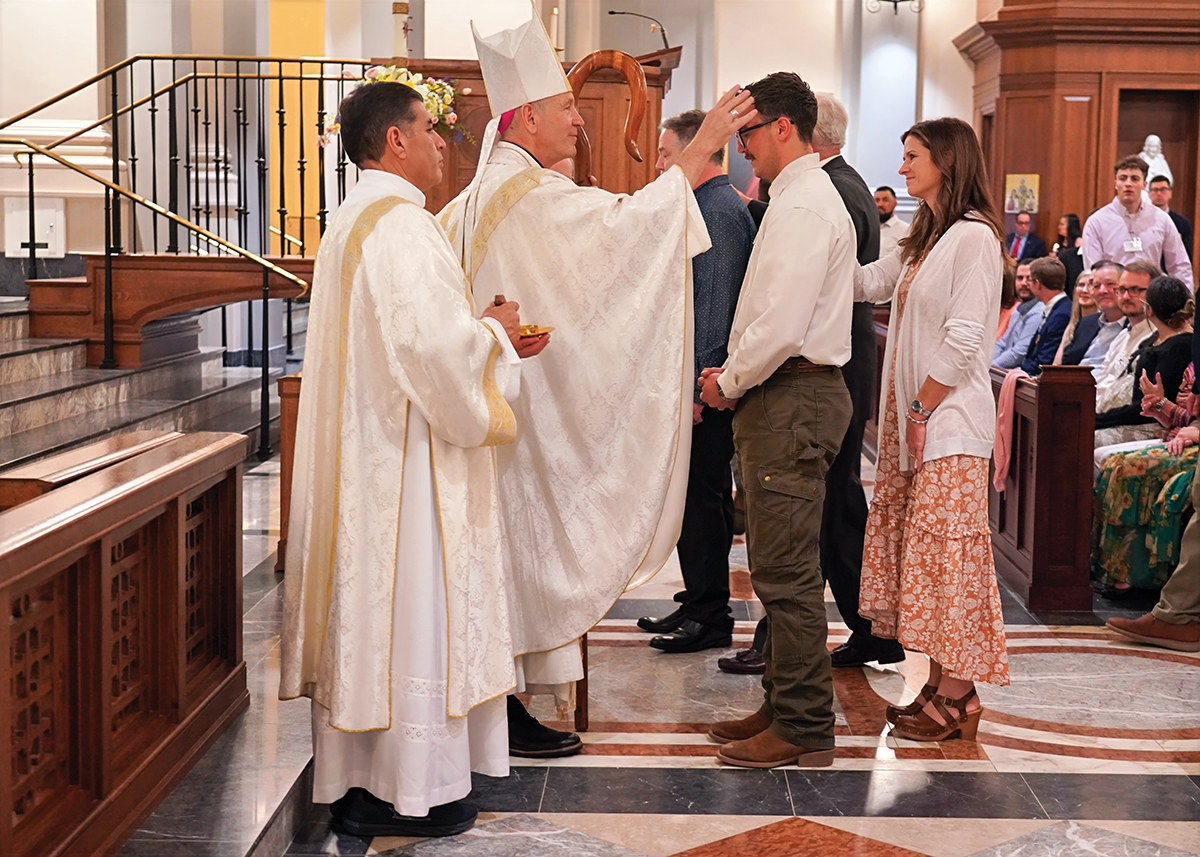
The Diocese of Knoxville welcomed nearly 1,100 adults into the Catholic Church during the 2025–26 catechetical cycle. The Rite of Election and Continuing Conversion, celebrated by Bishop Mark Beckman in February for those seeking full communion with the Church, drew a standing-room-only crowd at the Cathedral of the Most Sacred Heart of Jesus in Knoxville.
This momentum has been building for several years, not only in East Tennessee but also in dioceses across the United States and around the world. Even national secular news outlets have taken notice.
In a recent New York Times article, “Roman Catholic Church Sees a Surge of New Converts,” religion correspondent Elizabeth Dias reported that “people are joining the Roman Catholic Church in surprising numbers.” She cited dioceses anticipating their largest influx of new Catholics in decades, with some reporting year-over-year increases of more than 50 percent leading up to the 2026 Easter Vigil.
Reports from Catholic news organizations point to a similar pattern internationally. Highly secularized cities such as London and Paris are experiencing notable increases in those entering the Church, particularly among young adults between the ages of 18 and 35.
Conversations with directors of religious education and coordinators of the Order of Christian Initiation of Adults (formerly RCIA) throughout the Diocese of Knoxville reveal a similar sense of enthusiasm. Many describe the challenge of finding additional space and resources to accommodate growing numbers of inquirers and candidates. Several parish leaders report that inquiries for the 2026–27 catechetical cycle remain strong, suggesting that this movement continues to gain momentum in East Tennessee.
Parishioners across the diocese have noticed the growth as well. Some wonder whether the increase represents a temporary surge that will eventually level off. Others question whether departures from the faith remain significant enough to offset these gains. Both are reasonable questions, and the answers will become clearer in the years ahead.
For now, however, a more immediate question presents itself: Why are people coming to the Catholic Church, and how can we help form them into lifelong disciples of Jesus Christ?
Every journey to the faith is deeply personal. Each neophyte and candidate has a unique story, yet common themes continue to emerge. Among them are a search for truth, authentic relationships, and beauty. Increasingly, it appears that many seekers are discovering all three within the Church founded by Christ.
One such story belongs to Cara Dixon, a young woman who was received into full communion at the Easter Vigil in 2025 after spending most of her life worshiping in a Protestant denomination.
When asked what first attracted her to the Catholic Church, she recalled attending the marriage celebration of a couple in a Catholic church.
“I attended a Catholic wedding a couple of years ago,” she said, “and it suddenly became clear to me, as I stood in that beautiful church, that what my boyfriend had been telling me about the Real Presence of Christ in the Eucharist was true.”
She continued: “I had no doubt in those moments, as I looked toward that beautiful tabernacle, that Jesus was calling me to His Church. So, I began my OCIA journey, and here I am, more certain than ever that this is where I belong.”
Cara and her fiancé, Patrick, are preparing to celebrate the sacrament of matrimony at Holy Spirit Church in Soddy-Daisy later this month. She added that through her journey she has discovered a deeper relationship with Christ and a stronger sense of belonging within a faith community than she ever imagined possible.
In Cara’s story, truth, relationship, and beauty converged in a powerful way. Her journey began with a simple invitation to explore the Catholic faith and ultimately led her to the sacraments and a new life in Christ.
While personal invitations remain powerful, many converts today begin their journey online. Long before they enter an OCIA classroom or step into a parish, they encounter Catholicism through podcasts, videos, social media, and digital resources that present the faith in compelling and accessible ways.
Deacons, priests, and OCIA leaders throughout the diocese regularly share stories of young Christians, atheists, and even non-Christians whose interest in Catholicism began through podcasts, social media, online videos, or the writings of the early Church Fathers.
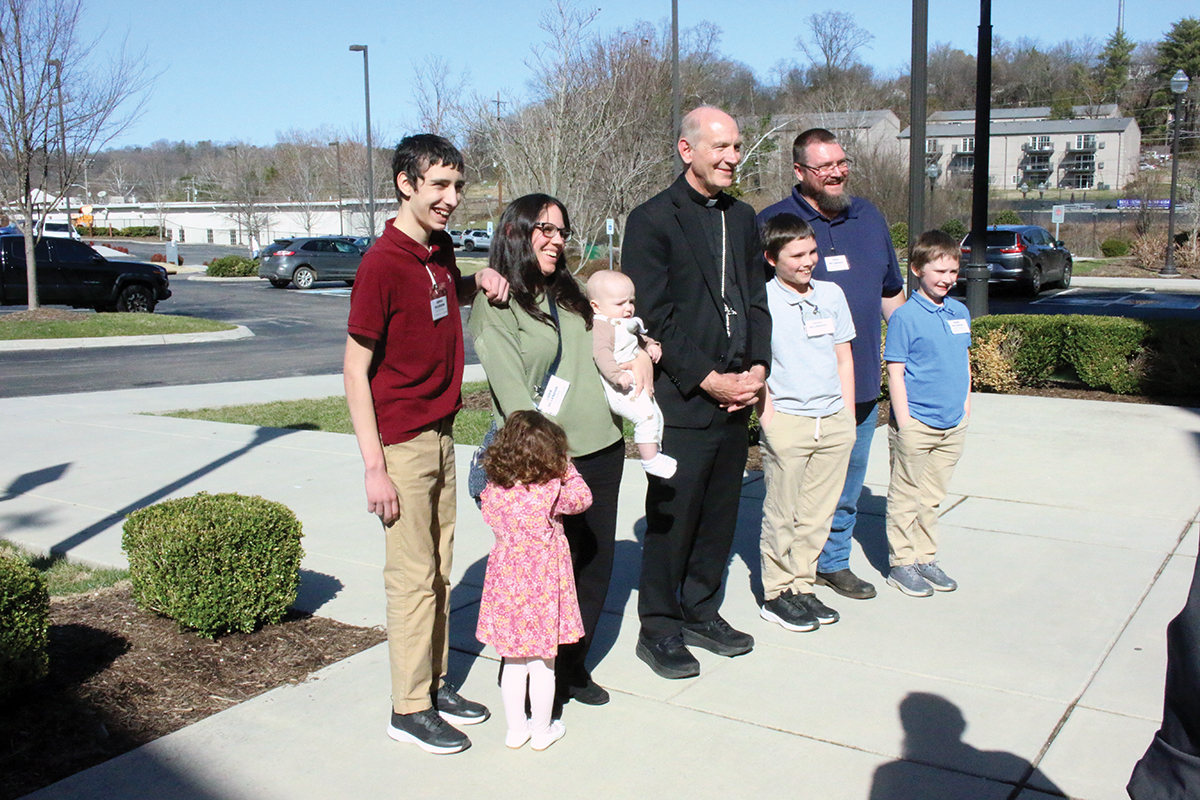
Bishop Mark Beckman joins a family entering the Church in East Tennessee for a photo following the Rite of Election on Feb. 21. (Photo Dan McWilliams)
One young man recently received into the Church in Knoxville described his surprise upon discovering that much of what he had been taught about Catholicism throughout his life was inaccurate. His perspective changed as he began studying the origins of Christian worship and recognized the connection between the Mass and the Last Supper.
Another convert explained that his decision to enter the Church solidified when he came to understand the Catholic Church’s role in preserving and canonizing sacred Scripture. He concluded that without sacred tradition, significant obstacles remained to fully understanding God’s revelation and plan for His children.
Catholics have become increasingly effective at using digital media not only to explain and defend the faith but also to showcase the beauty of sacred art, music, architecture, and liturgy. Through platforms such as Hallow, Catholic Answers, and many others, even non-Catholics are being introduced to the richness of Catholic life through faithful voices such as Father Mike Schmitz, Jimmy Akin, Jonathan Roumie, and countless others.
For Catholics, statistics and sociology can explain only part of the story. Ultimately, conversion is the work of the Holy Spirit.
As members of the body of Christ, however, we are invited to cooperate with that grace. Every authentic witness, every invitation, act of charity, or conversation about faith can become the means through which God draws someone to Himself. By living an authentic and unafraid Catholic life in our families, workplaces, and communities, we bear fruit for the Kingdom.
An invitation extended to a Protestant friend may be accepted. A computer screen displaying sacred art may spark a conversation about faith. A compassionate ear offered to a struggling family member may become the first step on a journey back to God.
As we welcome new Catholics into our parishes, we have an opportunity to build relationships that become the foundation for continuing formation and lifelong discipleship. “Make a friend, be a friend, bring a friend to Christ” has long been a guiding principle of the Cursillo movement. It may also be a catalyst for what we are experiencing today.
Behind every statistic is a person searching for meaning, truth, beauty, and relationship. Behind many of those stories is a Catholic who befriended, accompanied, and invited. The numbers tell us that something remarkable is happening. The stories remind us that conversion is ultimately not simply about statistics but a relationship with Jesus Christ.
Deacon Jim Bello serves at Holy Spirit Parish in Soddy-Daisy and also as director of Christian Formation for the Diocese of Knoxville.