
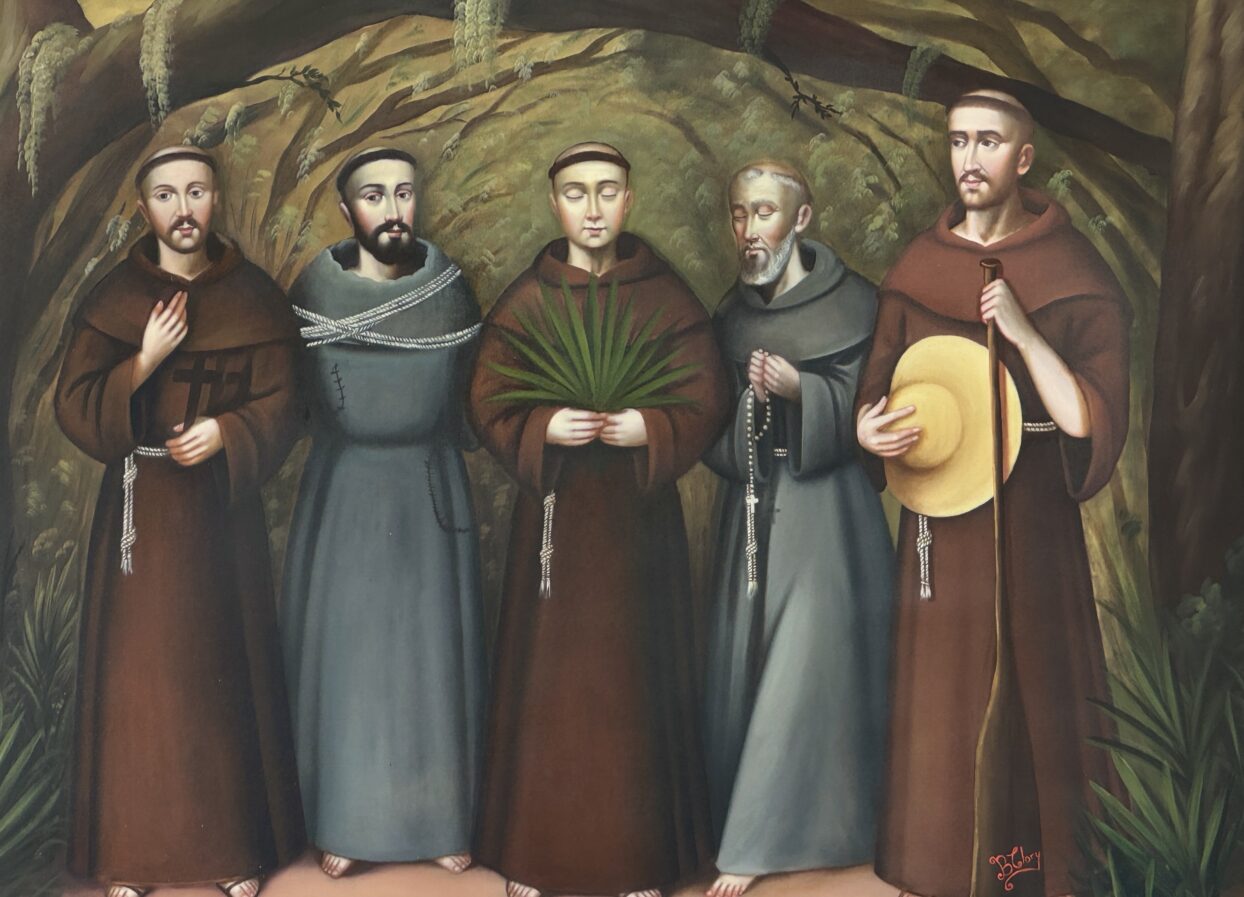
Oct. 31 beatification for five Georgia Martyrs is 429 years in the making
By Bee Goodman
On a Sunday morning in September 1597, a Franciscan priest on the Georgia coast was preparing to celebrate Mass. He never reached the altar.
Father Pedro de Corpa and four fellow Franciscans, Father Blas Rodríguez, Father Miguel de Añón, and Father Francisco de Veráscola Sáez de Castañiza, and Brother Antonio de Badajóz, will be declared Blessed 429 years later. The Diocese of Savannah on the coast of Georgia will celebrate the beatification Mass on Saturday, Oct. 31, at 11 a.m. at the Savannah Convention Center. Cardinal Frank Leo of Toronto will preside as papal legate, representing Pope Leo XIV.
It will be the first beatification in Georgia and the first in the American South. According to the diocese, it will also be only the sixth on American soil.
The Franciscans are known as the Georgia Martyrs. They were five ordinary missionaries who stayed when staying was dangerous.
Life on the mission
Long before Jamestown or Plymouth, Spanish Franciscans were serving along the Southeastern coast, working out of St. Augustine, Fla. The five friars were sent north to minister to the Guale, Native Americans whose towns lined what is now the Georgia shoreline.
Life there was hard. The friars lived as the Guale did, in huts of tree trunks, branches, and mud, thatched with palmetto fronds. They ate what they could gather or grow: acorns, shellfish, a little game. Even vestments for Mass were sometimes hard to come by. Mosquitoes, ticks, and sand gnats tormented them through the heat of the year, and the nearest Spanish soldiers were far away in St. Augustine.
Father Corpa, a skilled preacher and confessor, arrived in Florida in 1587 and was sent to the village of Tolomato, near present-day Darien, Ga. Father Blas arrived in 1590 and served at Tupiquí, near Eulonia, Ga. Father Miguel, who had been in Florida only two years, led the mission on St. Catherines Island, where Brother Antonio, who spoke the Guale language well, served as his interpreter.
Father Francisco, born into a Basque family in 1564, arrived in 1595. He was nicknamed the “Cantabrian Giant” for his size and strength, and his athleticism made him popular with Guale youth, who invited him to join their wrestling and spear-throwing, and a game that resembled soccer.
These were not distant figures. They were neighbors.
A promise broken
Among the hardest things the friars had to teach was the Church’s understanding of marriage: a lifelong union of one man and one woman. The Guale culture allowed polygamy. The friars’ practice was not to baptize an adult man unless he vowed to live in a permanent marriage with one wife.
Trouble came when a baptized Guale chief named Juanillo broke that promise and took a second wife. Father Corpa admonished him, and Father Blas, from the neighboring mission, supported the correction. Juanillo left in anger and gathered warriors to drive out the friars he saw as meddlesome.
Before dawn on Sunday, Sept. 14, the feast of the Exaltation of the Holy Cross, the war party crept into the mission compound at Tolomato. As Father Corpa was about to leave his cabin to celebrate morning Mass, they killed him.
A final homily
The war party then went to Tupiquí and seized Father Blas. During the two days he was held, he was allowed to celebrate Mass and preach one last time.
Father Blas told his captors, “My sons, for me it is not difficult to die.” He reminded them that every person must die someday and that all of us must be ready at all times. What truly grieved him, he said, was that they had been led to commit an offense against their Creator and had forgotten what the missionaries had done to teach them the way to eternal life.
He gave away his few possessions to the people of his flock. On Sept. 16, he was killed.
The next day, the war party reached St. Catherines Island, where the local chief refused to harm Father Miguel and Brother Antonio. He warned them and offered a canoe and rowers to take them to safety. Brother Antonio did not believe the warning, or perhaps he would not flee. When the war party arrived, the chief offered everything he owned to spare the friars. The offer was refused.
It was the feast of the Stigmata of St. Francis. Father Miguel celebrated Mass, and the Gospel of the day included Jesus’ words that whoever loses his life for His sake will find it. The friars spent hours in prayer. Then they were killed.
Father Francisco was the last. He was returning by canoe from St. Augustine with supplies for Mass, materials for his unfinished mission, and gifts for his Guale flock. He was killed on arrival, sometime before the end of the month. A sixth Franciscan, Francisco de Ávila, survived, and his account is among the sources historians rely on.
Why martyrs?
Soon after the fatal events, the friars of Florida saw it as martyrdom. A Franciscan report to King Philip III in 1612 said the friars were killed because of the law of God they taught and the moral precepts that clashed with Guale customs, especially their refusal to permit a married Christian more than one wife. According to that report, the Guale themselves gave this as the reason.
In January 2025, Pope Francis approved the decree declaring that the five were true martyrs, killed in odium fidei, a Latin phrase meaning “in hatred of the faith.”
Bishop Stephen D. Parkes of the Diocese of Savannah has emphasized the friars’ witness to the sanctity of marriage and has asked the faithful to seek their intercession for marriage and family life. The Franciscan friars of the Province of Our Lady of Guadalupe, who have worked with the diocese on the cause for decades, see a broader message for America: that the love of Christ is stronger than hatred, and that we are called to set aside violence and division.
The path to sainthood
The Church moves slowly in these matters, and the cause of the Georgia Martyrs has taken the better part of a century.
The Franciscans began promoting the cause for canonization in 1950. Changes to the Church’s process meant the formal investigation did not open until February 1984, when Bishop Raymond W. Lessard of Savannah launched the diocesan cause. After 23 years of work, the diocesan inquiry closed in 2007. Its official records, nearly 500 notarized pages, were carried by hand to Rome.
Then, on Jan. 27, 2025, came the decree that gave the five men the title venerable and cleared the way for beatification.
Martyrdom cases differ in one important way. The Church requires a miracle before beatification and two before full canonization, but miracles must be investigated through the Vatican. For recognized martyrs, that requirement is waived. A miracle will be needed, however, before any of the five can be canonized.
A Mass that outgrew its room
Organizers first planned for about 2,000 people to attend the beatification. Then registrations began arriving from across the country. The diocese has since reconfigured the space inside the convention center to hold roughly 12,000.
Attendance is free, though the diocese asks everyone planning to attend to register. Registration does not guarantee a particular seat. It helps organizers manage traffic and the distribution of Holy Communion, and gives them a way to send updates.
Some parishes that hoped to charter buses have told parishioners to make their own travel arrangements, and Savannah hotel rooms are expected to fill quickly.
The Oct. 31 date carries a double significance. Bishop Parkes has said it matters to Catholics in both the Diocese of Savannah and the Archdiocese of Atlanta. And the friars will be named Blessed in the same year the Church marks the 800th anniversary of the death of St. Francis of Assisi, who died in 1226.
Back to the coast
Away from the convention center, the preparation has been quieter and more personal.
Nativity of Our Lady Church in Darien, a designated pilgrimage site for the martyrs, sits near the coast where Father Corpa once served. Parishioners there have spent years telling visitors about a chapter of Georgia history that many residents never learned in school. One of those volunteers, Laura Daniel, plans to attend the Mass with her husband.
Bishop Parkes has called the beatification a new beginning, a chance for Georgia Catholics to learn more about the deep roots of their faith in the state and to ask for the martyrs’ prayers.
Five ordinary men
The Church has not yet declared them saints. But on the last day of October, after more than four centuries, they will be called Blessed, and thousands of people will gather in Savannah to say thank you.
Father Corpa never reached the altar that Sunday morning in 1597. On Oct. 31, thousands of Catholics will gather around one in his honor.
And for readers of this column, the friars’ story offers a simple but profound invitation: holiness is not reserved for the remarkable. It is available to anyone willing to stay, again and again, for the people they have been sent to serve, and to be ready, as Father Blas told his captors, at all times.
They came from Spain as friars, teachers, and neighbors. They will be remembered in Georgia as Blessed.
[Top photo: This oil on canvas of the five Georgia Martyrs titled “Faith breaks language barriers of the five martyrs” was created in 2021 by artist Clorinda Galdós Bell.]
Bee Goodman is a multimedia journalist for the Diocese of Knoxville who writes for The East Tennessee Catholic. She is a member of the Cathedral of the Most Sacred Heart of Jesus.