

Religious Sisters of Mercy of Alma launch campaign to expand home base
By Bill Brewer
The Religious Sisters of Mercy of Alma have a problem. And as problems go, it’s a wonderful one to have. But it’s still a problem, nevertheless.
The Michigan-based religious order, which has an East Tennessee convent with Sisters who serve in the Diocese of Knoxville, is seeing a spike in vocations as more young women profess vows as a Mercy Sister.
That growth in turn has put a real squeeze on space at the Alma, Mich., motherhouse, where the order’s 120-plus Sisters are no longer able to join together at one time.
“A motherhouse is a place of formation for Sisters beginning their religious life, but also a true home for Sisters sent out on mission. It is the place to be rejuvenated, to be reformed, and to be re-energized in one’s vocation. Finally, it is also the place where Sisters prepare to meet their spouse, Jesus Christ, at the end of their lives,” explained Sister Gianna Marie Savidge.
Sister Gianna Marie and Sister Claudia Marie Murray, Religious Sisters of Mercy who provide health care to those in need in East Tennessee with the St. Mary’s Legacy Clinic, shared that because of space limitations the Sisters in the Diocese of Knoxville were unable to assemble at the motherhouse over the summer with their Sisters serving around the United States and outside the country as they typically do. And they will once again remain in Knoxville during Christmas next month because there is no “room at the inn” at the motherhouse.
Sister Gianna Marie, who is medical director for the mobile medical clinic, and Sister Claudia Marie, who is the clinic’s nurse supervisor, are sharing the order’s detailed plans for expansion in Alma.
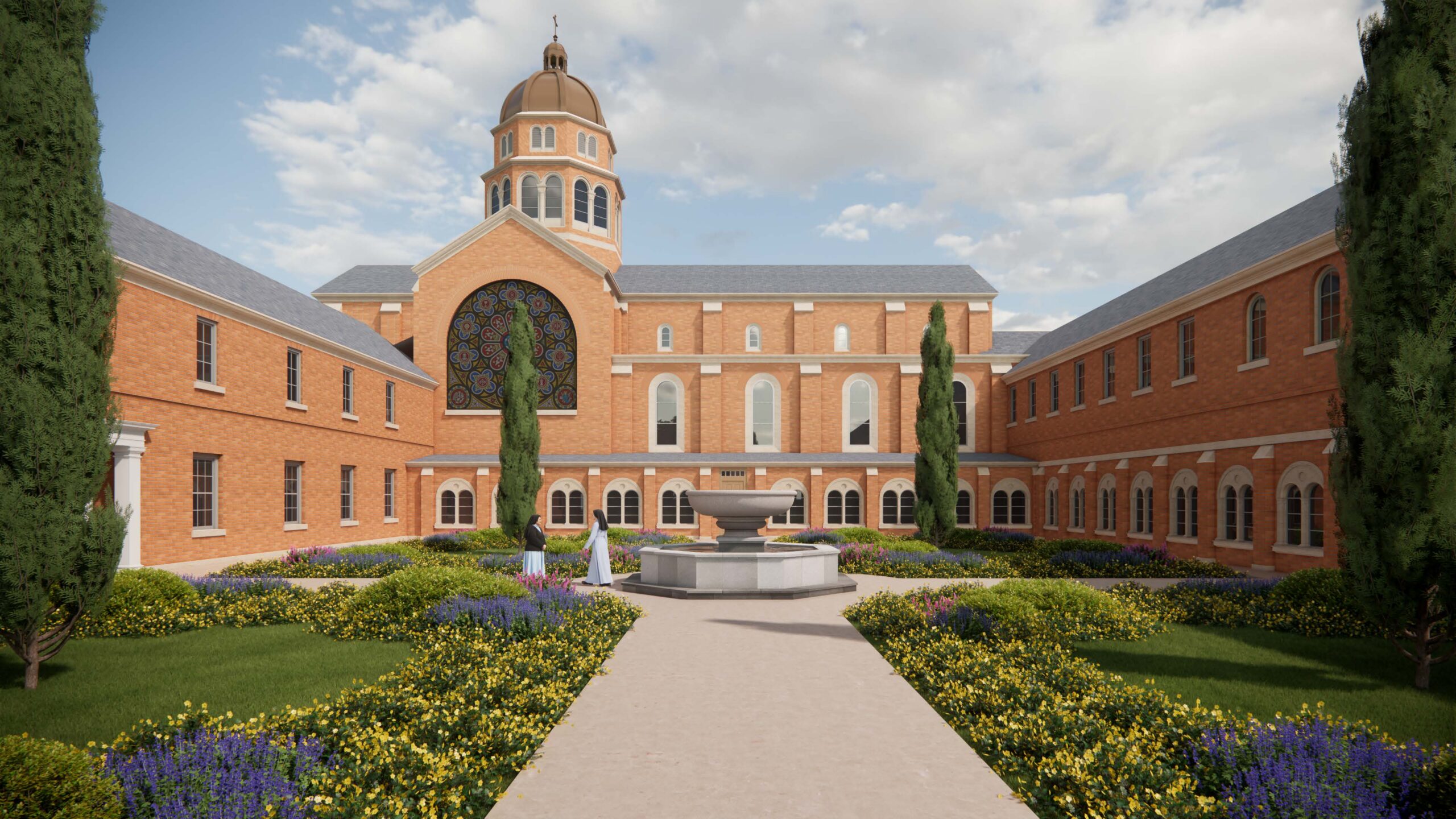
A design rendering shows what the upgraded motherhouse for the Religious Sisters of Mercy of Alma will look like. Architect Nicolas Charbonneau with Harrison Design has designed the Motherhouse Building Project, with plans to break ground in 2027 when fundraising is completed. (Photo courtesy of the Religious Sisters of Mercy of Alma)
A fundraising campaign currently is underway to help cover the cost of the project, which will involve a larger chapel to accommodate all of the Sisters, an infirmary to care for aging Sisters, a larger formation house for first-year discerners who are in the formation stage of postulancy, and more individual rooms for the congregation so that every Sister can stay at the motherhouse at one time.
According to the religious order, which was founded in 1973, “We have outgrown our capacity to welcome all of our Sisters home to the motherhouse at one time. Union and charity among our Sisters is inseparable from our service in Mercy, and it is important to our identity as a religious institute to be able come together as a corporate body for retreats and important celebrations.”
Sister Gianna Marie pointed out that presently the order’s chapel in Alma can hold 60 to 70 Sisters comfortably, with the ability to increase that to a maximum of 80 if needed.
“Common liturgical prayer is the lifeblood of a religious community. In worshiping the Triune God, we become the community we are called to be. This worship serves the ‘life and holiness of the Church,’” Sister Gianna Marie said, referring to the Pope St. Paul VI document Lumen gentium. “The necessity for this project comes out of having an increased number of vocations of women entering our community and then also Sisters who are aging. And right now, we’re seeing a need for Sisters who are elderly or infirm residing in most of our convents across the United States.”
Many, if not most, religious orders are structured so that aging members can live in the same facility, where there is a continuum of community and care. As it is now, there are few older Sisters residing at the motherhouse while others are being cared for at RSM convents outside of Alma, including the one in Knoxville.
“There does come a time when it’s difficult for a local community to continue that if the care becomes heavy. At that point, our Sisters are usually kind of split between apostolic work (like the mobile clinic work we do in the Diocese of Knoxville) and caring for the infirm Sisters in the convent. As this situation is becoming very common throughout our institute, we have realized that it is ultimately better for our community to have an infirmary in Alma where we can care for our elderly Sisters as a group and involve our younger Sisters who are in formation. Our postulants and novices learn how to become nurses and care for the elderly because this is an integral part of who the Religious Sisters of Mercy are,” Sister Gianna Marie said.
The charism embraced by the Religious Sisters of Mercy of Alma is union and charity, entrusted to them by their foundress, Venerable Mother Catherine McAuley. That mercy extends to caring for the poor, sick, and ignorant, which is why many of the Sisters are health-care professionals and educators.
“We have many Sisters who are physicians and nurses. We just lack the physical space to be able to do that safely and effectively. Our current infirmary is a makeshift situation, with three Sisters who are infirm and two to three Sisters who serve as nurses living with those older Sisters. They already are over capacity for the space that they have,” Sister Claudia Marie said.
“And we want those who are infirm to be able to go to a place that is going to be its own local community and have that sense of continuity of how they’ve lived their religious life up until that point. They’re going to be able to continue to do that where they can all have their meals together, pray together, and join at the motherhouse for meals and prayers as well. And then to have the opportunity for the Sisters who are young in formation to learn from that wisdom and have that historical perspective passed down to them from the older Sisters. Also, for the older Sisters to be reinvigorated by the zeal of the younger ones. They can learn from each other,” she added.
As a Sister who in recent months arrived at the Diocese of Knoxville convent from Alma, Sister Claudia Marie said it has been a privilege to spend time with the infirm Sisters.
“As one who has recently come from the motherhouse, I know that early basic formation is a privileged time to get to know and care for our infirm Sisters. I was already trained as a nurse and so I knew some of the practical skills involved in nursing. But learning how to care for ‘one’s own’ was a different experience: it was a beautiful expression of our charism of union and charity as Mercy Sisters. We’ve done this since the beginning, since the 1830s. Mother Catherine McAuley, our foundress, who is now venerable, spent much of her life, even prior to the founding of the Sisters of Mercy, caring for family members, friends, and loved ones without ever having any nursing training. She learned from those around her and learned by her own experience but knew that she saw Christ in all of those who she was caring for,” Sister Claudia Marie said.
Sister Gianna Marie noted that there is a certain joy for the Sisters in returning to the Alma motherhouse no matter what age, and the growing, thriving religious order will continue to be a blessing to the Church and its faithful.

The Religious Sisters of Mercy of Alma are pictured in this Aug. 16 photograph on the steps of the Cathedral of Mary of the Assumption in Saginaw, Mich., with Bishop Robert D. Gruss and Bishop John O. Barres. (Photo courtesy of the Religious Sisters of Mercy of Alma)
“There is the joy of having the younger Sisters around, the joy of being able to be of service in carrying on the tradition of mercy by imparting something to the new generation. So, I think there’s a whole dynamic that will evolve as we’re able to build this out. And that will be life-giving for the whole Church, really, because as we form a new generation of young Sisters, we’re not just forming our own because those Sisters are going to go out and form other young people. They’re going to form them in schools; they’re going to form mothers; they’re going to be involved in women’s groups, and going to have an impact on the Church globally. And so, you’re imparting something to a new generation of religious that is really life-giving for the whole of the Church,” Sister Gianna Marie said.
That joy and excitement about the growth and bright future for the order is carrying over to the building project.
“We’re excited about this project. It’s a big project, an expensive project, too, and it’s not something that we’ve ever done before or anticipate doing in the future in the next 100 years. It’s something that is foreign to us in the sense that we don’t usually fundraise. Our livelihood comes from the stipends that we make as Sisters, and we strive to live off that with some donations although we usually exceed our income. But this project takes us way beyond our means financially. And so, we’re looking at a project that’s in the range of $35 million to $40 million to be able to build the chapel, infirmary, new bedrooms, and improve the structure that’s already in place,” Sister Gianna Marie said.
Sister Gianna Marie explained that architect Nicolas Charbonneau with the Harrison Design firm has designed a project that will maximize savings by using as much of the existing motherhouse as possible but still upgrade the facility to meet the Sisters’ needs. She emphasized that the architect has come up with a simple design to reduce building costs.
“We feel that we’ve done the best job in a responsible way to cut down costs while preserving a sense of beauty, which we want to have because of the nature of religious life. Religious life points to a heavenly reality. And we want whatever we build to be not just functional but also beautiful, and to draw people into the beauty of our life and into the beauty of God, ultimately,” she noted, adding that the chapel will be called Mary Mother of Mercy Chapel.
The present footprint of the motherhouse at 1965 Michigan Ave. in Alma includes the Our Lady of Grace Education Center, which was converted from a car dealership about 20 years ago. When this meeting space opened, it was in addition to worship and living space for a small congregation of women religious that would hopefully grow.
Sister Gianna Marie and Sister Claudia Marie highlight that the newly designed motherhouse reflects the tradition of the Religious Sisters of Mercy, when Venerable Mother Catherine McAuley made it a point to call the original Dublin, Ireland, convent a “Home of Mercy.”
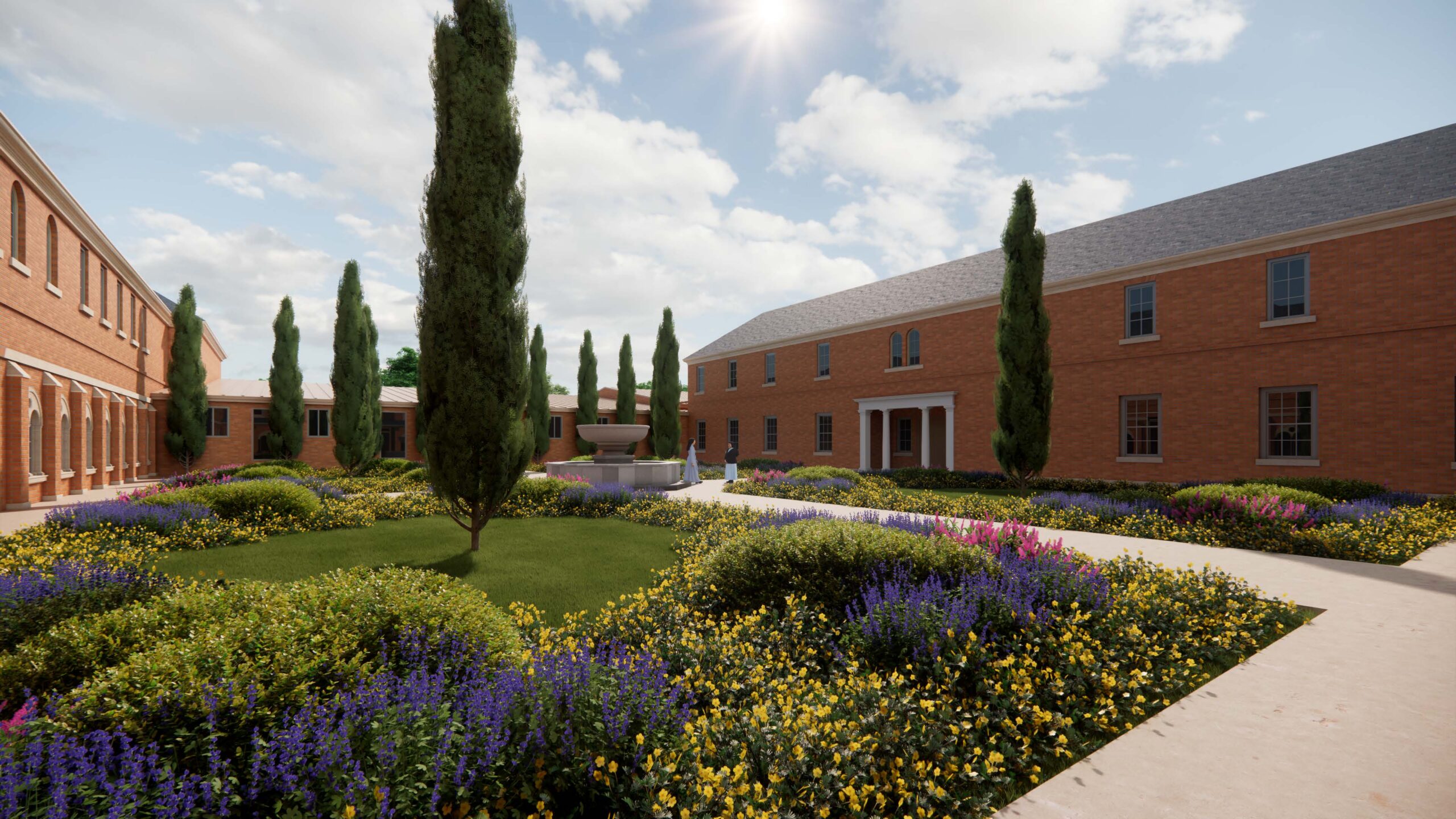
An exterior design rendering of renovations planned for the Religious Sisters of Mercy motherhouse in Alma, Mich. (Courtesy of the Religious Sisters of Mercy of Alma)
Mother Catherine McAuley wanted the early Sisters to live in a home setting rather than a place with an institutional setting.
“We traditionally live in a home setting to foster community life as the wellspring from which our service flows. Part of the reason for the beauty of it is like that tradition and mercy of having it be a warm home environment to welcome the Sisters, but also to welcome those in need,” Sister Claudia Marie said.
“You can see that the convent that Mother Catherine originally built in Dublin in 1827 in Ireland looked similar to what we’re seeking to build. Our design actually mirrors the simple brick home where she housed women whom she took in off the street to educate them, and then children also. She had a school there to educate them,” Sister Gianna Marie added.
As part of the current expansion process, Mother Mary Christa Nutt, superior general of the Religious Sisters of Mercy of Alma, and the Sisters must consider future as well as present needs. Sister Gianna Marie said the key is to plan for growth but not over-plan, which can drive up costs.
“We actually can’t physically be in the same space and pray together when we are at the motherhouse together. We have to go up at separate times or some local communities have to stay back and not come to the motherhouse because there just isn’t enough physical space, not only in the chapel but also with the bedrooms and other spaces. In building the new chapel, we’re looking at building it so that there is room for growth. We’re looking at having enough space for 200 Sisters, not 500 Sisters,” Sister Gianna Marie said.
“We’re building it based on the growth rates that we’ve had in the history of our 53 years of being an institute. We’re a little over 120 Sisters now. So, we’re building to be able to grow into it but also recognizing that we’re a slow, steady-growing community, not a rapidly growing group. The size of the chapel is going to reflect that,” she noted.
Sister Gianna Marie and Sister Claudia Marie are encouraged that fundraising for the Motherhouse Building Project is going well and response has been positive. But there still is need, and the Sisters will not proceed with the much-needed project until there are firm pledges for the entire cost of the project.
“We have about half pledged at this point. So, we’re still in need of about $20 million. We’re still hopeful that the remaining amount will be able to be raised by the spring of 2027 or at least the summer of 2027,” Sister Gianna Marie said.
She noted that there are several options available to donors to give to the project and that no donation is too small. There also are naming opportunities available so that a donor who is able to give a generous, sacrificial donation will have the opportunity to have part of the project named for them or a loved one, such as a choir stall or a bedroom.
“Know that the Sisters will be praying in gratitude for that intention through the year,” Sister Gianna Marie shared.
Anyone interested in donating to the Religious Sisters of Mercy of Alma Motherhouse Building Project can contact Sister Gianna Marie at knoxville@alma.org. For more information on the building project, go to www.almamercy.org/building-project.