
Diocesan Care of Creation Commission gathers down on deacon’s farm
By Brett McLaughlin
“In the end, we will conserve only what we love; we will love only what we understand; and we will understand only what we are taught.” – Baba Dioum
Deacon Chad Shields is not your average farmer. He wishes he was.
That’s because the deacon of Christ the King Parish in Tazewell believes the work he and his family do on their nearby farm is an extension of their Catholic faith.
On May 2, the Shields family hosted some 50 people at a From Liturgy to Land eco-farm retreat at their Six Stone Jars Farm in Claiborne County. Among those attending were several members of the Care of Creation Commission appointed by Bishop Mark Beckman in June 2025.
“How better to advocate for creation than getting out in it,” Deacon Shields said, adding, “Interaction with creation is part of our faith tradition … a continuation of our liturgy, not something that can be parceled out.”
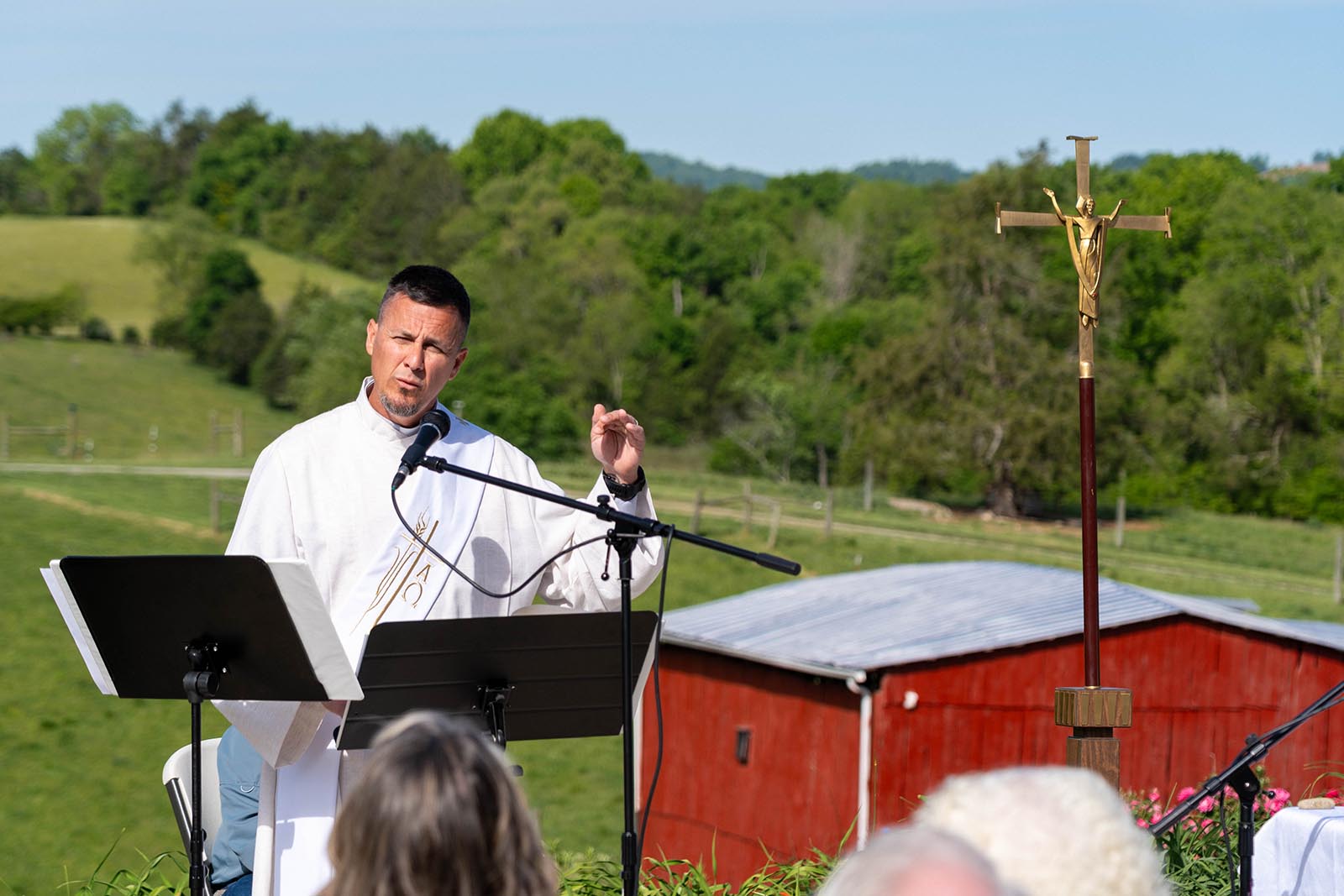
Deacon Shields gives the homily during the May 2 Care of Creation retreat Mass. (Photo John Mecklenborg)
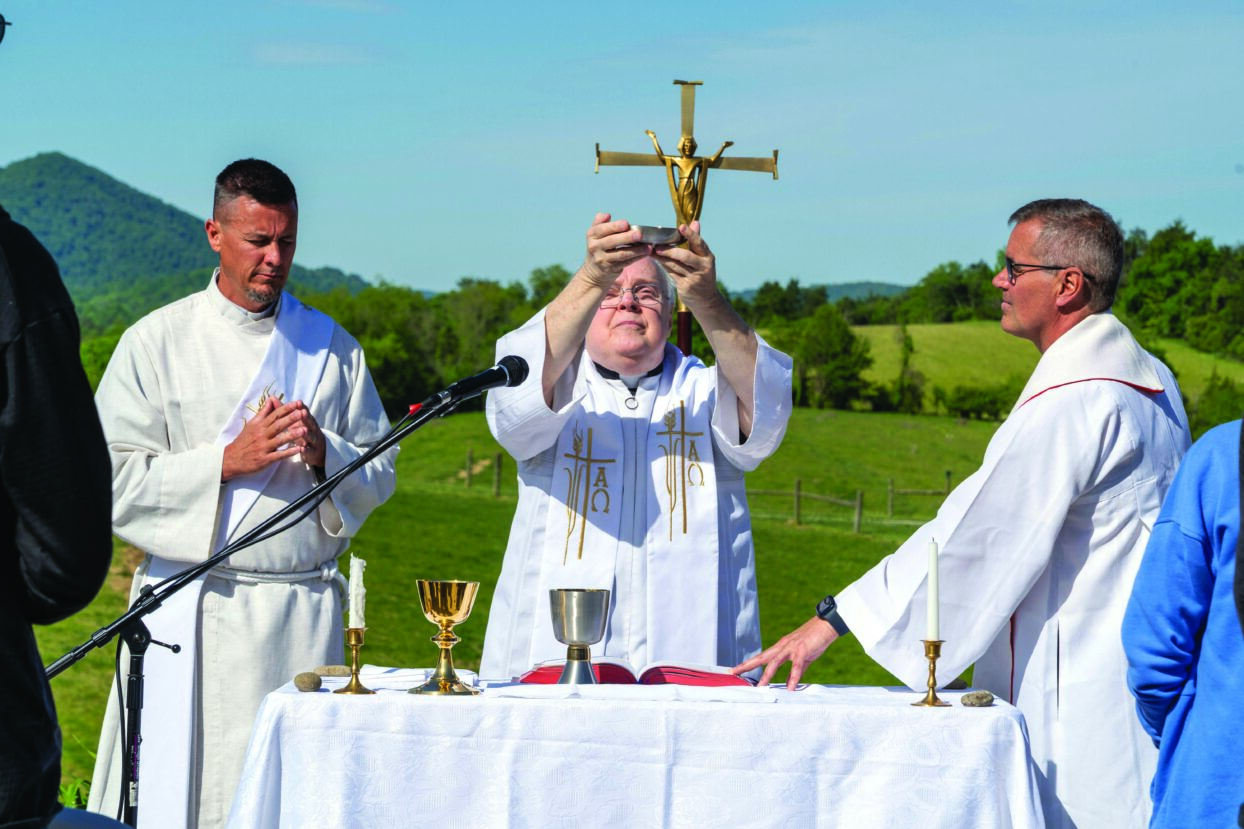
The event began with an outdoor Mass overlooking the pastoral farm. Concelebrants were Christ the King pastor Father Sam Sturm and Father Peter Iorio of Our Lady of Fatima Parish in Alcoa.
Attendees then toured the farm, making stops to admire pasture animals, garden and pond spaces, and a bit of the farm’s woodlot. At each stop Deacon Shields offered a reflection that focused on ecological education and how faith and family life can model stewardship in practical, tangible ways.
Having shed his vestments and looking every bit a farmer, Deacon Shields first greeted his guests at the pasture entrance after calling in the cattle, including several newborn calves.
“On a good day, you don’t push cattle—you call them. And if you’ve done the work well, they’re already waiting at the gate,” he said, noting the contrast between “pushing,” which equals noise, pressure, fear, and urgency, and “pulling,” which equates to trust, desire, familiarity, and expectation.
“Animals don’t have to be forced when things are healthy. They learn the voice, the rhythm, the gate. They anticipate the move. They want the next pasture,” he continued, noting that in his Gospel, John says, “The sheep hear his voice … he calls his own sheep by name and leads them … and the sheep follow him, for they know his voice.”
“This is not incidental imagery. It’s revelatory. Jesus does not describe Himself as one who drives—but one who draws. God does not primarily convert by pressure. He converts by attraction, beauty, and love. The Christian life is not meant to be managed by fear but by desire rightly formed.
“People are rarely argued into the Kingdom,” Deacon Shields said. “But they are often drawn by a life that looks like it has found good pasture. Daily prayer, week ly Mass, and liturgical seasons are not obligations to ‘push’ us; they are rhythms that train the heart to recognize the Shepherd’s voice.”
Moving on to the edge of the farm’s woodlot, the deacon described what he called “the edges” as the most biodiverse and resilient areas, where there is abundant life and where two environments come together.
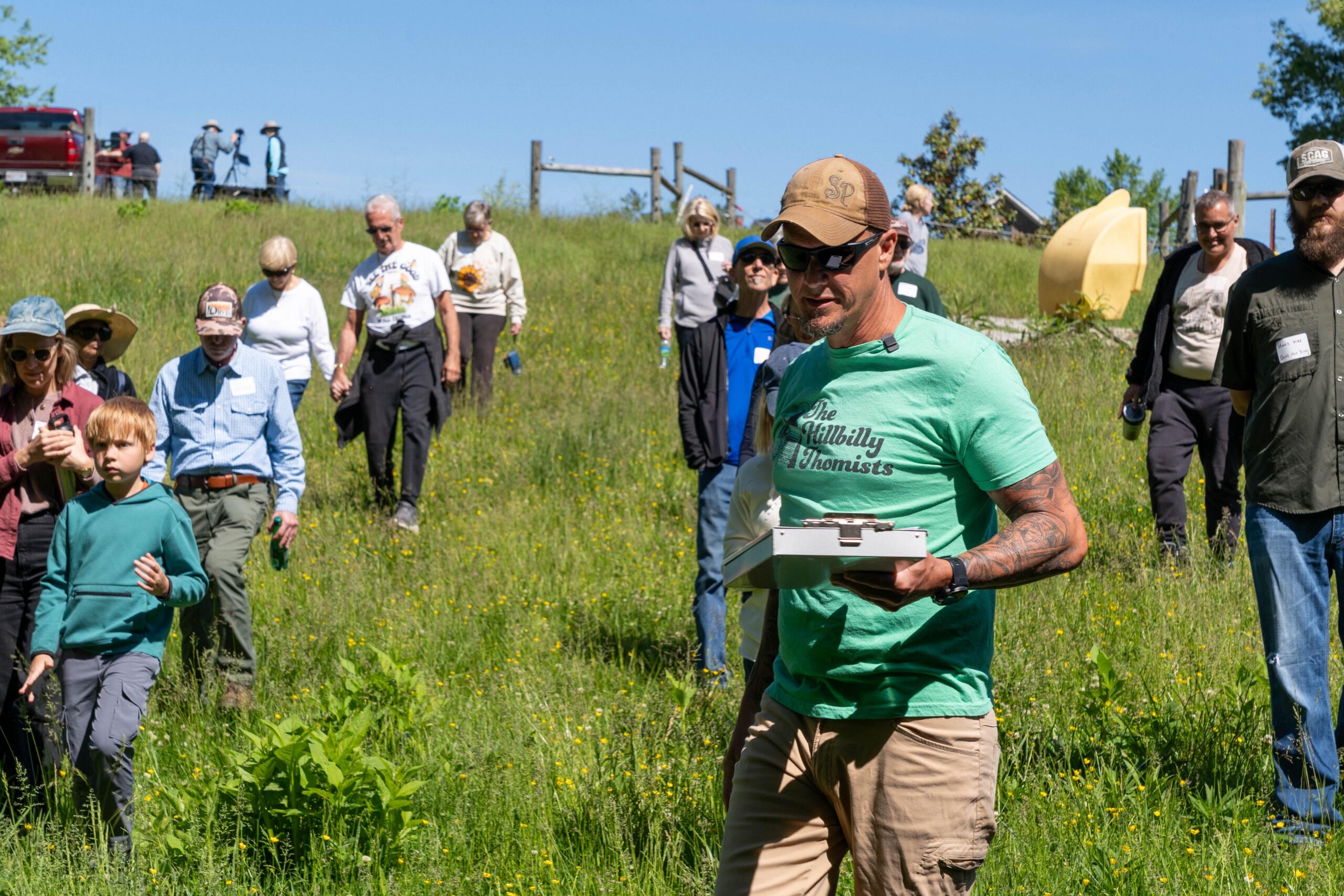
Deacon and farmer Chad Shields leads a group of adults and children on a tour of his Claiborne County farm as he offers Scripture-based teaching on caring for the environment created by God. The group was taking part in the From Liturgy to Land eco-farm retreat at the Shields’ Six Stone Jars Farm on May 2. (Photo John Mecklenborg)
Offering examples of riverbanks, where forests meet fields, and of coral reefs in the ocean, he said, “Liturgy is an edge; not just symbolic but real. It is where heaven and earth come together in the Mass, where heaven and earth overlap, where time and eternity touch, and where the visible and invisible meet. What you see in the bread, wine, people, and place becomes the meeting point of what you cannot see, the grace, the communion of saints, and Christ’s sacrifice.”
At its best, he said, the Church lives on the edge—not rigid, not formless, but alive.
“Christian life always happens at the boundary, where something is being given up and something new is emerging,” he said as attendees moved through the woodlot and then emerged overlooking a pasture in which some 40 newborn lambs bounded along and chased their mothers.
During a final stop, Deacon/farmer Shields discussed the growing of grass.
“You don’t grow grass by grazing it. Grass doesn’t grow because animals eat. It grows because it is given time to rest,” he explained, drawing the spiritual parallel, “Where am I ‘overgrazing’ my own life: constant output, no recovery? Do I treat rest as unproductive, or as essential for fruitfulness?”
Spiritual root growth, he suggested, happens with prayer, silence, and Scripture while busyness without depth results in greenness for a moment and then collapses.
“Left alone, animals overgraze their favorite spots. A good farmer moves them for the good of both land and animal,” the deacon and farmer pointed out. “The Shepherd leads me not just to feed me—but to protect what feeds me … rest is where God restores what only He can grow.”
Deacon Shields, who moved to Tennessee in 2013 after leaving active-duty service with the U.S. Army, was ordained a permanent deacon in the Diocese of Knoxville in June 2022.
He will be one of three speakers making brief presentations on Laudato Si’ and ecological spirituality at 5 p.m. on Wednesday, May 27, at All Saints Church in Knoxville.
Bishop Beckman and priests of the diocese will then celebrate a Mass marking the anniversary of Pope Francis’ 2015 encyclical. A reception will follow in the parish hall.
Bishop Beckman created the Care of Creation Commission as a response to the urgent care needed by people of faith for God’s creation.
The Commission’s website, dioknox.org/care-of-creation, is grounded in the seven goals of Laudato Si’ and is designed to serve as a resource for the formation of Creation Care Teams in all parishes throughout the Diocese of Knoxville.
“Today (was) not just about farming—it (was) about seeing creation through the lens of the Church. (The day provided an opportunity) for the faithful to see how the grace of the liturgy extends into daily life—especially through stewardship of the land, care for creation, and a sacramental vision of the world,” Deacon Shields said.