
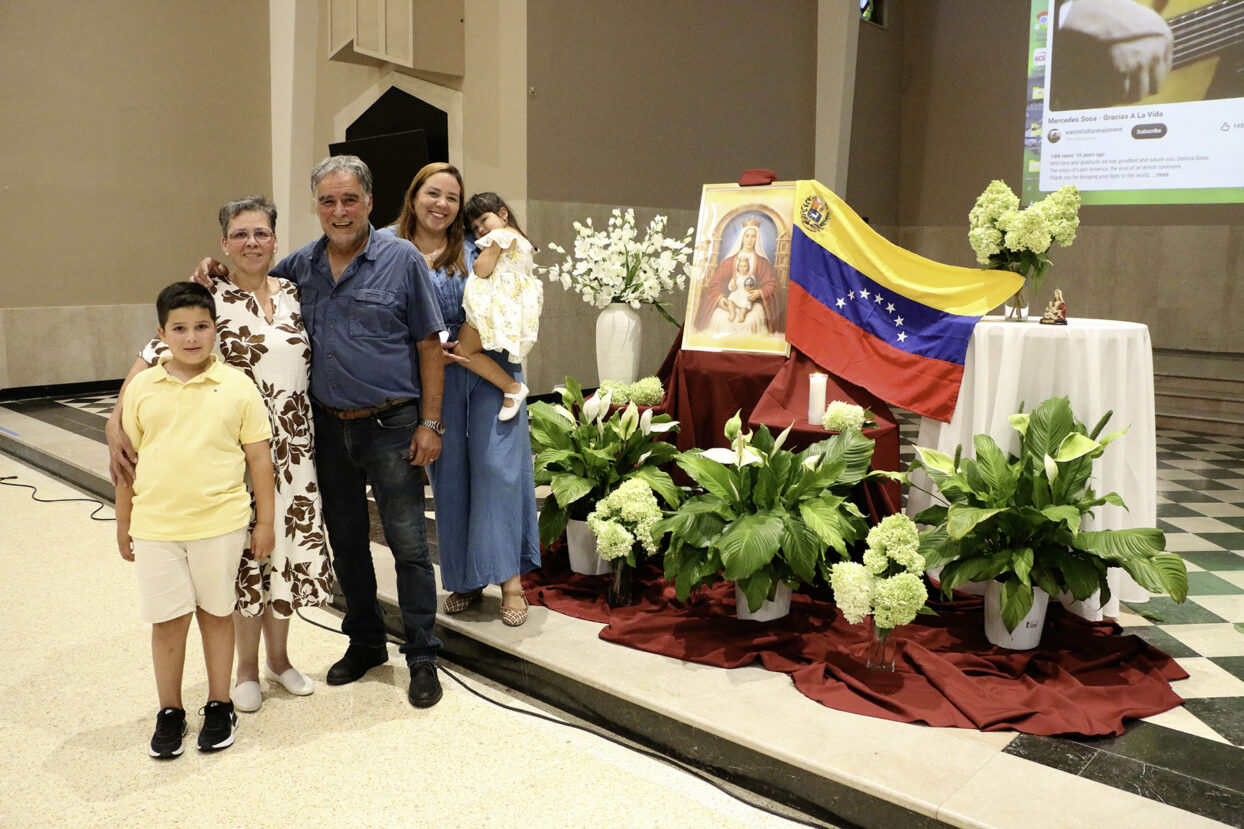
The devastating earthquakes in June impacted the family of diocesan seminarian Abrahan Da Silva
By Bill Brewer
A special Mass for Venezuela celebrated on July 8 at the Cathedral of the Most Sacred Heart of Jesus was especially poignant for Antonio Da Silva and his wife, Yazmin Vidao, who are natives of the South American country that was devastated by earthquakes on June 24.
The couple, who live in Knoxville and whose son, Abrahan Da Silva, is preparing for ordination to the transitional diaconate for the Diocese of Knoxville and is to be ordained a priest next year, have family in harm’s way.
Mr. Da Silva and Mrs. Vidao said after the Mass that family members were killed while either rescuing victims or trying to escape following the 7.2- and 7.5-magnitude earthquakes that struck the Venezuelan coastal area surrounding the capital of Caracas. And many of their relatives lost their homes and all their personal possessions.
The devastation compounds the distress of a country already in crisis, beset by economic struggles, an infrastructure that continues to be overwhelmed, and an ongoing political and human rights state of emergency.
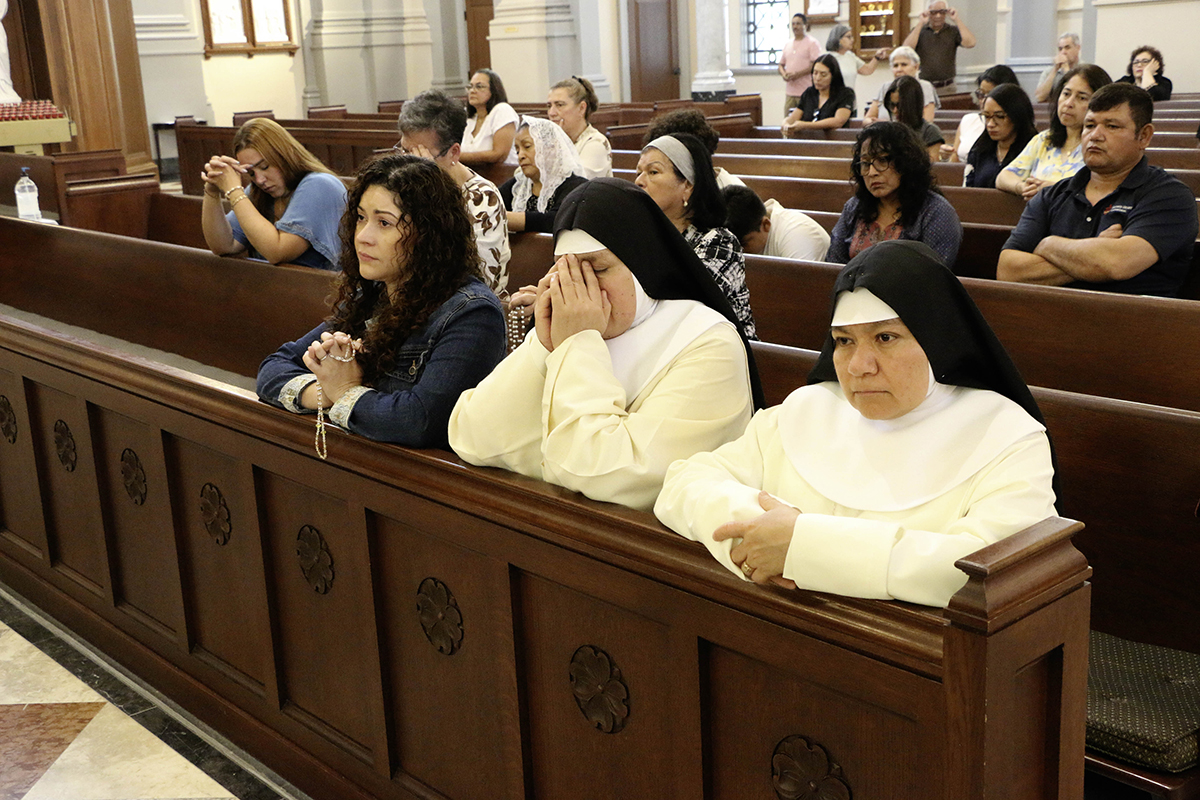
Religious Sisters and members of the Diocese of Knoxville faith community gather for adoration and to pray the rosary before the Mass for Venezuela at Sacred Heart Cathedral on July 8. (Photo Bill Brewer)
The cathedral Mass was held in solidarity and support for the people of Venezuela and those from that country who are now in the Diocese of Knoxville. Father Diego Rivera, an associate pastor at the cathedral, was the principal celebrant, with cathedral rector Father Michael Cummins and associate pastor Father Danny Herman concelebrating. Deacon Fredy Vargas served as deacon of the Word and altar.
And Mr. Da Silva, who currently is in formation to be a permanent deacon for the diocese, was an altar server for the Mass, which was attended by many parishioners of the diocese.
The Diocese of Knoxville’s Office of Hispanic Ministry helped to organize the Mass and with the cathedral co-sponsored a reception afterward, where those attending he Mass shared a meal together and words of encouragement and testimonies.
In his homily, Father Rivera juxtaposed the elation much of the world is feeling about the World Cup and all the international soccer competitions occurring throughout America with the devastation and suffering Venezuela is experiencing.
He called on the community to follow the example of Christ, take on the attitude of the Christian, and offer compassion, understand the suffering taking place, and “be the merciful face of Christ” as the world comes to Venezuela’s aid.
“We have found ourselves with a feeling of pain because of our brothers and sisters who have suffered and experienced the terrible situation of the earthquake, from which many families were destroyed. Many people were left alone,” Father Rivera said. “There were many deaths. And it changed the story of everyone in an unexpected way. When we saw on the television screens the reality of the tragedy that took place in Venezuela, I would say that most of us had a feeling of astonishment and sadness for seeing the suffering that those people were going through.”
“But personally, a reality caught my attention. While the Venezuelan people took their dead out of the rubble, while many mothers and fathers mourned the loss and absence of loved ones, and many others were facing the uncertainty of not having or not finding the people who were missing on the other side of the world, on those same screens, everyone was celebrating the World Cup. What a contradiction. It was the pain of one country and the euphoria and joy of another…. It was the feeling of astonishment for the anguish of what was happening and the insensitivity and oblivion of others. Because of the emotion of sport, we forgot the tragedy of our brothers and sisters,” he added.
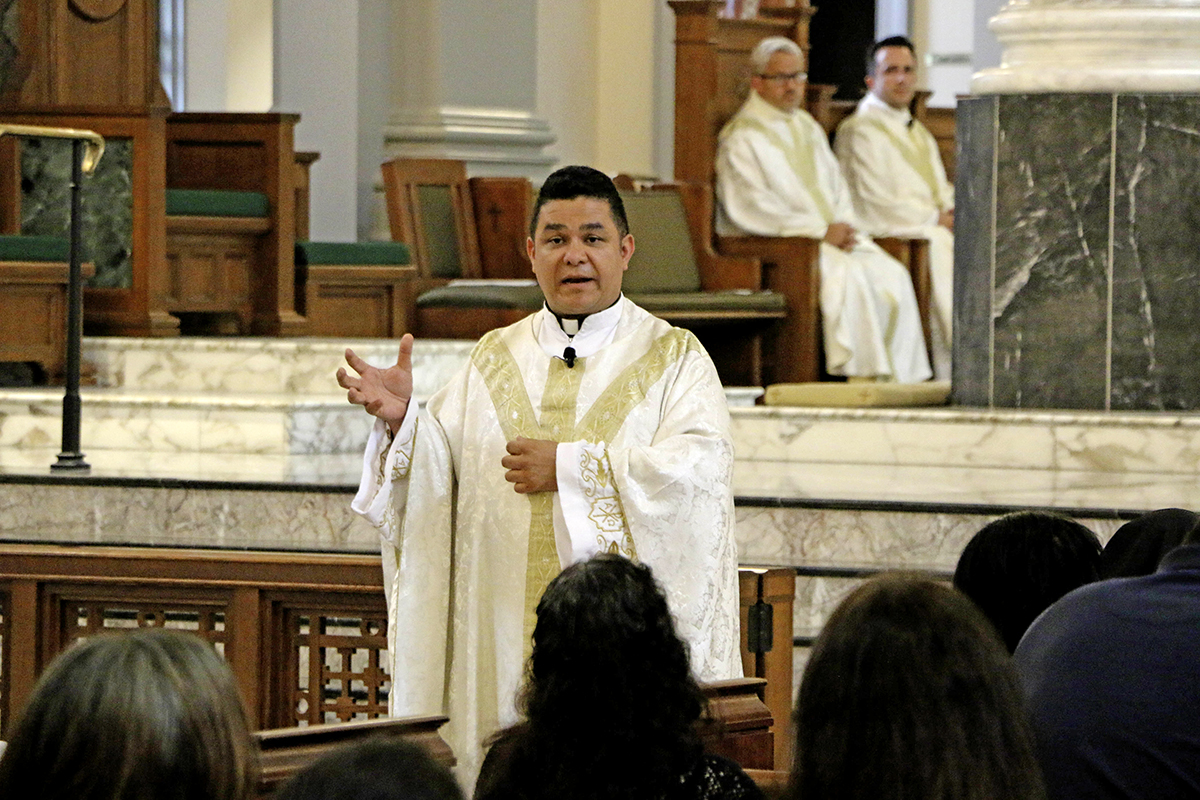
Father Diego Rivera preaches the homily at the special Mass for Venezuela on July 8 at the Cathedral of the Most Sacred Heart of Jesus. In the background are cathedral rector Father Michael Cummins (left) and Father Danny Herman, who is a cathedral associate pastor along with Father Rivera. (Photo Bill Brewer)
Father Rivera noted that no one experiences the pain of another “in their own flesh” because it is “very different to observe the suffering from afar than to embody the suffering in ourselves.”
“It is very difficult from the (television) screen to observe the other suffering than for the tragedy to knock on the door of our house. There is a very dismal difference between living and experiencing this suffering in person or simply telling it to us or listening to it from afar. We cannot fall into an insensitive attitude of emotions of the moment, where we comfort ourselves and we cry and we are astonished but at the same time we are screaming and smiling and we are in the euphoria (from soccer) and we forget the pain that others are suffering,” Father Rivera continued.
Father Rivera stressed that the compassion of someone who speaks of Christ is seen through prayer, the sacrifice of the Mass, a personal expression of “I’m sorry.”
“It is to embrace that suffering, to incarnate that suffering in me … to become the guardian of the brother and sister, to take responsibility of the one who suffers, to take him by the hand, to rescue him. That is the attitude of the Christian,” the associate pastor said. “Jesus in the Gospel leaves us a wonderful message: ‘Go be instruments of consolation…be instruments that know; be instruments that unite…be the merciful face of Christ.’”
Father Rivera concluded his homily with a prayer for the people of Venezuela:
“We should be united in a strong chain of prayer, asking for them. But we who are here, we say to the Lord, ‘Lord, we ask for the people of Venezuela, we ask for these brothers and sisters, we ask that You set us free from such a tragedy, and we ask that our hearts are always sensitive and compassionate to our brothers and sisters who suffer. We should not let the reality of suffering be erased by temporary and emotional events. That cannot be greater than the pain of the people. The pain of the people has to teach us to value the gift of life, to value God in our lives, to thank Him for everything we have, and He must lead us to pray, and unite us as brothers, so that we may have the strength to raise our hands and raise our heads. Amen.’”
Father Cummins said the sacrifice of the Mass served as an important observance of the faithful in the Diocese of Knoxville who are one with the people of Venezuela.

Diocese of Knoxville faithful gather for adoration and to pray the rosary before the Mass for Venezuela at Sacred Heart Cathedral on July 8. (Photo Bill Brewer)
“The Mass was an opportunity for us to show our solidarity with the people of Venezuela and the Church as they go through this time of loss and suffering. And to lift them up in our prayers and to pray for God’s blessings and God’s strength. And also to gather together as the universal Church to pray for our sisters and brothers in Christ,” the cathedral rector said.
Blanca Primm, director of the Office of Hispanic Ministry, believes the Mass and reception were an important way to show support for the people impacted by the disaster.
“This time of prayer and togetherness was an opportunity to offer consolation and accompaniment to the Venezuelan community in the aftermath of this tragedy. When a member of the body of Christ suffers, we share in their suffering and we can offer them hope,” Mrs. Primm said.
Zoraida Ballew, a Diocese of Knoxville parishioner, attended the Mass as a show of support for friends she has from Venezuela.
“The main reason is I wanted to have a solidarity with my friends. I have a lot of friends from Venezuela. They are my sisters and brothers, and we are all Latin American people,” Ms. Ballew said. “The Mass with Father Diego was amazing because it opened our eyes to what life should be, which is helping our brothers and sisters in their time of distress, death, and disaster.”
Ms. Ballew was especially moved by Father Rivera’s remarks of how people can focus their lives on superficial interests, wants, and needs, such as the World Cup, while forgetting that people are suffering.
“And we forget to give ourselves to them,” she said.
The reception was held in Cathedral Hall, where members of the Hispanic community gave testimonials about the disaster and shared ways to extend help to the people of Venezuela.
Mr. Da Silva was among those delivering a testimonial, where he appealed for assistance that can be sent to Caritas Venezuela, a nonprofit, non-governmental humanitarian organization, or Catholic religious orders that are serving in Venezuela.
During the reception, Mr. Da Silva and Mrs. Vidao shared their thoughts on the disaster and its impact on their family.
The couple and their family are from the Venezuela state of Vargas and the city of La Guaira, which was the earthquakes’ epicenter.
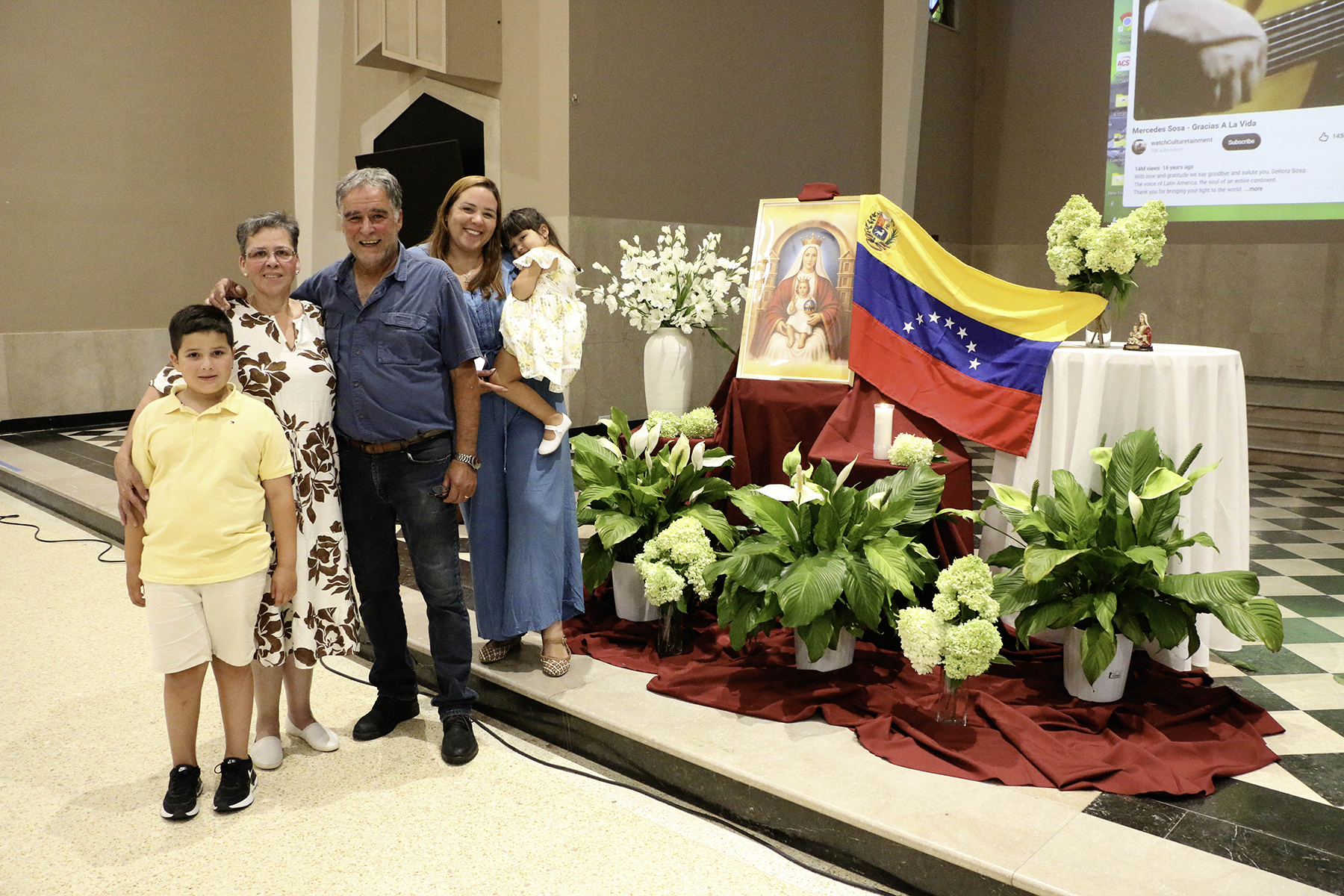
Antonio Da Silva and his wife, Yazmin Vidao, are pictured with Antonella Da Silva and children in the Cathedral of the Most Sacred Heart of Jesus parish hall following a Mass for Venezuela on July 8. (Photo Bill Brewer)
Mr. Da Silva explained that in 1999, a similar tragedy struck Venezuela in which severe flooding caused devastation and loss of life.
“This (earthquakes) is 20 times larger of a catastrophe. Buildings have fallen and people are trapped. In my family and in my wife’s family, everyone lost their home,” he said. “In my family, there are five siblings, and all of them lost their homes.”
“I have seven siblings, and thanks to God they did not die. But all of them lost their homes, and my nieces and nephews did as well,” Mrs. Vidao said.
Mr. Da Silva described how one of his brothers suffered a fractured collarbone that punctured his lung in the temblor while his brother’s wife sustained a skull fracture.
And tragically, his niece’s husband was killed when a building collapsed on him as he was rescuing family members. And the bodies of the parents of another family member were recovered from rubble.
Putting back together the lives of the couple’s family in Venezuela will not be easy.
“It is very hard for them to rebuild. It will take a lot of strength,” Mrs. Vidao said, noting that the Venezuelan government controls much of the infrastructure needed to sustain the economy and assist those whose lives have crumbled.
For example, Mrs. Vidao said there is no Western Union or similar entity in Venezuela where people can wire money to those in dire need of assistance.
As another example, she said while people wanting to assist impacted Venezuelans cannot send money directly to citizens, they can send money directly to Venezuelan grocery stores, where the people may receive credit for much-needed groceries.
Mr. Da Silva and his wife stressed that faith at this time is essential for Venezuelans as they work to recover from the earthquakes.
“God strengthens you, and only through Him can you rebuild your life and your heart,” Mrs. Vidao said.
Mr. Da Silva then quoted St. Paul: “I can show you my faith through my works. We cannot have a dead faith. Faith is the certainty that hope will come.”
“Faith can help you achieve what you think you cannot achieve,” Mrs. Vidao said.