
Fulton Sheen grew from Midwest farmboy to a Venerable Servant of God
By Bee Goodman
It is easy to picture a saint as someone born for the spotlight. We imagine sweeping vestments, packed cathedrals, a voice made for the microphone from the very start. Surely a man who wins an Emmy Award, who beats Milton Berle in the ratings, who lands on the cover of Time magazine—surely a man like that went looking for the stage.
Fulton Sheen did not.
He wanted, from the earliest age he could remember, to be a priest. Nothing more elaborate than that. He said in his autobiography, “I can never remember a time in my life when I did not want to be a priest.” He did not dream of television. Television, in the truest sense, had not even been invented yet.
And then, without asking for it, along came fame.
It landed on him the way a cross sometimes lands on an ordinary man walking home from the fields—not sought, not rehearsed, simply placed there. What he did with it, and where it has led the Church 47 years after his death, is worth pausing over.
Coming Sept. 24, Venerable Servant of God Fulton J. Sheen will be beatified at a Mass at The Dome at America’s Center in St. Louis, presided over by Cardinal Luis Antonio Tagle on behalf of Pope Leo XIV, the first beatification or canonization ever celebrated in the Archdiocese of St. Louis.
Far from just a farmboy
Fulton Sheen was born Peter John Sheen on May 8, 1895, in El Paso, Ill., the eldest of four sons born to Newton and Delia Sheen. When he entered first grade at St. Mary School, the name on the roll was quietly changed to “Fulton,” his mother’s maiden name, and it stayed with him the rest of his life.
He was, by his own admission, no farmer. A neighbor once told his father plainly that his oldest boy would “never be worth a damn” because he always had his nose in a book. His brothers took to the fields without complaint. However, Fulton later wrote that he simply endured farm work; he did not enjoy it.
One story from his boyhood has followed him ever since. Serving Mass as an 8-year-old altar boy for Bishop John L. Spalding of Peoria, he dropped a wine cruet and shattered it on the floor. Rather than scold him, the bishop pulled the frightened boy aside and made two predictions: that he would one day study at the University of Louvain in Belgium, and that he would someday become a bishop himself. Both became true.
Fulton Sheen graduated valedictorian of Spalding Institute in Peoria, Ill., studied at St. Viator College in Bourbonnais, Ill., and entered St. Paul Seminary in Minnesota.
He was ordained a priest of the Diocese of Peoria on Sept. 20, 1919, at St. Mary’s Cathedral in Peoria. That same day, he made a private promise to God: he would spend one hour every day before the Blessed Sacrament for the rest of his life. He kept that promise for 60 years through fame, through controversy, and through failing health.
He later called it the wellspring of everything else he ever accomplished.
“Everything else,” as it turns out, would be considerable.
Then came television
His public ministry began quietly enough, in 1930, when he was asked to fill in on NBC Radio’s Sunday night program The Catholic Hour. He stayed on as its regular host for two decades, reaching an estimated 4 million listeners a week at its peak, a striking number for a Catholic priest addressing a country still uneasy, in the years after Al Smith’s failed presidential run, about whether Catholics could ever be fully American.

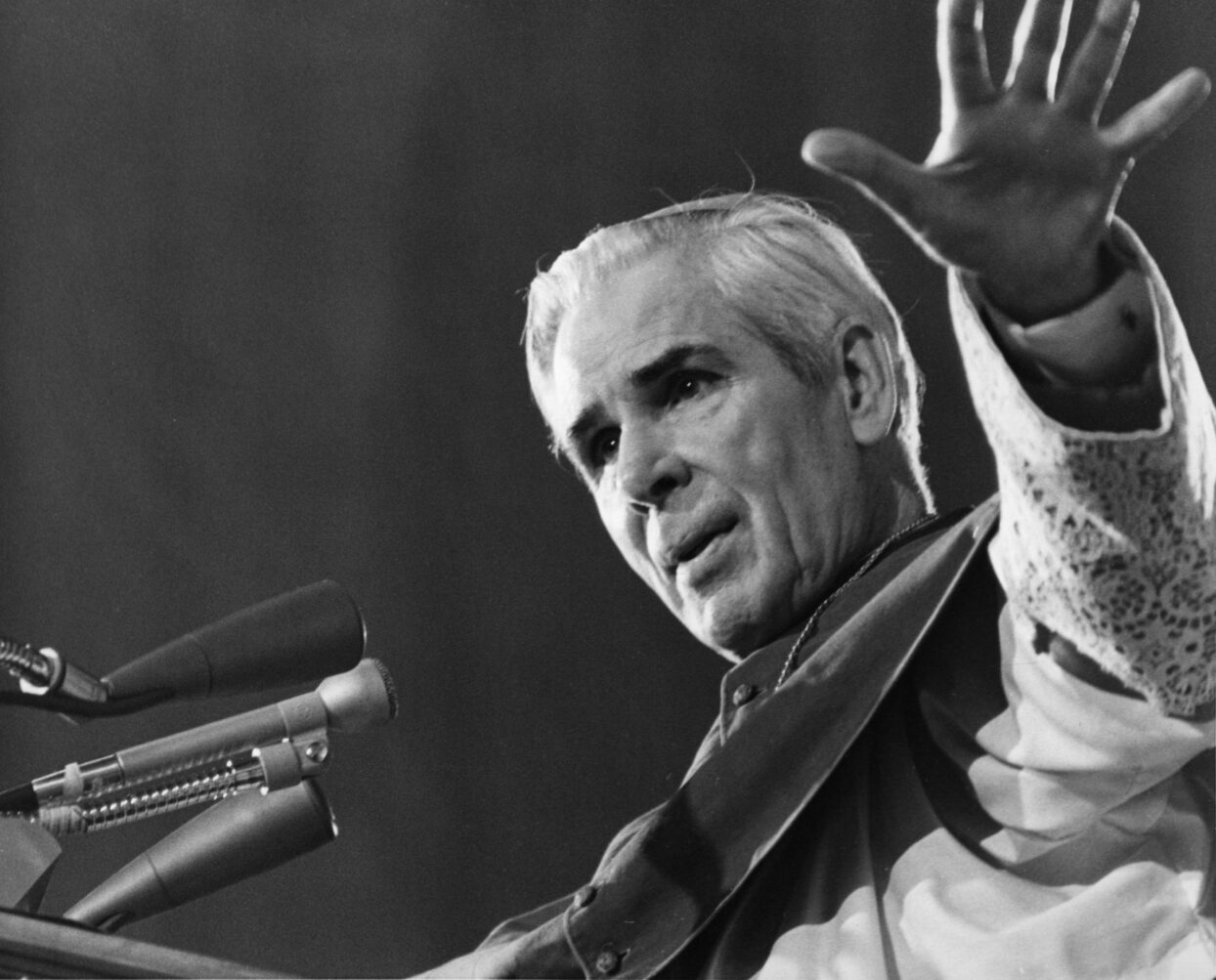
Despite high-profile delays in recent years, the beatification of Venerable Servant of God Fulton J. Sheen, the popular, scholarly archbishop and 20th-century pioneer of Catholic broadcasting, is set for Sept. 24 in St. Louis. Archbishop Sheen is pictured in an undated photo. (OSV News photo)
Then, in 1951, Father Sheen was ordained a bishop and named an auxiliary of New York. Cardinal Francis Spellman urged him to try the new medium of television. The following February, the small DuMont network slotted his program, Life Is Worth Living, opposite the wildly popular Milton Berle show, a scheduling decision made almost as a joke, since no one believed a preaching bishop stood a chance against the nation’s most popular comedian.
They were wrong.
Dressed in a flowing cassock and a gold pectoral cross, Bishop Sheen walked onto a bare set each week and delivered a half-hour, entirely unscripted talk, chalking his points onto a blackboard that an unseen stagehand—Bishop Sheen called him his “angel”—quietly erased between scenes. Catholics and non-Catholics alike could not look away.
At its height, the program drew an estimated 30 million viewers a week, believed to be the largest audience any religious television program has ever reached in this country. Fan letters arrived by the thousands.
In 1952, Bishop Sheen won the Emmy Award for Most Outstanding Television Personality, beating legendary journalist Edward R. Murrow, superstar Lucille Ball, and the popular Arthur Godfrey. Accepting it, the bishop thanked his writers: “Matthew, Mark, Luke, and John.” He appeared on the cover of Time magazine in 1952.
Life Is Worth Living ran until 1957, and Bishop Sheen returned to the air from 1961 to 1968 with a similar syndicated program, The Fulton Sheen Program.
He used every bit of that fame the way he had used his ordination day: to point elsewhere. He personally instructed a remarkable number of well-known Americans into the Catholic faith: noted violinist Fritz Kreisler, automaker Henry Ford II, actress Virginia Mayo, even the former communist official Louis Budenz.
From 1950 to 1966, he served as national director of the Society for the Propagation of the Faith, crossing the country to raise money for missionaries in 129 American dioceses. This was the work that first brought him to St. Louis in 1953, when a missions exhibition he led there drew 270,000 people.
It is not lost on many that the very city where he will be beatified is the city where, decades earlier, he once asked its Catholics to give.
He attended every session of the Second Vatican Council from 1962 to 1965, working alongside a young theologian named Father Joseph Ratzinger, the future Pope Benedict XVI, who later recalled how Bishop Sheen’s evening talks would “fascinate” the churchmen gathered in Rome.
In 1966, Pope Paul VI named him bishop of Rochester, N.Y. He resigned three years later at age 75, writing in his resignation letter that he was “not retiring, only retreading.” He was named archbishop of the titular see of Newport, Wales, and spent his final decade preaching and writing.
On Oct. 3, 1979, Pope John Paul II, who was visiting St. Patrick’s Cathedral in New York, asked specifically to greet the aging archbishop, seated in his favorite spot near the Lady Chapel. The pope embraced him and offered what has become his epitaph: “You have written and spoken well of the Lord Jesus Christ. You are a loyal son of the Church.” Archbishop Fulton Sheen died just over two months later, on Dec. 9, 1979.
A baby who did not breathe
The Church moves slowly and carefully toward sainthood, and Archbishop Sheen’s cause has been no exception. It formally opened in 2002 under Bishop Daniel R. Jenky of Peoria, followed by a decade of investigation into his writings and the sworn testimony of those who had known him.
On June 28, 2012, Pope Benedict XVI declared that Archbishop Sheen had lived a life of “heroic virtue,” granting him the title Venerable Servant of God.
The next step required a miracle.
In 2010, a baby boy in central Illinois was born showing no signs of life. For 61 minutes he did not breathe. As doctors prepared to pronounce the infant dead, his family and their community turned to Archbishop Sheen and prayed.
The child suddenly began to breathe on his own. After years of medical and theological review, Pope Francis formally recognized the healing as miraculous in 2019. The boy, named James Fulton Engstrom in the archbishop’s honor, is today a healthy young man.
A beatification originally scheduled for December 2019 was postponed at the last hour after some American bishops requested further review of Archbishop Sheen’s brief tenure in Rochester. That review has since concluded. On March 25 of this year, the solemnity of the Annunciation, the Vatican announced the beatification would finally proceed.
Not looking for the stage
With his beatification, Archbishop Fulton Sheen will receive the title “Blessed.” A second confirmed miracle would be required before the Church could declare him a saint, and many of his devotees continue to pray for one, hopeful that the man once called “God’s microphone” will one day become the first American-born male saint.
He never asked to be famous. He asked, at 24 years old, kneeling in a cathedral in Peoria, for one thing only: to give an hour a day to God. Everything that followed—the radio program, the Emmy, the missions raised, the souls instructed, the pope who embraced him near the end—followed from that one small, hidden promise, kept faithfully in rooms that no camera ever saw.
That is worth remembering the next time we feel life placing something on us we did not ask for—an interruption, an inconvenient face turned toward us, a burden we would rather set down. Fulton Sheen did not go looking for 30 million viewers any more than the person who finds a heads-up penny on the sidewalk. He simply kept his promise day after day and let God decide what to do with the rest.
In September, the Church will recognize the archbishop who was featured on the cover of Time magazine, bested television stars in the ratings, converted communists, and earned the praise of St. John Paul II with the words, “You have written and spoken well of the Lord Jesus Christ.”
While Archbishop Sheen never sought to become a larger-than-life figure, his simple goal of wanting to be a priest meant becoming the booming voice that was heard across the country and around the world.
Bee Goodman is a multimedia journalist for the Diocese of Knoxville who writes for The East Tennessee Catholic. She is a member of the Cathedral of the Most Sacred Heart of Jesus.