
Frs. Gladysz, Herman are the ‘Odd Couple’ when it comes to reviewing the movie ‘Silence’
By Bee Goodman
Faith is easy to talk about when nothing is asked of it. It is another thing entirely to hold onto it with a foot raised over the face of Christ, a sword at your neck, and no one watching but God.
That was the question in the room on June 12 when the Cathedral of the Most Sacred Heart of Jesus hosted Movie Night with a Priest for a screening of Martin Scorsese’s 2016 film Silence, based on the novel by the Japanese Catholic author Shusaku Endo.
The evening was billed as a discussion. It turned into something closer to a debate, and a farewell to beloved cathedral associate pastor Father Martin Gladysz.
In preparing for his new assignment, Father Gladysz said farewell to Sacred Heart Cathedral to become pastor of St. Therese Parish in Clinton, and this was among his final nights with the parish he has served since January 2019.
At Movie Night, Father Gladysz was joined by cathedral associate pastor Father Danny Herman, and the two arrived on opposite sides on purpose. Father Herman counts Silence among his favorite films. Father Gladysz has called it, in his own words, a “silent killer of faith.”
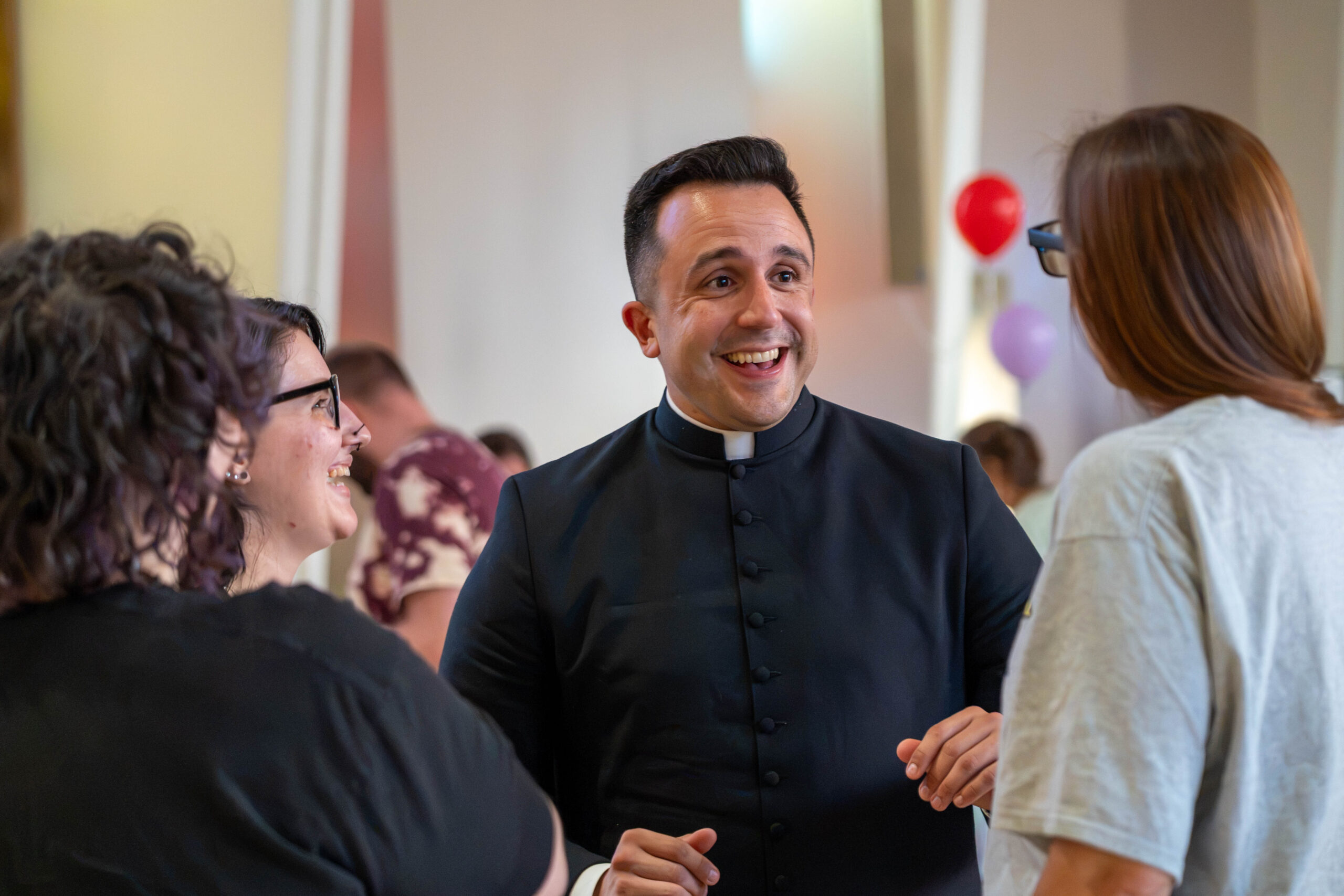
Father Danny Herman converses with several people who are attending Movie Night with a Priest at the Cathedral of the Most Sacred Heart of Jesus parish hall on June 12. (Photo Bee Goodman)
The pairing wasn’t planned so much as it grew out of a running joke. Father Herman had earlier suggested Silence as a good discussion film back when the Movie Night with a Priest ministry first began, according to Stacey Waldron, who started the lay ministry and organized the June event.
Months later, at a different movie event, Father Gladysz brought up the film unprompted, saying he’d watched it several times and did not recommend it. When the committee told him it was Father Herman who had originally suggested it, Father Gladysz’s reply set the entire evening in motion.
“I will come back to watch Silence, but Father Danny better be here,” the priest from Poland said.
Committee members reminded Father Herman of the remark, and the young priest began teasing Father Gladysz about it, and the teasing turned into the idea of the two co-leading the discussion together.
“It turned out to be great marketing for the event, because they are both very loved at the cathedral, and people were excited to see them spar about the movie,” Ms. Waldron said.
Father Gladysz was upfront from the start about where he stood, she noted, adding, “Father Martin made it clear before we invited him that he did not endorse the film.”

Father Martin Gladysz and others watch attentively the movie Silence. (Photo Bee Goodman)
That contrast was part of the draw; two priests who are close friends but very different from one another, the kind of dynamic parishioners already recognize from the way the two sometimes needle each other. It was the ministry’s second event to feature more than one priest; a movie night last November with Father David Boettner, Father Gladysz, and Father Herman drew some 150 guests.
Silence follows two fictional 17th-century Jesuit missionaries searching Japan for their mentor, a priest who is reported to have renounced his faith under torture.
The film depicts the real persecution of Japanese Christians under the Tokugawa shogunate, including the use of the fumi-e, an image of Christ that suspected believers were forced to trample to prove they had abandoned the faith.
And yet, without priests or regular access to the sacraments, the underground Church in Japan survived roughly 250 years of hiding, a survival Pope Pius IX once called the “Miracle of the Orient.”
Mr. Scorsese has said he carried the project for nearly three decades before it reached a screen, and Mr. Endo wrote as a Japanese Catholic who often felt like an outsider in both the country of his birth and the faith he practiced, a tension that runs through the film and invites many questions and comments as well.
Movie attendees at the cathedral who stayed after the credits filled nearly every seat for the discussion that followed, and the two priests made clear before a single question was asked that they were not going to let each other off easy.
A film that divides the room
Before the deeper theology, the priests spent time on a simpler question: is Silence even a good depiction of what happened in Japan?
Father Herman defended the film’s historical bones, noting that the fumi-e, the underground Church, and the missionary suffering it portrays are all drawn from a documented and painful chapter of Church history rather than invented for effect.
Father Gladysz did not dispute the history so much as the way the film uses it, arguing that historical accuracy is not the same thing as pastoral responsibility, and that a film can get every fact right while still leaving its audience with the wrong idea of what the faith asks of them.
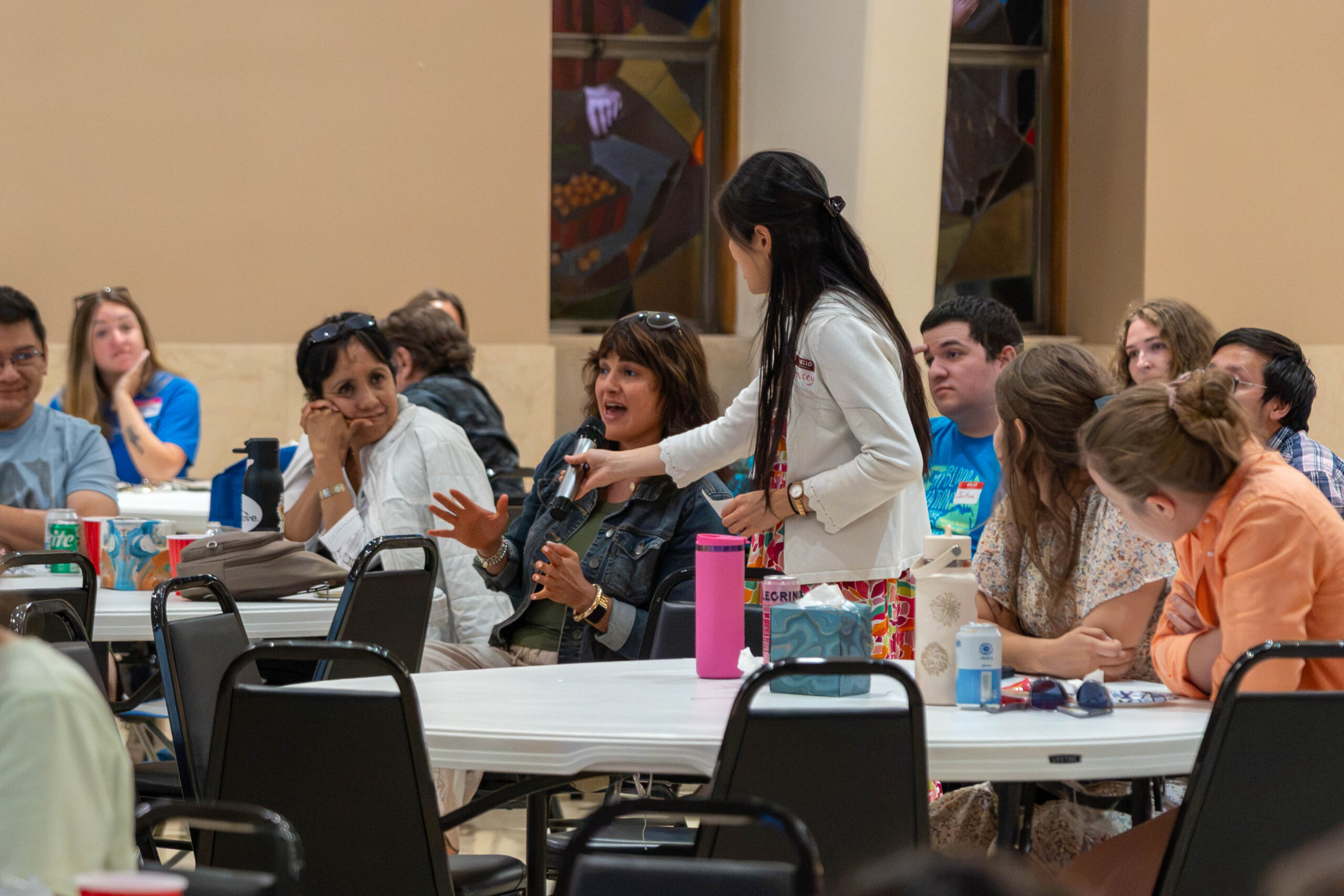
Stacey Waldron, who started the Cathedral of the Most Sacred Heart of Jesus lay ministry Movie Night with a Priest and organized the June event that viewed the movie “Silence” in the Parish Hall, engages audience members in a Q&A session. (Photo Bee Goodman)
That disagreement set the tone for the rest of the night. Neither priest budged much, and neither seemed to expect the other to.
Audience questions ranged from the practical to the deeply theological, starting with the sacraments themselves. One of the film’s missionary priests hears confessions in Japan despite a language barrier, and someone in the room wanted to know: could such a confession possibly be valid?
Father Herman said contrition and honesty matter more than fluent words, noting that the faithful confessed in Latin for centuries without understanding every syllable of what they spoke. What God asks for in the confessional, he said, is a truthful heart, not a translated one.
Father Gladysz agreed with the theology but added a caution of his own, saying a language barrier “cannot become a hiding place” for a penitent avoiding a fuller and more honest confession. A priest who cannot fully understand the words in front of him, he said, has to work harder, not less hard, to make sure nothing important slips through in the space between two languages.
The two priests went back and forth on this point for a while, with Father Herman returning to the mercy shown to penitents throughout Church history and Father Gladysz returning to the responsibility a priest carries not to let mercy become an excuse for a confession left unfinished. Several in the audience nodded along with each side in turn, suggesting the room itself was as divided as the two host priests.
Discernment in the dark
The two priests found firmer common ground in the film’s most debated scene, the moment its central missionary believes he hears the voice of Christ telling him to step on the fumi-e.
Father Herman framed the scene through Ignatian discernment, the spiritual framework St. Ignatius of Loyola laid out in his Spiritual Exercises to help a soul tell the difference between the movements that come from God and the movements that come from elsewhere.
In his reading, the missionary is a man in spiritual desolation, exhausted, isolated, and watching others suffer for his sake, in no state to discern rightly in that moment. Read that way, the scene is less an act of apostasy than a portrait of how far desolation can distort a soul’s hearing.
Father Gladysz did not disagree with the theology. He disagreed with what the film does with it. He said the movie never makes that Ignatian context clear to an audience unfamiliar with the Spiritual Exercises, and most viewers have never studied Ignatian discernment at all. Left without that framework, he said, many walk away instead with the mistaken sense that any failure of faith is quietly forgiven regardless of one’s actions, a reading he said edges toward predestination and sits uneasily beside the Letter of St. James, which insists that faith without works is dead.
It was here that the two priests came closest to meeting in the middle. Both agreed the theology behind the scene, rightly explained, is sound and even merciful. Where they parted was on whether a two-hour film, watched once in a theater, can be trusted to explain it.
Two kinds of care
From there the conversation moved to the responsibility priests carry as models for the people they serve, and to a harder question underneath it: when does a shepherd’s care for his flock’s souls give way to care for their bodies, and how does a priest know which the moment calls for?
Father Herman weighed the question through Catholic moral theology, considering the object of an act alongside a person’s motivation and the mitigating circumstances surrounding it. An act that looks identical from the outside, he said, can carry very different moral weight depending on what a person knew, intended, and was capable of at the time. Applied to the film’s missionaries, that framework leaves more room for mercy than a simple pass-fail reading of their choices would allow.
Father Gladysz answered from experience rather than the manuals, drawing on his own eight years as a missionary in Papua New Guinea. He said the first task of a missionary priest is to enter a culture, not to impose on it, and that a shepherd who cannot tell the difference between the two will eventually fail his people in one direction or the other. Care for souls and care for bodies, he said, are not really two separate jobs. A priest who ignores one long enough will find he has lost his ability to offer the other.
The freedoms we forget to notice
Both priests closed the night the same way: by asking the room not to take the sacraments for granted.
Father Herman pointed to the Christians still enduring persecution today in parts of the Middle East and Nigeria, and to the ongoing shortage of priests across South and Central America as reminders that the freedom to walk into a confessional or receive the Eucharist on any given Sunday is not shared by every Catholic in the world.
Father Gladysz offered a memory of his own from Papua New Guinea, where he was once the pastor responsible for 18 churches, and parishioners waited seven hours in the jungle for him to arrive and say Mass. He smiled telling it, noting the contrast to the complaints he sometimes hears now at the cathedral over a 10-minute delay. He left the room with one more question, not about the film’s theology but about the debate itself: which priest, he asked, had been right about Silence?
No one in the room was asked to answer out loud. Perhaps that was the point. The Christians of Silence kept their faith for two and a half centuries with no priest to ask.
For Ms. Waldron, the night fit squarely into why she started Movie Night with a Priest in the first place.
Before becoming Catholic, she belonged to a smaller spiritual community that watched movies together and held informal discussions afterward with ministers, an experience that pushed her, in her words, “to become more heroic and more saint-like like the movie characters.”
She brought the idea to Father Herman, who encouraged her to get it started, and with help from him, cathedral employees Scott Barron and Rick Grinstead, and the cathedral’s Women’s Ministries, the ministry ran a trial of three events the summer before it began in earnest.
Films have to carry real Christian themes and, practically speaking, fall under the cathedral’s public screening license. Audiences then vote on upcoming picks, as they did with Silence. The goal, she said, is a “low-pressure way to encounter our priests” and a chance to grow in faith alongside people who might not otherwise find a community that fits their season of life.
Of this particular screening, Ms. Waldron said the film’s weight was part of the point. “This particular movie was quite heavy but showed the reality of human imperfections and choices that people make in terrible circumstances,” she said.
“It was a good reminder of how we ought to be grateful for having such easy access to the sacraments and the importance of growing strong in our prayer life so we can more gracefully make choices that bring glory to God, even when things are very difficult,” she concluded.
Comments 2
I am not sure how I feel. I wish we had something like this to make us think more about ,confession and.communion .
Adoration being my first choice, I think all parishes should do this….maybe not as often as the Cathedral as some of us attend a Mission Church, but what a great opportunity to be directly involved in our faith and what it means to be a follower of Christ.