
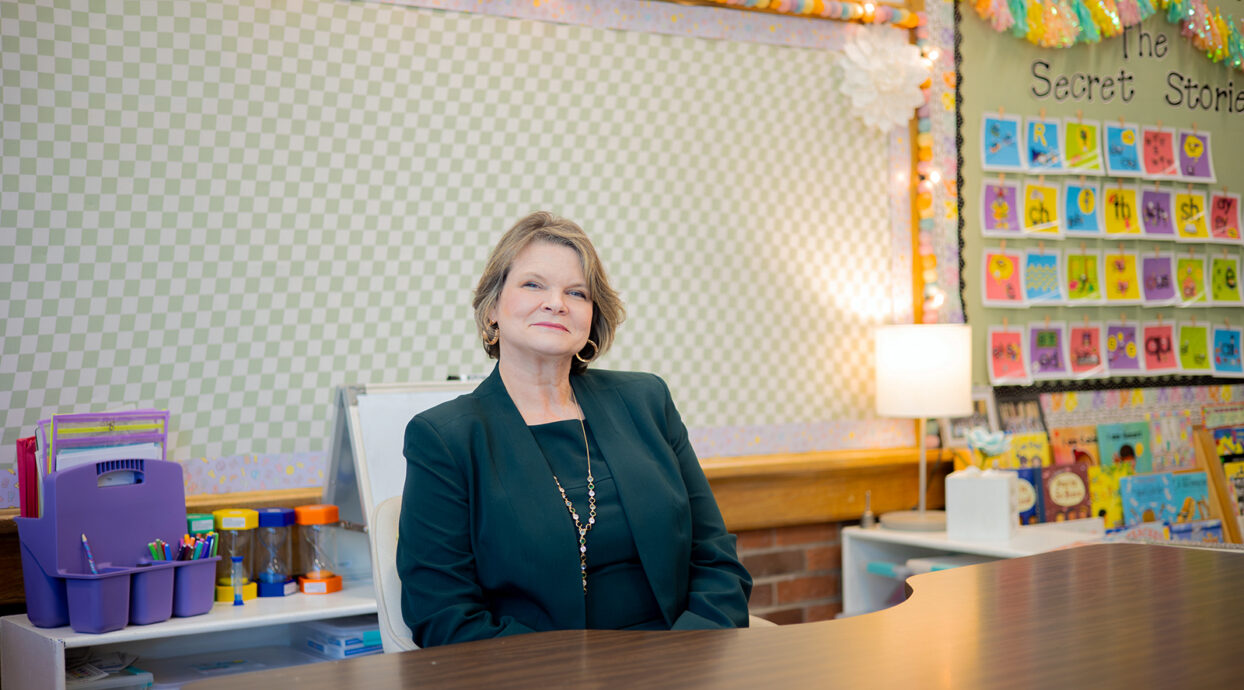
Martha Mundine settles into role as superintendent of Church schools in East Tennessee
By Bill Brewer
For Catholics, many decisions are based on faith. Then there are the leaps of faith that can help define a person and their vocation.
Martha Mundine made such a leap earlier this year when she left the low country of her native Gulf Coast for the hills of East Tennessee to become the Diocese of Knoxville’s new superintendent of schools.
As she and her husband, David, and their daughter, Katherine, relocated to East Tennessee, she was confident and joyful in the decision she had made—teaching about Jesus Christ to thousands of students while supporting and promoting Catholic education in a part of the country burgeoning with the Catholic faith.
Her first days on the job were in April and May, when she worked closely with retiring superintendent George Valadie to learn about the diocese and its eight foundational schools: St. Dominic in Kingsport, St. Mary in Johnson City, Our Lady of Perpetual Help and St. Jude in Chattanooga, St. Mary in Oak Ridge, St. John Neumann in Farragut, and St. Joseph and Sacred Heart in Knoxville, as well as its two high schools, Knoxville Catholic and Notre Dame in Chattanooga, in addition to the Chesterton Academy of St. Margaret Clitherow in Knoxville.
In getting to know Ms. Mundine, students, faculty, parents, and parishioners will see that she is a wife of 33 years, mother of two children (Katherine, 23, and Ryan, 29), a grandmother, and a career Catholic schools educator.
Martha Mundine may not have had a choice but to become an educator. Apparently, it’s in her family DNA.
“I’m a fifth-generation educator. It’s all my mother’s side of the family. Going way back, my great-great-grandmother was a teacher. I mean, this is in the 1800s. My great-grandmother taught school. My grandmother and my grandfather taught school,” the superintendent shared.
Now, as Ms. Mundine becomes the diocese’s lead education administrator, she will lean on that heritage as she guides the schools through an important period in the diocese’s 38-year history.
The Diocese of Knoxville is experiencing surging growth as record numbers of people are joining the Church and more Catholics are moving to East Tennessee. Those trends are translating to expanding enrollment in diocesan schools as well as the positive impact the Education Freedom Scholarships that make Catholic education more affordable for families are having on the schools.
There also is the new federal Education Freedom Tax Credit program for 2027 that promises to have an impact on Catholic schools similar to the state Education Freedom Scholarships.
And then there is reaccreditation for all 10 diocesan schools early next year that Ms. Mundine and her team of assistants and education professionals in the schools must navigate.
Ms. Mundine has been preparing for all of those situations and more, and she is a quick study. After all, school administration is nothing new to her.
Since 2017, she has served as an associate superintendent and deputy superintendent in the Archdiocese of New Orleans, which oversees 66 schools.
When the superintendent of schools for the Archdiocese of New Orleans learned that Mr. Valadie was retiring and was assisting in the search for candidates to fill his office, the archdiocesan superintendent thought Ms. Mundine would be right for the job and that this was an opportunity she needed to pursue.
Well-schooled
You could describe Ms. Mundine as a lifelong learner.
As the superintendent launches her first full academic year leading Diocese of Knoxville schools, she is studying for her doctoral degree in executive leadership.
She is on track to receive her Ph.D. from the University of Holy Cross in New Orleans in the 2027-28 academic year. She is now working on her dissertation.
And you could say she is a believer when it comes to Catholic education. She also has the perspective of having attended public school as a child.
Martha Murphy was born in Dallas into a faith-filled Catholic family. When she was about 10 years old her family moved to Lafayette, La., where her father was in the petroleum industry. As the U.S. oil business began to slump in the 1980s, the family—with a 16-year-old Martha and two other children in tow—relocated to Ocean Springs, Miss., which is where the teen would graduate from high school.
She attended the University of South Alabama in Mobile, earning a bachelor’s degree in elementary education. She then returned to Ocean Springs as a fiancée to teach at St. Alphonsus Catholic School.
And since then, she always has worked in Catholic education. Did she ever have a desire to return to public schools as a teacher or administrator?
“No, not a desire and not a calling,” she said, explaining that early in her teaching career she applied for a teaching position in public school.
“When I moved to Mobile, I had no children. I was 25 years old, and I thought I could make a lot more money in public school and so I put in an application to public school and Catholic schools. Well, I had three job offers in Catholic schools before public school even called me back. So, God had a plan. Yes, oh absolutely. And I felt better called to that,” she added.
She was a classroom teacher for nine years. When she was 27 in 1997, she was asked to become an assistant principal. And then she began fulfilling a career interest.
“I had always had a desire to do administration. Even when I was in college and getting my undergraduate degree, I knew that teaching was not my endpoint. It was something I was called to do, it was something I wanted to do, but it was my avenue to get where I wanted. And where I am now is not ever where I imagined I would be, but I always wanted to be a principal,” Ms. Mundine shared.
At that point she returned to college in 1998 to begin earning a master’s degree, a requirement for principal-level positions, and which she received in 2001 as she juggled her career and being a wife and mother.
She received her graduate degree at the end of her first year as principal of Our Lady of Lourdes School in Mobile.
While that experience was invaluable in her training as a principal, it also proved to be one of the most difficult times of her career.
“It has since closed. I actually was the closing principal. You know how you look back and think, why did you do that? It was God,” she said. “It was a school that was on the verge of closure when I took it. And I found that out very quickly. But we kept it open for three more years. We actually closed it before we had to. There were other schools in the area. The parish had said, ‘We can keep you open.’ But I said, ‘I’m not going to bankrupt the parish to support the school when we know what’s going to happen.’”
According to Ms. Mundine, studies showed that demographics had shifted and the parish population had shrunk.
“That was probably the most difficult thing I’ve ever done in my career, closing a school. It’s very emotional. I learned so much. But that place will always have special meaning to me, and I still keep up with people from there even though that was 22 years ago. It was a great little parish,” she said.
“That community was so sweet and so good. The ladies from the parish would come over and give me gifts. It was such a great place. And I had my daughter while I was principal there. The parish threw me a shower. It was just so sweet. I think my granddaughter actually still has one of the knitted afghans that one of the ladies from the parish made me. I passed it down,” Ms. Mundine continued.
When she learned the school would close, she was offered a position at another school. But she could feel God guiding her in a specific way.
“I knew it was God’s plan when I was offered at the beginning of my third year before we knew we were closing. I was offered a position at another school. They came and just said, ‘We’d really like to see you come here.’ I just couldn’t do it. I could just feel God saying. ‘You are needed here.’ The night that we went to make the (closure) announcement and I met with the parish council and my board and some people from the parish to announce that we were going to close, I sat in my office beforehand with the priest, who asked me to make the announcement,” she recalled.
“My superintendent, I looked at her and I said, ‘I should not be the one doing this.’ And she looked at me and she said, ‘God chose you to stay here. You had an out. God told you to stay here. This is why you’re here,’” she continued. “When I finished, she looked at me and she said, ‘I think I might know who my successor is.’ And I looked at her and I said, ‘If you’re talking about me, I have no desire to ever do your job.’ And she said, ‘You don’t want to be a superintendent?’ I said, ‘No. I’m too young.’ She said, ‘Well, not today.’ And I said, ‘No, that’s not something I’m ever interested in. I want to be a principal.’ And it’s funny how God calls you.”
So, Our Lady of Lourdes School in Mobile closed in 2004 after enrollment declined from about 800 to 100 students.
Ms. Mundine continued to serve as an assistant principal at St. Dominic School in the Archdiocese of Mobile, and in 2006 she became principal of the school. Enrollment was increasing. Test scores were “great.” And her tenure at St. Dominic was going well.
But there are challenges in every family, and the Mundines are no exception. In the fall of 2010, when her son was in eighth grade and her daughter was in first grade, both attending another Catholic school, the Mundines faced a difficult choice: the need to relocate the family.
Katherine was diagnosed with autism, and her physician firmly suggested to Mr. and Ms. Mundine that Katherine be enrolled in a school with a proven program to teach children with autism.
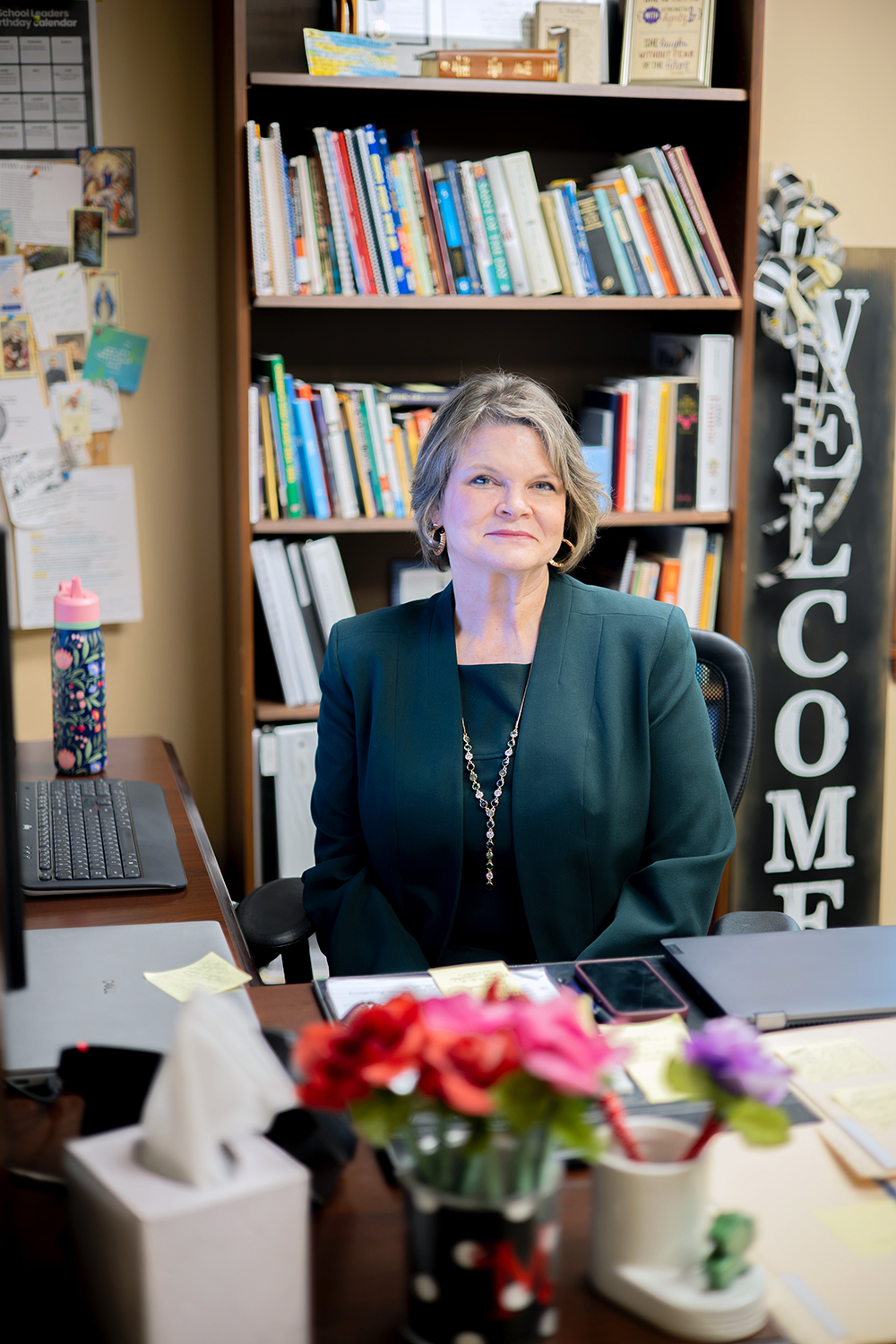
Martha Mundine brings years of administrative experience and a joy for Catholic education to her new role as superintendent of schools. (Photo Eleyana Nahigian)
That meant moving to the New Orleans area, where Katherine could be enrolled in a school recognized with awards for its special-education program. And Ryan could transfer before he started high school. The family also was moving near Ms. Mundine’s parents.
“We prayed and prayed and prayed. My mother and father lived by that time in St. Tammany Parish in Mandeville, La., which is the north shore of New Orleans. And my mother said the public schools there had just won awards for the things they were doing with special education. My parents were getting older and we loved being with them. So, we would be with them before we have to take care of them. As everyone described it, we took a leap of faith because the time was right, because if we were going to move, I was not going to do it when my son was in high school if I could avoid it. When I was 16, my family had to move. I moved between my sophomore and junior year in high school. That was very hard,” Ms. Mundine shared.
“I loved both places, and I have friends from both areas. But it’s very difficult. And as a result, you don’t ever feel like you have those roots in the high-school years. I didn’t want my son to have to go through that. So, we decided to move and we started looking for jobs. My husband got transferred. He actually ended up living with my parents for a few months because he went early to New Orleans.
The move proved to be a success. Ms. Mundine accepted a principalship at Pope John Paul II High School in Slidell, La., which is in Tammany Parish. Despite her misgivings of her children attending the same school where she worked, her son attended and graduated from Pope John Paul II.
“It ended up being good. And my daughter had a great experience in public school,” Ms. Mundine recalled.
The Mundines decided to move Katherine to St. Therese Academy for Exceptional Learners in New Orleans for her junior and senior years, where she thrived and graduated.
In 2017, Ms. Mundine was named the associate superintendent for secondary schools for the Archdiocese of New Orleans. She oversaw 23 high schools.
Then in 2020 she was named deputy superintendent of all 66 Catholic schools in the archdiocese, where she served before being named superintendent of Diocese of Knoxville schools on Feb. 12 by Bishop Mark Beckman. She began this new position on April 13.
Teaching priorities
As her new position began last spring, Ms. Mundine took a page from Bishop Beckman’s rules of thumb on learning a new diocese: look, listen, and learn. And that is what she has been doing.
She shared several of her best practices for being an effective educator.
“I’ve always said for years flexibility and humility are among the top characteristics of people who work in schools. And the No. 1? Always listen to God,” she said.
And she fondly recalls prophetic words from her father the day before he died in March 2024.
“I’ll never forget this. I was on the phone about something because I was with him in his hospital room. And he asked what I was working on. I was explaining what the issue was. And he said, ‘You are going to make such a great superintendent.’ And I looked at him and said, ‘Dad, you know I don’t want that job.’ And his words to me were, ‘It’s not your decision to make.’ I will never forget that,” she recalled.
Ms. Mundine noted that her parents were very faithful Catholics. And she wouldn’t be surprised if her mother joined the family in East Tennessee. Her son, Ryan, and his wife, McKenna, live in Nashville with their 3-year-old daughter. Ryan and McKenna are expecting their second daughter in September. Ryan is the head golf pro at Belle Meade Country Club.
Ms. Mundine believes all of her lived experiences have been valuable in her formation as a Catholic schools superintendent, whether it was growing up in a faith-filled family, attending public school from kindergarten through 12th grade while participating in religious-education classes (CCD), becoming a Catholic schools teacher and administrator, being a wife, mother, and grandmother, or earning her master’s and doctorate degrees.
They have taught her the most profound differences between a public-school education and a Catholic-school education.
“The biggest difference is, I’ve always said, how can you teach a whole person leaving the center of the whole person out, which is Christ? You can teach to the pieces, but you can’t truly teach to the heart if you don’t have Christ in education. And to me, that’s the biggest thing,” Ms. Mundine said, lamenting how politics and political issues often enter the public-school arena. “I think there are pros and cons everywhere. But our (pro) is how we teach, integrating that faith into everything, and we are raising disciples, and we want to have disciples for life. So, we have to form discipleship, and you can’t form disciples of Christ without having people understand Christ. Yes, there are wonderful homes and parents that do a great job with it, as my parents did, but the way that I view it is it’s a partnership, and we are helping with what the parents laid the foundation for as the first teachers of their children.”
In addition to having Jesus Christ in education, teaching the whole person also involves those with special needs, which is something Ms. Mundine is familiar with as a parent and as an educator.
Providing the resources to effectively teach students with special needs is something public schools, to a large degree, have been able to work out. For Catholic schools, the challenge is much harder because of limited resources.
“And that is the challenge. That’s the challenge everywhere. It was a challenge in New Orleans. We don’t have the resources, and I think that we have to be up-front about that. But at the same time, we can’t just say we don’t serve everyone because that’s not who we are. We are Catholic, and that is welcoming. That is universal. Accessibility is not just about making sure your tuition is low enough. Making our schools accessible to all is including those with special needs. What can we do to try to meet it? How can we work toward it?” Ms. Mundine asked.
“I will say in New Orleans they began an initiative, in 2010 I believe, of starting those programs. We finally got one off the ground in a high school. They’re doing well now and it’s spreading more. But that’s been 16 years and it’s still not something that is widespread because they’re doing the best they can. They’re doing a great job. They’re doing more than they ever did. With special education, there are more regulations and legal issues that you have to jump through, and again, that’s a lot of those resources that we don’t have. Hopefully it’s getting better. I think it is getting better. But our biggest challenge is we’ve got to first be open-minded about it. Instead of saying what can’t we do, what can we do?” she said.
A look ahead
Since arriving in April, Ms. Mundine has visited all 10 diocesan schools and met with their staffs. She has been impressed at how welcoming the schools are as well as the absence of negativity in teacher-student interactions.
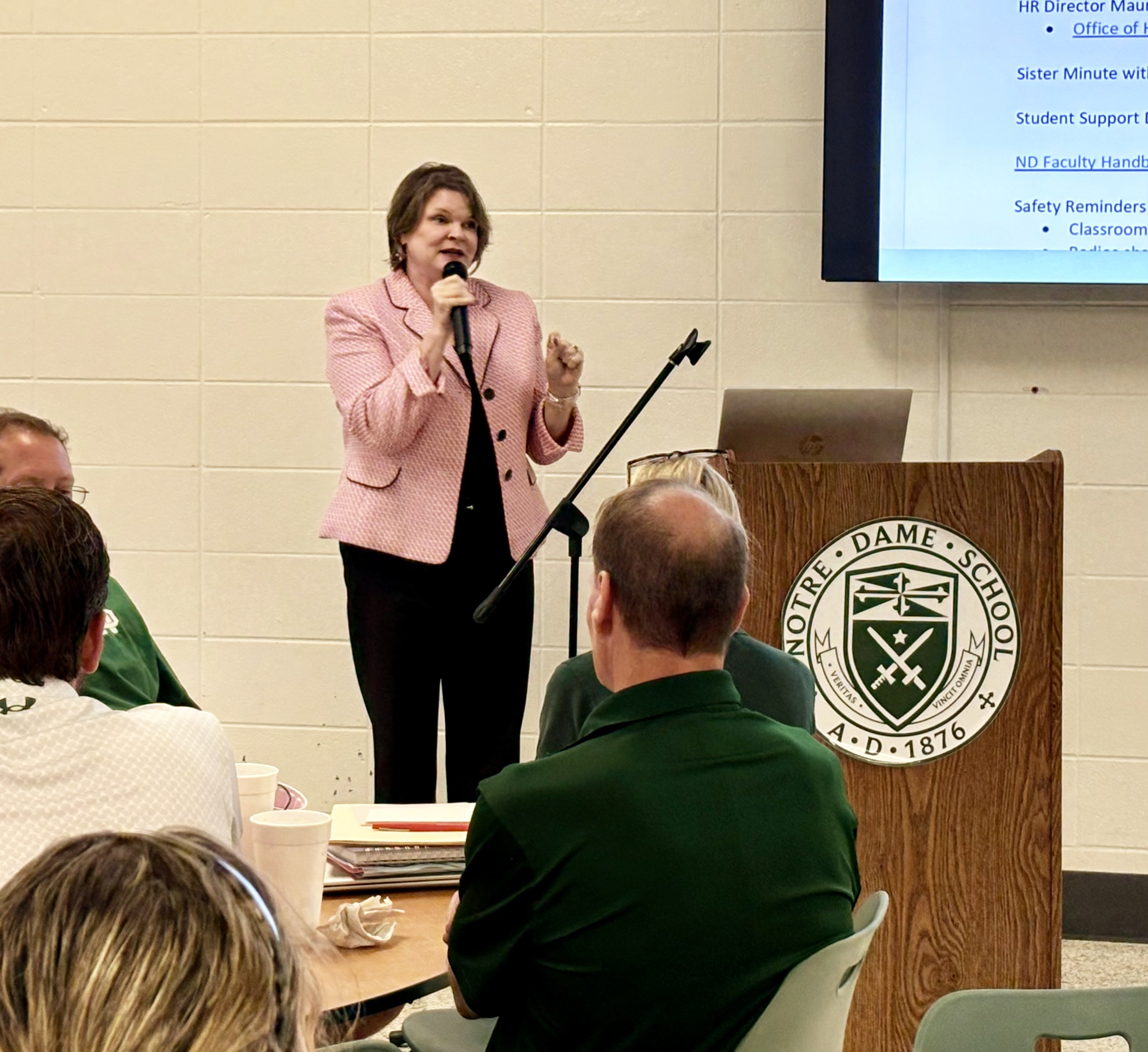
Diocese of Knoxville schools superintendent Martha Mundine meets with Notre Dame High School faculty prior to the beginning of the 2026-27 academic year. (Courtesy Cleo Gravitt/Notre Dame High School)
She fully endorses a positive approach in handling difficult situations, and she is looking forward to seeing more of that.
“I’ve been in a lot of schools over the years. You tend to see somebody who is angry or upset or handling a situation with a child in what I would call a non-Catholic way. I didn’t see any of that. I did see students who were being reprimanded, but in a very loving way. That struck me. In one particular situation I witnessed, an older student must have been giving a hard time in the classroom. I happened to be in the hall, and the teacher opened the door and took the student out into the hall where she could talk to her privately. And the words she said were, ‘What is wrong? This is not like you,’ instead of, ‘You better quit disrupting my class!’ And I thought, that’s who we are. What is wrong? This is not like you. And of course, that student opened up. It’s teaching the individual,” Ms. Mundine shared.
“I went to the principal later to say please make sure you go tell that teacher how impressed I was. The teacher didn’t know I saw it. I have been very impressed by our schools,” she added.
As Ms. Mundine enters the 2026-27 school year, she has some initiatives planned for the school system. Above all, she wants the Diocese of Knoxville Office of Catholic Schools to be a resource for each school.
“I want people to understand that I’m here to help. That is my biggest objective. My goal is to help the schools as much as I can so that they can help the students. That’s our ultimate goal. But I am here as the educational arm of the bishop, if you will, so I can help him learn as well,” she said. “There are some things that I’m going to be putting in place administratively, not anything outrageous, just some accountability things so that I can learn a little bit more.”
She emphasized that her biggest “ask” of the schools is to work in partnership with the schools office and inform her of anything they need assistance with “so I can be aware.”
Ms. Mundine and her staff in the schools office—Mary-Hannah MacCurdy and Rachael Leitner—want what is best for the students, their teachers, and parents.
“I think we all want the same thing for our children. We just all go about it in different ways. I have seen people making preconceived notions and judging others because of anger and emotion. One of the greatest lessons I’ve learned over the years is to not let emotion enter into things. You have to look at the facts. You have to look at how they are. I’m all about compliance. And if you don’t like a rule, don’t just disregard it. Do something to change it or accept that it has to be that way,” she said.
“That applies to children and their parents, too. It’s not easy. It’s not easy because that’s our heart. My husband was in banking for many years, and we used to laugh that we dealt with the two things that people owned: money and kids,” she added.
And Ms. Mundine wants everyone involved in each school to know she is available.
“I am here. I’m here for them. I serve at the pleasure of Bishop Beckman, but I’m here to help them. And we are all a system of schools. To me, that’s a beauty about Catholic schools. Each has autonomy, but we do work as a system when working properly,” she said.
Comments 1
Martha Mundine is a fantastic leader and a great mentor for her teachers, I should know I taught under her at St Dominic in Mobile. She leads with the positive and puts her faith in action. What a blessing you have received.