
Faith-filled youth showed the world God has a place in heaven for everyone
By Bee Goodman
God does not discriminate.
He called upon David, a young shepherd boy, to defeat Goliath and later become the king of Israel. Christ didn’t seek out perfect people; He surrounded himself with tax collectors, criminals, and the sick. Jesus never told children they weren’t welcome, rather He called to them saying, “Let the children come to me.”
If there is anything these little saints can show us, it’s that God calls on whom He deems as worthy. (Here’s a hint: you are all worthy, as God created us in His image.) Sts. Jacinta Marto and Francisco Marto, Portuguese siblings who died at ages 9 and 10, and their cousin, Venerable Lúcia dos Santos, who lived to tell their story, show that no matter how small, God can use you.
She promised to send a sign
It started with the three children in the field of Covia da Iria, where they were visited by a “lady all in white,” who told them to return to that spot on the 13th day of each month to pray for the conversion of sinners. She told them that at the end of her six visits a sign would prove the children’s visions.
This was on May 13, 1917. Five months later, on Oct. 13, Portugal experienced “The Miracle of the Sun,” an event which proved to the faithful and nonbelievers alike that the children were telling the truth.
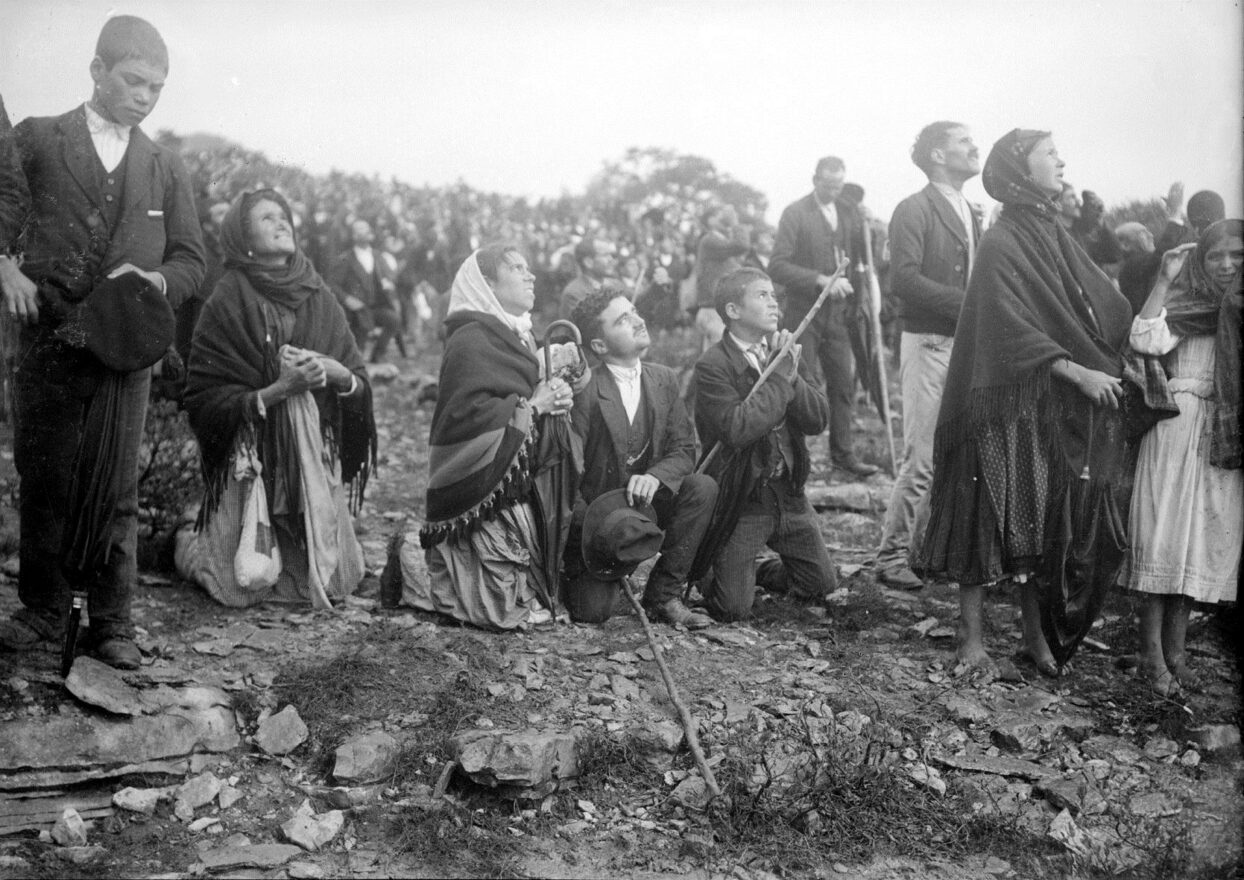
On that day, the attendees watched the sky as the sun appeared to spin and “dance,” as the event is also called “the day the sun danced.” The first coverage of the event came from a non-Catholic, Masonic newspaper called O Seculo.
O Seculo reported that approximately 70,000 people gathered to see the children’s predicted miracle, they watched the dark, cloudy sky open to clear, bright light that moved from one place to another. Witness accounts told of their rain-soaked clothes and the puddled ground beneath them drying in an instant. Pictures of the events show barefooted individuals with no marks from mud, and dry leaves surrounding them.
It was reported that more than 220,000 Portuguese civilians died during World War I, most from the Spanish flu and severe food shortages. Overall morality in the country was weak, and to make matters worse, the First Portuguese Republic, which was heavily influenced by Freemasons, suppressed Christian ways. The government seized parishes and schools and killed nearly 2,000 priests and nuns from 1911-19. The administration pushed the idea that God was dead, but the visions of three children stood against them. Now Fátima stands tall as one of the most visited Marian shrines.
In 1930, Bishop José da Silva officially pronounced the apparitions and associated phenomena authentic and worthy of local Church belief. Later in the 1950s, Pope Pius XII reported witnessing a similar phenomenon in the Vatican gardens, which he wrote about in his personal notes.
After the apparitions, the three children faced heavy criticism and threats of imprisonment and death. It was reported they said, “if they kill us, it doesn’t matter, we are going to heaven.”
Despite the threats, the children attempted to return to their civil lives. Each day as they walked to school they passed the church and stopped to greet Jesus in the Eucharist, and it was reported that others began to join them, knowing that these were the children God chose to bring a message.
Francisco
Not long after the apparitions, siblings Francisco and Jacinta were hit with deadly bronchopneumonia, a severe lung infection that often led to sepsis. Francisco continued attending Mass until he was too sick to leave bed. Still young, he had yet to receive his first Communion. Despite his health, he fasted and prepared for confession. Too sick to travel even short distances, a priest was called to their home, and Francisco had his confession and first Communion from bed.
He shared with Jacinta and Lúcia, “I am going to paradise, but from there I will pray to Jesus and Our Lady to take you up there, too, soon.” The next day, April 4, 1919, Francisco died.
Lúcia explained that despite his great deal of pain, Francisco would sit up in bed for hours, eyes closed in meditative prayer. When it was announced to him that he would not live long, he told Lúcia, “You go to school, I will stay here with Jesus.”
In his last days, the young Francisco had a vision of Our Lady of Fatima. She told him that he could go to heaven on the condition that he prayed many rosaries. He pledged to her, “I’ll say as many rosaries as you want!”
Lúcia asked him: “Francisco, what do you prefer more, to console the Lord or to convert sinners?” He answered: “I prefer to console the Lord…did you not see how sad Our Lady was when she told us that men should no longer offend the Lord, who is already so offended? I would like to console the Lord and then convert sinners so that they will no longer offend the Lord.”
After a while he continued: “Soon I will be in heaven. And when I get there, I will console Our Lord and Our Lady very much.”
Jacinta
Jacinta was two years younger than Francisco, and his death was difficult on her. Her own health continued to suffer. Jacinta knew that after her brother, she would soon follow him in death. Our Lady told her that she would go to a hospital and continue to suffer, but the young girl was not afraid.
Jacinta offered her life and sufferings to the Lord as she prayed for the conversion of sinners. She begged Lúcia to pray with her: “I suffer much, but I offer everything for the conversion of sinners and to make amends to the Immaculate Heart of Mary.”
Among the three apparitions that the three children experienced together, the first “secret” offered descriptions of hell, the second offered predictions of World War II (this apparition happened in 1917, prior to the end of World War I), and the third was kept hidden.
The “third secret of Fátima” was kept hidden by the Vatican for decades, only to be revealed after its prediction came true. The secret said that a man “clothed in white…falls to the ground, apparently dead.”
On May 13, 1981, exactly the same day as the first apparition in 1917, two shots were fired at Pope John Paul II in St. Peter’s Square in Vatican City. During the homily of the beatification Mass on May 13, 2000, Pope John Paul II thanked Jacinta, crediting her spiritual sacrifices, made in the name of Our Lady of Fatima, as a source of protection during the assassination attempt.
Being young provided a naivete that normally serves as a hindrance, but in the case of Jacinta it was a part of her unconditional love for Christ. Her childlike trust in Mary and the heavenly Father is no different from the trust young children have in their earthly parents. Even long before her death, she knew that her soul was protected and she would soon be with Our Lady and Francisco.
Lúcia
Siblings Francisco and Jacinta had numerous visitations from Our Lady, but their elder cousin Lúcia only partook in three. However, her role in their story is important, as she was reminded by her ill cousins. “You are to stay and tell our story,” Jacinta told her. Lúcia did just that.
Lúcia dos Santos continued until her death at age 97 in 2005. She lived to see her dear cousins be remembered as they were beatified by Pope John Paul II in 2000. They were canonized as the “Children of Fatima” in 2017 by Pope Francis. Lúcia dedicated her life to the Lord, becoming a Carmelite nun. Pope John Paul II and Sister Lúcia met and discussed the “third secret,” which would then be officially revealed to the public.
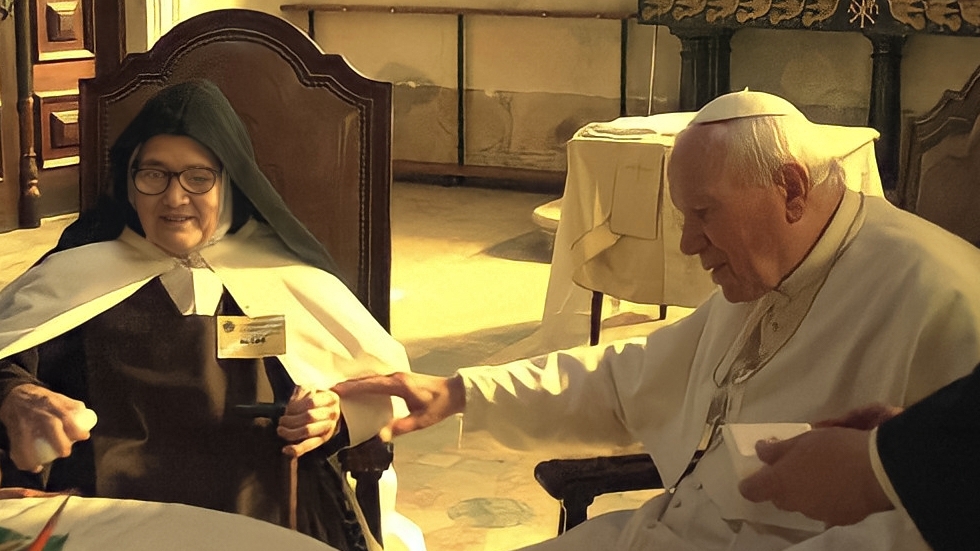
Sister Lúcia meets with Pope John Paul II in Fátima before the 2000 beatification of Lúcia’s cousins, Francisco and Jacinta Marto.
She was asked by the Church to record her experience. Between 1935 and 1941, Lúcia wrote four memoirs at the request of the bishop of Leiria. She later wrote a fifth. These are the main historical documents and records of the children’s apparitions, events at Fátima, as well as detailed accounts of the young cousins.
As the only living source of what happened to the three children and the Marian apparitions they had, Lúcia’s life and written memoirs are a huge part of their story and a reason they are so well-known today. She is an icon for children all around the world who wish to meet Jesus.
In fact, her stylish frames became a point of view for 25,000 children who pilgrimaged to Fátima on July 10, 1917. They were encouraged to pray and “see” God the way the Children of Fatima did.
“Lúcia, Francisco, and Jacinta, in their desire for Jesus, put on a sort of eyeglasses to see what was invisible, a result of their desire, their search, and believing and loving like Jesus,” Bishop Rui Gouveia of Lisbon reminded them.
Following the homily at the children’s Mass, a giant pair of glasses—similar to those worn by Sister Lúcia—appeared and displayed on the frames, “I want to see God.”
Lúcia was not the child of Fátima left behind—she was the child whose journey continued and who kept telling the story. She was a living testimony of the apparitions and the works of God. She carried the message that even in death, God can use you.
After her death in 2005, Sister Lúcia was quickly put on the path for canonization. The process typically requires at least five years post-mortem, but Pope Benedict XVI made a special exemption so that in 2008 she officially began the journey to sainthood. In 2023, under Pope Francis, Sister Lúcia was declared venerable.
At just 10 years old, Lúcia dos Santos was the eldest of the three shepherd children when they encountered Mary in the fields in Fátima, Portugal. The Holy Mother shared specific instructions with the children to return each month and pray. She told them that she would send a sign of the holy presence.
In 1917, the “Miracle of the Sun” took over the sky in Fátima, with thousands witnessing the light move across the sky.
This event and the Marian apparitions caused the faith to explode across the country and into the culture of Portugal. Despite their sickness and deaths, siblings Francsico and Jacinta Marto lived impactful, though short, lives. They continued to pray and offered their suffering to God.
Their cousin, Sister Lúcia dos Santos, went on living as a historical figure who told their story. She dedicated her life to Christ and remembered the messages her younger cousins told about sharing the love of Jesus. She lived to be 97 years old, still praying for the conversion of sinners as Mary instructed her when she was just 10 years old.
Whether you are 10 or 97, the Lord can use you.
“Let the children come to me and do not prevent them; for the kingdom of heaven belongs to such as these.” No matter the size, God has a place belonging to you in heaven. No matter the size, God knows your strength, which is always much more than you can know.
Bee Goodman is a multimedia journalist for the Diocese of Knoxville who writes for The East Tennessee Catholic. She is a member of the Cathedral of the Most Sacred Heart of Jesus.