
‘Almost every feast of the Church gives me a deeper knowledge of God and a special grace’
By Father Randy Stice
The liturgical year, which begins with Advent and concludes with the solemnity of Christ the King, “unfolds the whole mystery of Christ, from the incarnation and birth until the ascension, the day of Pentecost, and the expectation of blessed hope and of the coming of the Lord.”1 When Christ’s mysteries are celebrated in the liturgy “the riches of her Lord’s powers and merits…are in some way made present for all time, and the faithful are enabled to lay hold upon them and become filled with saving grace.”2 Each time Mass is celebrated, “there is an outpouring of the Holy Spirit that makes the unique mystery present.”3
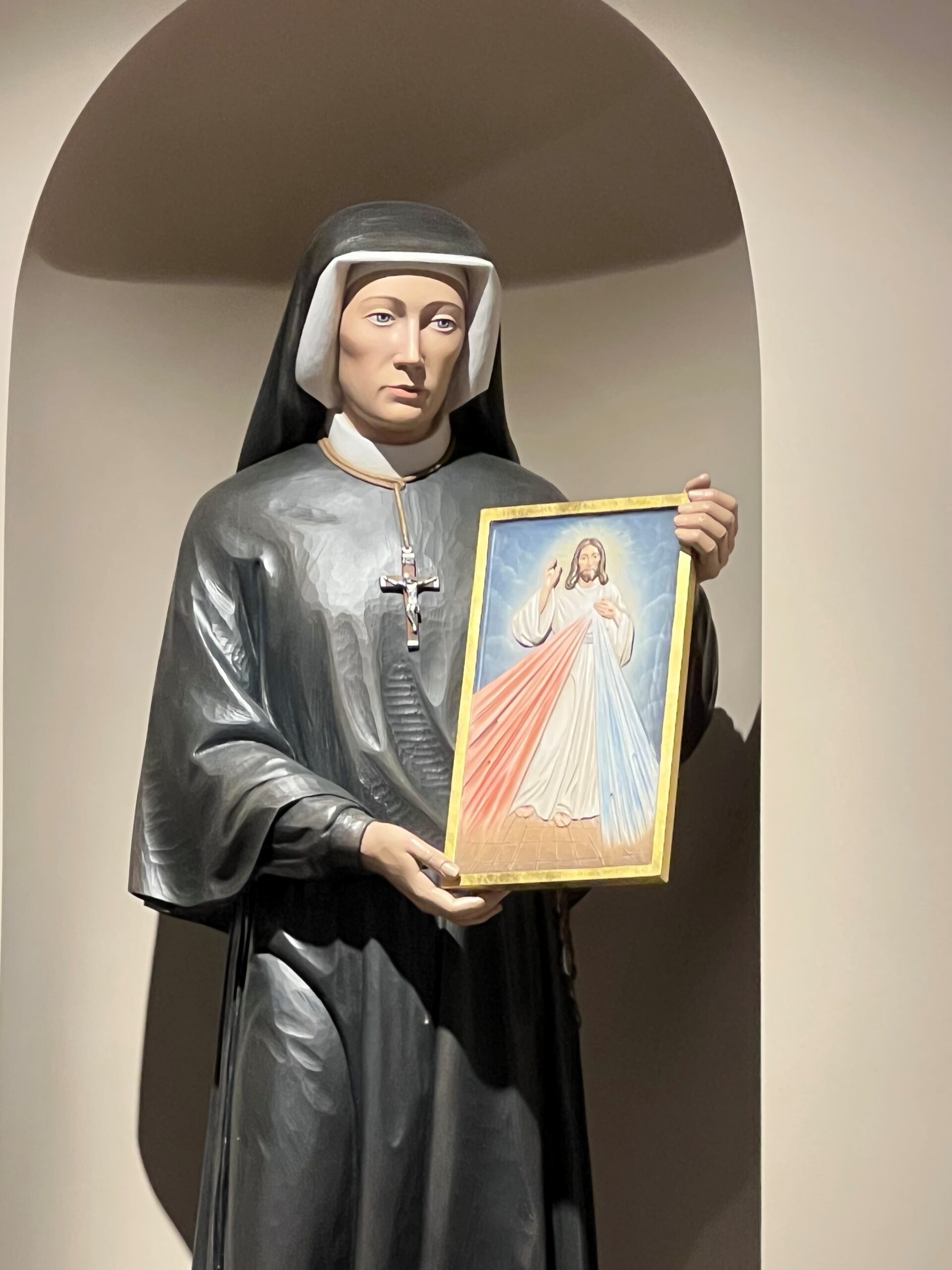 We have a generous example of the unique graces of each Mass from St. Faustina Kowalska, the Apostle of Mercy. She was born Helen Kowalska in 1905, entered the Congregation of the Sisters of Our Lady of Mercy in 1925, and died of tuberculosis on Oct. 5, 1938. Through her, the Lord gave the Church the image of the Divine Mercy, the Chaplet of Divine Mercy, and Divine Mercy Sunday, the Second Sunday of Easter. St. Faustina received different graces during Mass throughout the liturgical year and on special feast days, and she recorded them in her Diary. “Almost every feast of the Church,” she wrote, “gives me a deeper knowledge of God and a special grace.”4
Receiving special graces at each Mass led St. Faustina to prepare herself for each Mass, writing, “That is why I prepare myself for each feast and unite myself closely to the spirit of the Church.”5 She explained her preparation for the beginning of the liturgical year: “Advent is approaching. I want to prepare my heart for the coming of the Lord Jesus by silence and recollection of spirit, uniting myself with the Most Holy Mother and faithfully imitating Her virtue of silence.”6 During the Christmas Midnight Mass she saw a vision of “the little Infant Jesus, extremely beautiful, joyfully stretching out His little arms to me. After Communion, I heard the words: I am always in your heart; not only when you receive me in Holy Communion, but always.”7 At the Mass of the feast of Epiphany, she was “absorbed in the infinite majesty of God…I became aware of how much God abases Himself for my sake…. Taking advantage of the intimacy to which the Lord was admitting me, I interceded before him for the whole world.”8
At the start of Lent, St. Faustina wrote that she began it “in the way that Jesus wanted me to, making myself totally dependent upon His holy will and accepting with love everything that He sends me.”9 Her intention for Lent was “to beg divine mercy for poor sinners, and for priests, the power to bring sinful hearts to repentance.”10 She also noted that “Lent is a very special time for the work of priests. We should assist them in rescuing souls.”11 At Mass on Palm Sunday, the beginning of Holy Week, she wrote, “Jesus gave me to understand how much he had suffered in that triumphal procession. ‘Hosanna’ was reverberating in Jesus’ heart as an echo of ‘crucify.’ Jesus allowed me to feel this in a special way.”12
The Triduum—Holy Thursday, Good Friday, and Easter Sunday—particularly illustrates St. Faustina’s close union with “the spirit of the Church.” During the Mass of the Lord’s Supper (Holy Thursday), “when the moment for Holy Communion came, I saw the suffering face of Jesus in every host.”13 On Good Friday, “At 3 o’clock, I saw the Lord Jesus crucified, who looked at me and said, I thirst. Then I saw two rays issue from His side, just as they appear in the image…I offered myself, together with the dying Jesus, to the Eternal Father, for the salvation of the whole world.”14 At the Easter Sunday Mass, she wrote, “I saw the Lord in beauty and splendor, and he said to me, My daughter, peace be with you. … My heart was fortified for struggle and sufferings.”15
Experiences of the Trinity characterized the graces of the Easter season. On Divine Mercy Sunday, she wrote that, after Communion, “I was united to the Three Divine Persons in such a way that when I was united to Jesus, I was simultaneously united to the Father and the Holy Spirit…if only souls would want to understand how much God loves them!”16 On the feast of the Ascension of Our Lord she wrote that, after receiving Holy Communion, “my soul was drawn into the glowing center of love. I understood that no exterior works could stand comparison with pure love of God … I saw the joy of the Incarnate Word, and I was immersed in the Divine Trinity.”17
On the feast of Christ the King, the conclusion of the liturgical year, she felt God’s desire to save sinners and described her part: “I traverse the world’s length and breadth and venture as far as its ultimate limits and its wildest lands to save souls…through prayer and sacrifice.”18
Feast days were also important for St. Faustina. During Mass on the solemnity of the Immaculate Conception, “I heard the rustling of garments and saw the most holy Mother of God in a most beautiful radiance…She said to me, ‘You give me great joy when you adore the Holy Trinity for the graces and privileges which were accorded me.”19 And on the feast of the Sacred Heart, the Lord gave her during Mass “the knowledge of the Heart of Jesus and of the nature of the fire of love with which He burns for us and of how He is an ocean of mercy.”20
Although we may not experience some of the more extraordinary graces that St. Faustina received, her example and experiences can help us deepen our participation in the Mass. The special graces she received during Mass can encourage and strengthen our faith, her fidelity to the liturgical spirit of the Church is a disposition we can cultivate, and her dedication to preparing for each feast and season is a practice that we can emulate.
1 Constitution on the Sacred Liturgy, 102. This column is adapted from chapters five and six of Eucharistic Amazement: Experience the Wonder of the Mass by Father Randy Stice (Pauline Books and Media, 2025).
2 Catechism of the Catholic Church (CCC), 1163
3 CCC, 1104
4 Diary of St. Maria Faustina Kowalska: Divine Mercy in My Soul (Marian Press), paragraph 481. All subsequent references are to the Diary.
5 Paragraph 481
6 1398
7 575 (words spoken by Jesus are in italics)
8 870
9 1625
10 934
11 931
12 1028
13 413
14 648
15 1067
16 1073
17 1121
18 745
19 564 (words spoken by the Blessed Virgin Mary are in italics)
20 1142
Father Randy Stice is director of the diocesan Office of Worship and Liturgy. He can be reached at frrandy@dioknox.org.