
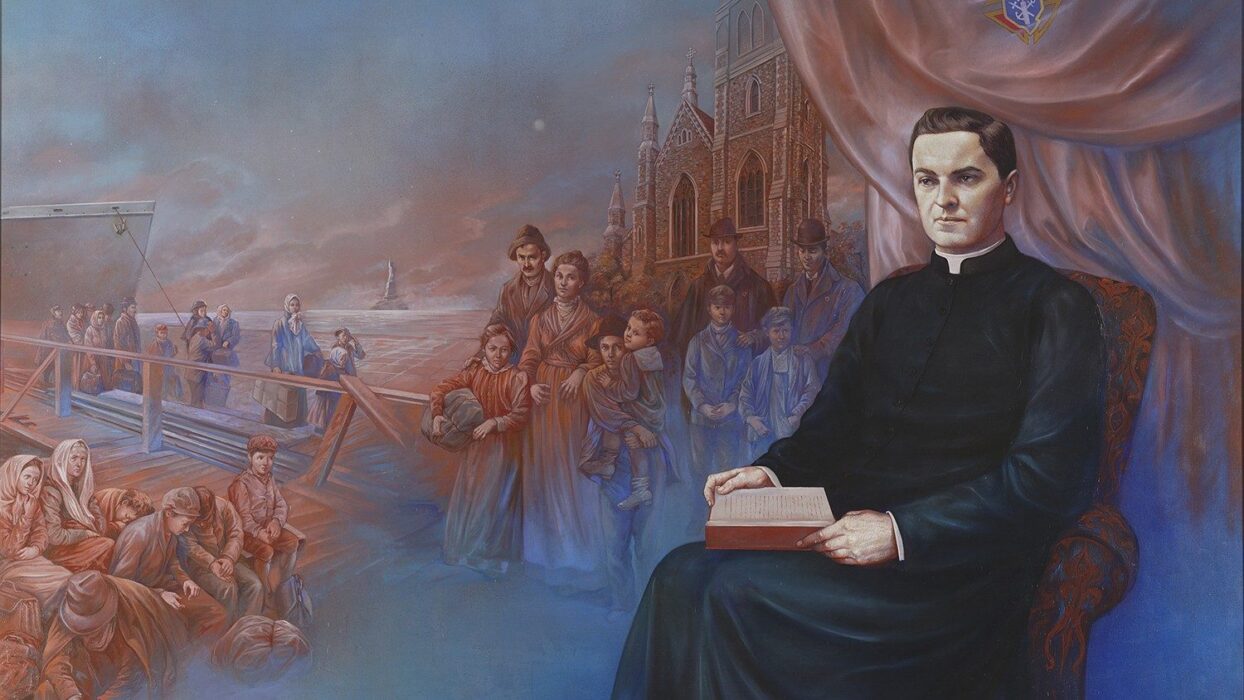
Sainthood awaits Conn. priest and Knights of Columbus founder known for holiness
By Bee Goodman
If you’re familiar with the Knights of Columbus, you more than likely know who Blessed Michael McGivney is. Often called the “Apostle of Spiritual Brotherhood,” Father McGivney founded the Knights of Columbus in 1882.
Father McGivney, beatified in 2020 by Cardinal Joseph Tobin on behalf of Pope Francis, isn’t a saint yet, but he is highly recognized as a holy soul among many.
Father McGivney’s parents emigrated from Ireland in 1849 and married in 1850. Born Aug. 12, 1852, in Waterbury, Conn., he was the eldest of 13 children born to Patrick and Mary McGivney, six of whom died in infancy or childhood. Two of his surviving brothers also became priests.
Father McGivney’s effort to form a fraternal brotherhood didn’t start with the grand idea of what the Knights of Columbus is today; it started as a parish organization to help immigrant families. The Knights of Columbus was created specifically as a mutual aid and insurance organization to provide financial security and emotional support to immigrant families. As it developed through the 20th century, it came to be known as the world’s largest Catholic fraternal organization.
A childhood cut short
Young Michael’s own life gave him firsthand education in the hardship he would later spend his priesthood trying to relieve. At just 13 years old, he left school to work in a Waterbury brass factory, helping to support his family the way so many immigrant sons of that era did. At 16, he set off for the College of St. Hyacinthe in Quebec to begin studies for the priesthood, but when his father died, Michael had to leave seminary and return home to help support his mother and younger siblings.
It was a sacrifice that could have ended his path to the priesthood altogether. Instead, with the support of his bishop, he resumed his studies, completing them at Our Lady of the Angels Seminary in Lewiston, N.Y., and finally at St. Mary’s Seminary in Baltimore, where he was remembered as much for his love of baseball as for his holiness.
Blessed Father McGivney was ordained on Dec. 22, 1877, at the Basilica of the Assumption, America’s first cathedral, in Baltimore, and was quickly thrust into a large leadership role as a new priest. In 1878, he wrote to a favorite professor from St. Mary’s Seminary, Father Alphonse Magnien: “I have been alone all summer with the whole work of the parish on my shoulders.”
His new assignment, as assistant pastor at St. Mary’s Church in New Haven, Conn., already carried a debt of roughly $165,000, which is approximately $5.5 million today adjusted for inflation. Despite this pressure, the young priest did not succumb to the stress. He delved into his ministry, becoming “a man of the people” as his contemporaries described him. He visited the sick, directed parish plays and fairs to raise funds, and involved himself in the everyday lives of his parishioners and community, Catholic and non-Catholic alike.
One of the most striking stories from his New Haven years involved a 21-year-old convicted murderer named James “Chip” Smith. Mr. Smith was convicted for killing a police chief. Father McGivney ministered to Mr. Smith in the months leading up to his execution, visiting him in his cell and walking with him to the gallows.
It was said that Father McGivney’s steady, compassionate presence helped the condemned man face his death with peace. That same instinct to stand beside people in their most desperate hour would soon shape something far larger than one parish.
The birth of the Knights of Columbus
Because of the explosion of industrial growth in America, many families were left fatherless and struggled to survive. Factory work was dangerous, life insurance was scarce and expensive, and Catholic immigrants, who were mistrusted by much of Protestant America, were often shut out of the few mutual aid societies that did exist to serve their communities.
Father McGivney had already seen this reality up close: he had become legal guardian to a young parishioner, Alfred Downes, after the boy’s father died and left the family in poverty. It was one more example of exactly the kind of tragedy he hoped to prevent.
Father McGivney called for a meeting in the basement of St. Mary’s Parish on Oct. 2, 1881. This was the first meeting of what would become the Knights of Columbus; it would officially be recognized by the Connecticut legislature in 1882. The vision was practical as much as it was spiritual: laymen banding together, paying into a fund, so that if a husband and father died, his widow and children would not be left destitute.
But Father McGivney also wanted something more than an insurance policy—he wanted Catholic men to find in one another a spiritual brotherhood, a source of strength for their faith in a culture that often made practicing that faith difficult.
A 2018 publication of Columbia, the magazine of the Knights of Columbus, included letters from Father McGivney’s early years of shaping the order. Of the only 13 letters that survived from Father McGivney’s life, many detail the organization’s difficult creation.
Father McGivney was eager to see the Knights grow across New England, and the early years were not easy. Just a year after its official establishment, he wrote that “the Order I was endeavoring to establish fell back almost lifeless, but not dead.” Despite that discouragement, by 1884 there were 11 parish councils formed, a sign that the idea, however slowly, was taking root.
Though there is no official patron saint of baseball, along with St. Rita, Blessed McGivney is also often considered. Through his adoration for the sport and the continued tradition through the Knights, many can see why Father McGivney is being considered for sainthood.
While the sport was still young, Father McGivney developed a love for baseball that would carry on as a tradition for the Knights of Columbus. Baseball became more than just a pastime for the men; it became a way to evangelize and fundraise for the order’s growth.
In fact, baseball is big for the Knights, and some Knights became big in baseball. Legends like Babe Ruth, Joe DiMaggio, Connie Mack, and Nap Lajoie were all members of the Knights of Columbus.
Baseball followed Father McGivney throughout his life. He organized games at parish picnics in New Haven and Thomaston, Conn. His love for the sport easily became a characteristic of the Knights, and the game became a tool for charity and evangelization.
In his remembrance, the Archdiocese of Detroit raised funds for McGivney Field in Clinton Township, Mich. The effort led by the Knights created a safe place for special-needs athletes over the age of 16 to play the game that Father McGivney adored. Forty-two Knights of Columbus councils across the Detroit Archdiocese joined the cause and raised $65,000 together.
A priest worn thin
Father McGivney’s own health, however, could not keep pace with his labors. In 1884, he was reassigned as pastor of St. Thomas Church in Thomaston, a smaller, quieter post, though by no means an easier one. He continued serving as chaplain to the growing Knights of Columbus even as he took on the full weight of his new parish.
The winter of 1889 into 1890 brought a pandemic that swept across the world, likely caused by a coronavirus, according to more recent scientific analysis. It’s a detail that carries an eerie resonance given the pandemic more than a century later during which Father McGivney would be beatified. The Connecticut priest fell ill with pneumonia while continuing to minister to his parishioners. He died on Aug. 14, 1890, two days after his 38th birthday.
He was buried in Waterbury, but in 1982 his remains were moved to St. Mary’s Church in New Haven on the centennial of the founding of the Knights of Columbus. This allowed his body to rest in the parish where it all began. Pilgrims and Knights still visit today, praying for his intercession and giving thanks for blessings received.
The long road to the altar
For more than a century, Father McGivney was remembered primarily within the Knights of Columbus as its founder. That began to change in 1997 when Archbishop Daniel Cronin of Hartford formally opened his cause for canonization, giving him the title Servant of God. In March 2008, Pope Benedict XVI declared him “Venerable,” recognizing that Father McGivney had lived a life of heroic virtue.
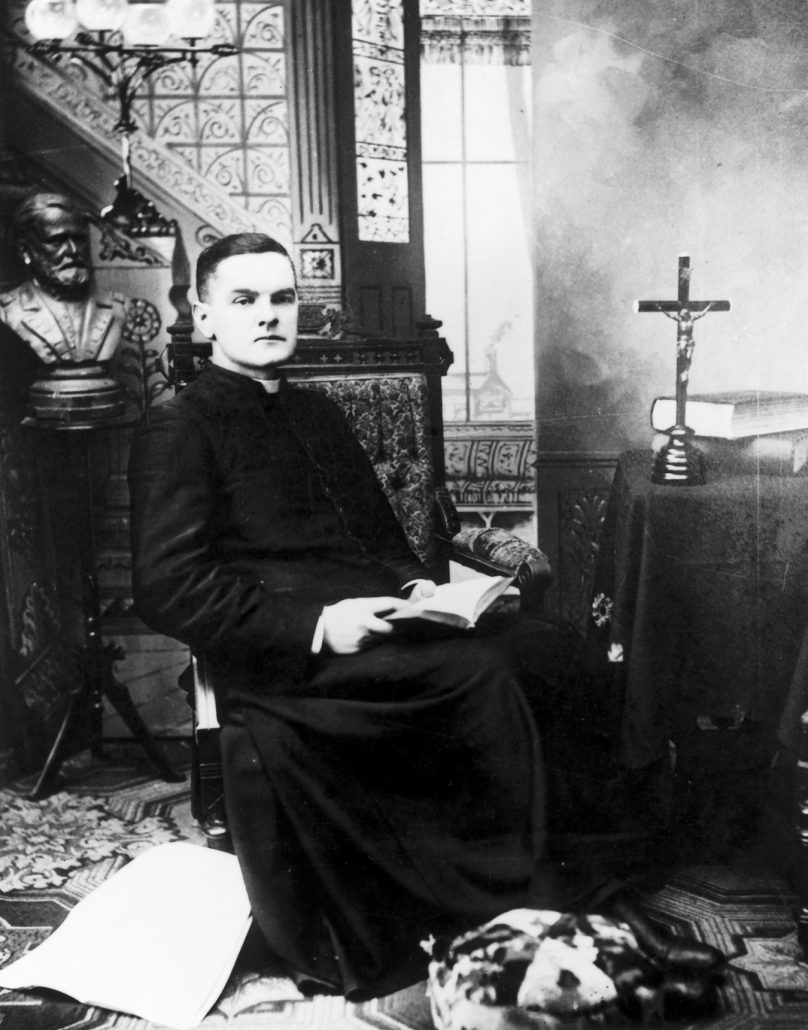
A photograph of Father McGivney at work in ministry.
The next step was beatification, which required proof of a miracle attributed to Father McGivney’s intercession after his death.
That miracle came through a Tennessee family, Daniel and Michelle Schachle, whose unborn son was diagnosed with fetal hydrops, a normally fatal buildup of fluid in the body of a baby still in the womb, compounded by a diagnosis of Down syndrome. A specialist told the family she had never, in 30 years of medical practice, seen a baby survive that diagnosis.
The Schachles, along with hundreds of friends and fellow Knights, prayed for Father McGivney’s intercession. At the next ultrasound, the fluid buildup had inexplicably resolved. The boy was born with Down syndrome but was otherwise healthy and was named Michael McGivney Schachle in thanksgiving.
He is now a healthy child, and doctors have offered no medical explanation for his recovery. Michael’s birthdate, May 15, 2015, is the anniversary of the first Knights of Columbus council.
On May 27, 2020, the Vatican announced that Pope Francis had approved the miracle, clearing the way for beatification. On Oct. 31, 2020, Father McGivney was declared “Blessed” at a Mass in the Cathedral of St. Joseph in Hartford, the diocese where he had spent his entire priesthood.
Cardinal Tobin of Newark, N.J., read the apostolic letter on behalf of Pope Francis, who wrote that Father McGivney’s “zeal for the proclamation of the Gospel and generous concern for the needs of his brothers and sisters made him an outstanding witness of Christian solidarity and fraternal assistance.”
Father McGivney became the first priest to be beatified who had spent his entire priestly ministry within a single American diocese, and the first Connecticut-born man to be beatified by the Catholic Church.
His feast day was set for Aug. 13, deliberately chosen as the day falling between his birthday, Aug. 12, and the day of his death, Aug. 14, so that his whole earthly life, beginning to end, is bound up in his annual remembrance.
What remains
One more confirmed miracle, attributed to Father McGivney’s intercession after his beatification, is required before the Church can declare him a saint. Knights and their families around the world continue to pray for that day, reciting a formal prayer for his canonization and reporting favors: healings, resolved hardships, and answered prayers received through his intercession.
Whether Father McGivney is ever formally canonized, his practical vision has already outlived him by more than a century. What began as a small group of men gathered in the basement of a debt-ridden New Haven parish has grown into an organization of roughly 2 million members across North and Latin America, the Caribbean, Asia, and Europe still built on the same foundation Father McGivney laid: Catholic men, who are bound together in faith, owe one another a kind of brotherhood strong enough to catch a family when a husband or father falls.
It’s worth remembering that Father McGivney never set out to build an empire. He was a parish priest with a mountain of debt, an overworked schedule, and a habit of noticing the people everyone else overlooked: the widow, the orphan, the immigrant, the man on death row. The Knights of Columbus was simply the tool he built to answer what he saw in front of him.
And that, more than the size of the organization he left behind, may be the real lesson of his life: holiness. For Michael McGivney wasn’t about grand gestures; he was more like showing up, again and again, for the people nobody else would.
Bee Goodman is a multimedia journalist for the Diocese of Knoxville who writes for The East Tennessee Catholic. She is a member of the Cathedral of the Most Sacred Heart of Jesus.