
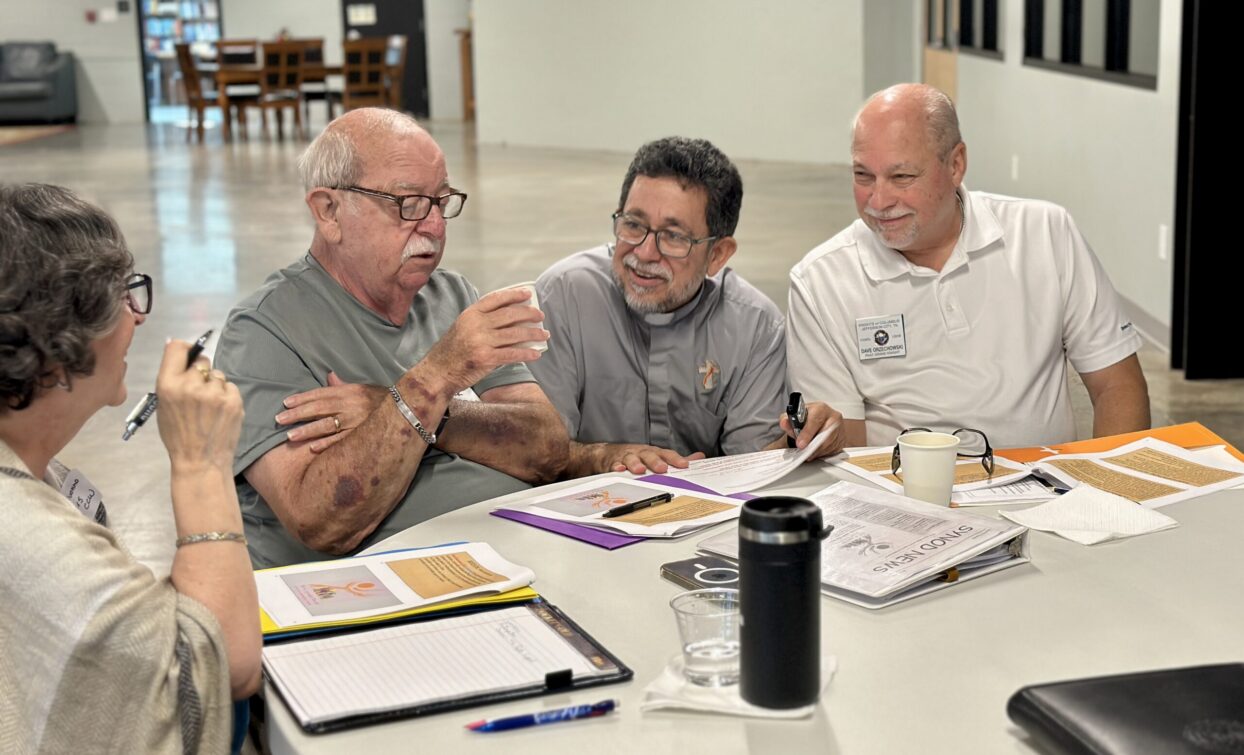
Delegates across East Tennessee discuss Bishop Beckman’s ‘guiding questions’
By Jim Wogan
On Sept. 19, more than 70 parish and ministry delegates gathered at four locations in the Diocese of Knoxville to reflect on the process of synodality in the Catholic Church. It was a major step in a Vatican-initiated effort that started in 2021—For a Synodal Church: Communion, Participation, Mission.
The concept of synodality isn’t new even if the word itself is unfamiliar. “Every step of the Church is a return to its source,” says the Introduction of the Final Document of the XVI Ordinary General Assembly of the Synod of Bishops in 2024.
It’s a sentence that is beautiful in its simplicity and profound in its meaning. It acknowledges that the Church is always moving, addressing the needs of its people, guided by the Holy Spirit, while always returning to its source: the life and teachings of Jesus Christ.
It is within this framework that the current Synod works. A construct that elicits both excitement and resentment—that something may be won or lost. Which is exactly what the Synod is not about.
The aforementioned Final Document, all 155 paragraphs of it, is up for discussion, but Bishop Mark Beckman has called on delegates who gathered at deanery locations at St. Jude Parish in Chattanooga, St. Alphonsus Parish in Crossville, St. Mary Parish in Johnson City, and the Cathedral of the Most Sacred Heart of Jesus in Knoxville to focus on three “guiding questions” to help move the diocese in a positive direction.
- How can we build and strengthen better community in our parishes and diocese?
- How can we foster a culture of collaboration between the laity and the clergy, and what does this truly mean?
- How can we create a welcoming and inclusive community that recognizes our shared responsibility for all of God’s creation?
His questions brilliantly embrace each of the three motivating pillars of this Synod: communion, participation, and mission. In a very practical and tangible way, and with deference to the rich and deeply sourced theological language of the Final Document, it is safe to say that Bishop Beckman has given us something to work with. It is not to say that we’re not doing this in some respects. But can we do better?
Synodality is, at its heart, a simple invitation to walk together as the people of God, listening to one another and, above all, listening for the voice of the Holy Spirit. Its purpose is not to change the Church’s faith or teaching, challenge the hierarchy, disrupt our traditions, nor to create another program or process. Rather, synodality calls on us to deepen the way we live our life as the Church: to listen with humility, to accompany one another with charity, and to discern together how God is calling us to proclaim the Gospel and serve His people. And it’s not a new concept.
Pope Francis gave us a clue about this when he spoke to the Synod of Bishops on Young People in 2018, three years before the current synod started.
“We recall that the purpose of the Synod is not to produce documents, but to plant dreams, draw forth prophecies and visions, allow hope to flourish, inspire trust, bind up wounds, weave together relationships, awaken a dawn of hope, learn from one another, and create a bright resourcefulness that will enlighten minds, warm hearts, give strength to our hands.”
Synodality is a journey, and it’s important to remember that holy Scripture and the Church’s history are full of journeys: wanderings, walks, encounters, exiles, and discoveries, each with its own set of challenges and rewards. In each example, we are reminded that those who listened found their destination. As this synodal journey continues, the Church is asking us to listen closely to the Holy Spirit.
Synodality is also about listening to each other, therefore, to assist delegates this month, they encountered a method of discernment called Conversation in the Spirit.
Conversation in the Spirit challenges our typical (and sometimes chaotic) way of discussing issues. It is a structured approach to group discussion recommended and often used in the Church’s synodal process. Participants speak in turn about a question, listen without immediately responding or debating, spend time in silence and prayer, and then discuss what they heard—including areas of agreement, disagreement, and questions that emerged—while listening for the guidance of the Spirit.
It is not a fast process. Each of Bishop Beckman’s three questions could consume 45 minutes of thoughtful reflection and discernment. And while it may be new to some of us, the foundation of Conversation in the Spirit has been around a long time.
The U.S. Conference of Catholic Bishops offered this translation of a letter of instruction on appropriate behavior sent to Jesuits attending the Council of Trent in 1546:
“Learn the surpassing worth of conversation; be slow of speech, be considerate and kind especially when deciding on matters under discussion, pay attention to the whole person, understand the meaning, learnings, and wishes of those who speak, be free of prejudice, argue from authority cautiously, quote important persons only if arranged beforehand, consider the reasons on both sides without showing attachment to your own opinion, avoid bringing dissatisfaction to anyone, be modest when you are certain, choose to speak at the other’s convenience even when certain, give conversation the time that it needs.”
Almost 500 years later, it still seems like sound advice.
Later this year, the delegates attending the deanery gatherings will assemble at the Cathedral of the Most Sacred Heart of Jesus for a synodal-style gathering with Bishop Beckman in attendance and joined by diocesan vicar general Father Peter Iorio.
What the delegates discuss and discern at this month’s gatherings will help shape the discussion points and agenda for November.
As this synodal journey continues, the Diocese of Knoxville, like every Catholic diocese in the world, will be called to give an account of the steps it has taken. As part of his first Ad Limina visit with Pope Leo XIV early next year, Bishop Beckman, like all other bishops, will be asked to update the Vatican on the ways the diocese has incorporated synodality into its life.
And the Vatican is already shaping instructions for the next steps in this ongoing process, which will continue through 2027 and culminate in an ecclesial assembly in Rome in 2028.
Jim Wogan, a former communications director for the Diocese of Knoxville, is the diocesan Synod Team leader. He and his wife, Mary, are members of St. Thomas the Apostle Parish in Lenoir City.