
Conference is opportunity for bishops to catechize on immigration
By Bill Brewer
What would Jesus do?
Bishop Mark Beckman of the Diocese of Knoxville posed that question during Mass as part of a regional immigration conference titled “Deepening Our Moral Witness” in Knoxville on Sept. 30 attended by bishops, priests, religious, and lay leaders from Florida, Georgia, Alabama, Louisiana, South Carolina, North Carolina, West Virginia, Virginia, Kentucky, and Tennessee.
It’s a question many people impacted by immigration in the United States are undoubtedly asking.
The “Deepening Our Moral Witness” conference occurred following National Migration Week (Sept. 21-27) and on the heels of the 112th World Day of Migrants and Refugees on Sept. 27. It was prompted by growing concern in the Catholic Church and among other faith and community groups about response to the continuing immigration crisis as well as the Tennessee bishops’ recent statement on immigration enforcement and the dignity of migrants plus the U.S. Conference of Catholic Bishops’ special message on immigration.
Bishop Beckman and Bishop John E. Stowe, OFM Conv, of the Diocese of Lexington in Kentucky served as hosts for the gathering on the campus of the Cathedral of the Most Sacred Heart of Jesus in Knoxville. They were joined by Archbishop Gregory J. Hartmayer, OFM Conv, and Auxiliary Bishop John Nhan Tran of the Archdiocese of Atlanta, Bishop Evelio Menjivar-Ayala of the Diocese of Wheeling-Charleston in West Virginia, Bishop David P. Talley of the Diocese of Memphis, and Bishop Brian L. Cole of the Episcopal Diocese of East Tennessee.
The conference was held in collaboration with the Hope Border Institute based in El Paso, Texas, and the Center for Migration Studies of New York.
A key moment of the event was a press conference on the steps of Sacred Heart Cathedral, where the bishops and more than 150 conference attendees joined in standing with all immigrant families and calling for meaningful immigration reform and changes in immigration enforcement.
The daylong conference featured speakers who addressed Catholic social teaching on immigration, the impact of increased deportations on families, and communication strategies, and called for orderly immigration reform rooted in compassion and due process. The regional gathering also highlighted how the Catholic Church is responding to the plight of immigrants.
In his Mass homily, Bishop Beckman thanked his brother bishops and priests for concelebrating the Mass, which was held on the feast of St. Jerome, who is renowned as a theologian and a doctor of the Church.
St. Jerome is recognized for his comment, “Ignorance of Scripture is ignorance of Christ.”
When it comes to immigration in the United States, just what would Jesus do?
“Most of you have heard the four initials, WWJD, right? What would Jesus do? That question is often asked about many things in life. As a lot of folks today gathering to reflect on the reality of immigrants in our own country have been listening to the stories of what is going on, we could ask that same question,” Bishop Beckman said. “What would Jesus do? WWJD.”
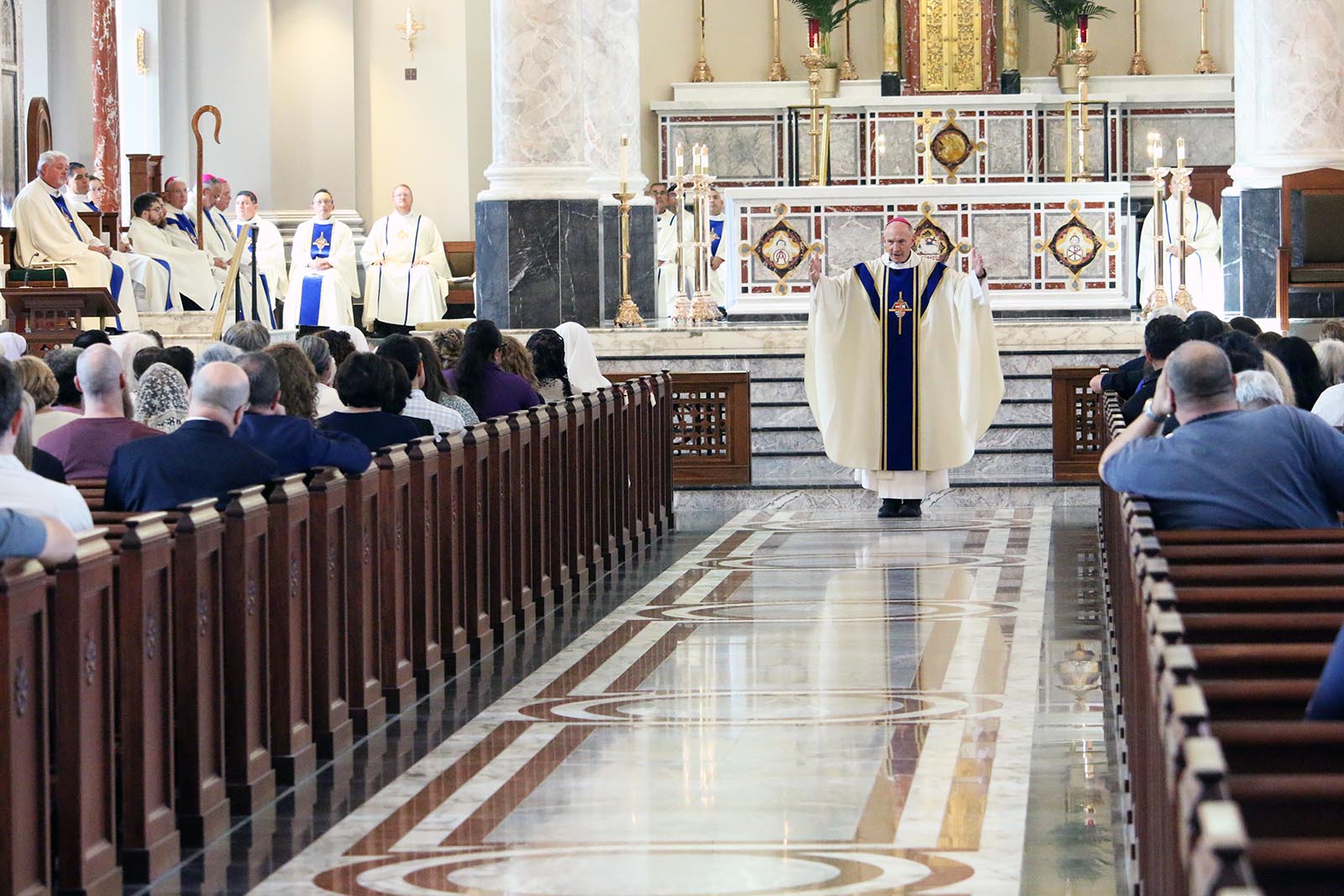
Bishop Mark Beckman gives the homily at Mass during the Deepening Our Moral Witness immigration conference at Sacred Heart Cathedral on Sept. 30. (Dan McWilliams)
Bishop Beckman assured the noon Mass congregation that there is indeed an answer to the question, thanks to the feast-day saint.
“The answer that St. Jerome gave was ‘Ignorance of the Scriptures is ignorance of Christ,’” the bishop said. “If we want to know what Jesus would do, then we have to immerse ourselves in the Word of God. It is listening to that Word, allowing that Word to enter our hearts and change us, that makes us the people that God has called us to be.”
He reminded the Massgoers of Scripture, which teaches that the decisive question in determining the eternal destiny of the individual is “what have we done for the least of our brothers and sisters? That is the criterion that the Lord gives us at the end of Matthew’s Gospel.”
“He’s very specific, too. ‘When you fed Me, I was hungry.’ When did we feed you when you were hungry, Lord? ‘When you did it for the least.’ When were you a stranger and we welcomed you? ‘When you did it for the least, you welcomed Me.’ When did we see You as a stranger and not welcome You? ‘When you did not welcome the least, you did not welcome Me.’ Powerful reminders from the Word of God on who we are called to be and what we are called to do,” Bishop Beckman continued.
In a world that is bombarded by information telling the public what to believe and how to respond in life’s challenging circumstances, Catholics and other Christians can find themselves at the mercy of popular culture.
“For those of us who believe in Jesus, our response must always be formed by the Word of God, by the Gospel of Jesus Himself. What would Jesus do?” the bishop asked.
Important topics of interest
During the conference, attendees heard from William Canny, executive director of the USCCB’s Secretariat of Migration, about the U.S. bishops’ “You Are Not Alone” immigration campaign. Dylan Corbett, executive director of the Hope Border Institute, spoke on migration and Catholic social teaching. And Mely Felipe, a member of Holy Ghost Parish in Knoxville who is a leader of the Tennessee Immigrant and Refugee Rights Coalition, delivered compelling remarks on how immigrant families are being affected by government policies and actions.
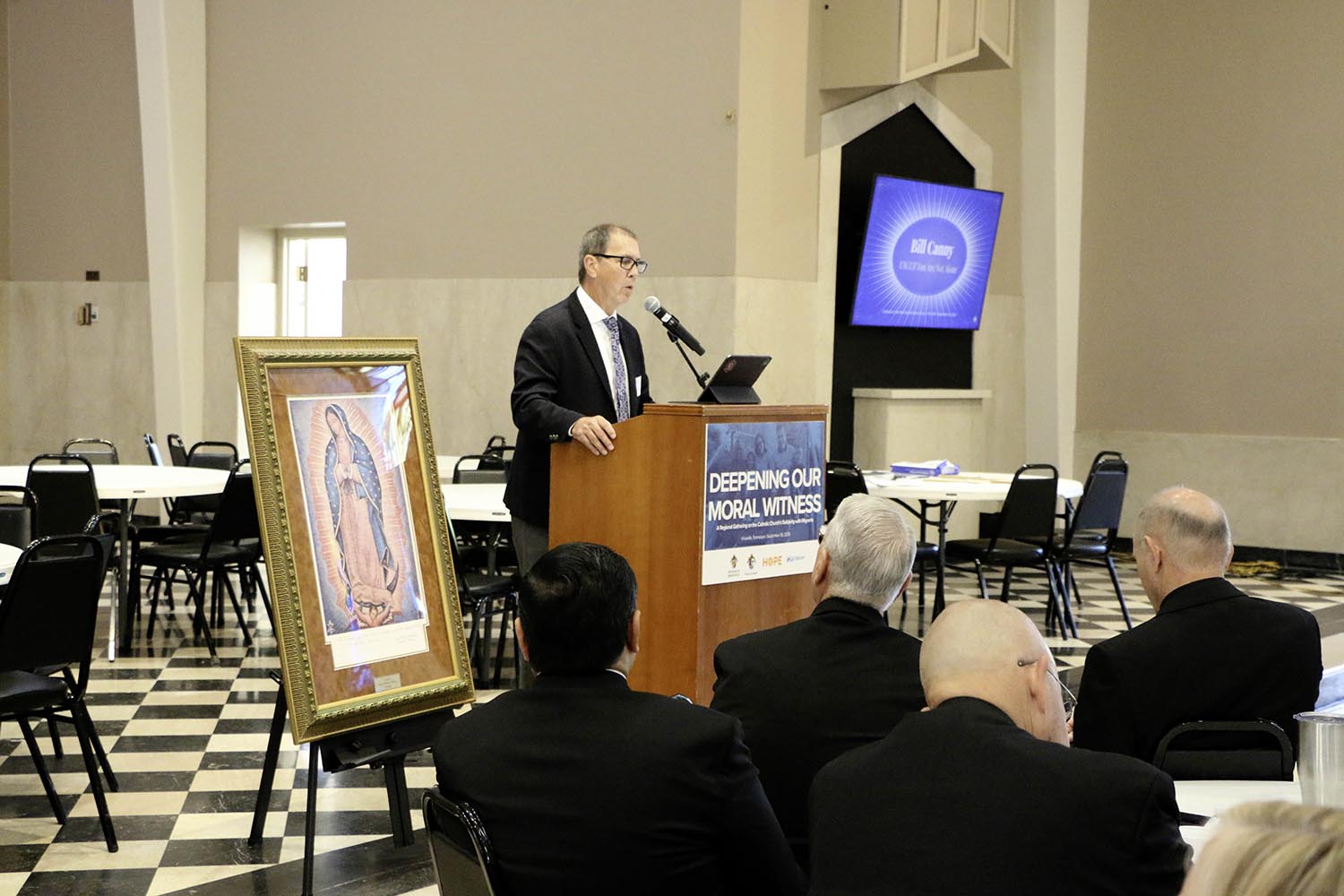
William Canny, executive director of the U.S. Conference of Catholic Bishops’ Secretariat of Migration, discusses the USCCB “You Are Not Alone” campaign.
Luis Ramos, pastoral associate and coordinator of high-school and young-adult ministry at Our Lady of Fatima Parish in Alcoa, was the master of ceremonies for the conference.
Blanca Primm, director of Hispanic Ministry for the Diocese of Knoxville; Deacon Chris Gutiérrez, director of Hispanic/Latino Ministry for the Diocese of Owensboro in Kentucky; and Elizabeth Elfers, who has organized the Cabrini Connection at Christ the King Church in the Diocese of Nashville, gave talks on Hispanic ministry and the importance of defending immigrant communities.
Emily Jones, an immigration lawyer from Lexington, Ky., who is the legal director for the New Americans Initiative, informed the gathering on immigration-enforcement realities and local preparedness. John Mecklenborg, communications director for the Diocese of Knoxville, and Astrid Liden, communications officer for the Hope Border Institute, discussed effective communications strategies on faith and migration. And Kevin Appleby, senior fellow for policy and communications at the Center for Migration Studies, gave a talk on diocesan and parish planning involving immigration.
Preaching the Gospel
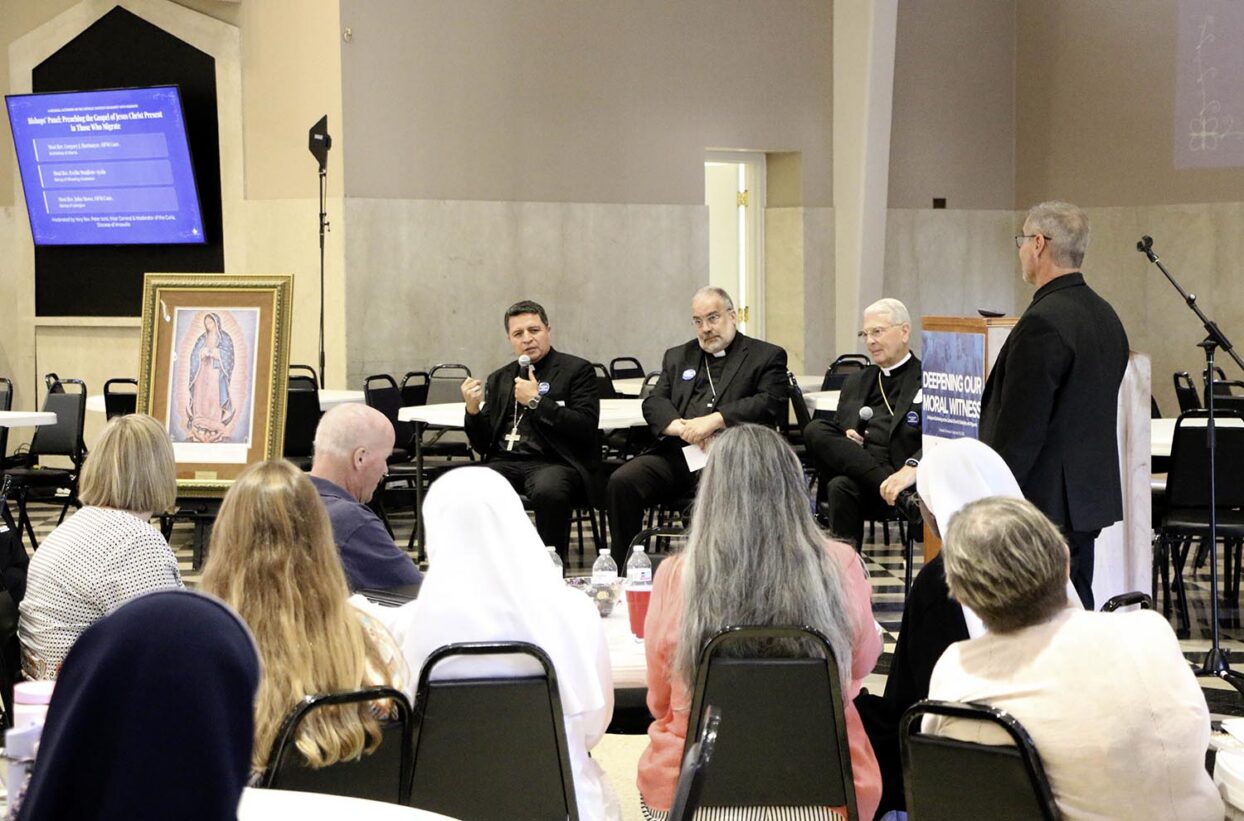
Father Peter Iorio, Diocese of Knoxville vicar general and moderator of the curia who also serves as pastor of Our Lady of Fatima Parish, was the moderator of a panel of bishops during the “Preaching the Gospel of Jesus Christ Present in Those Who Migrate” segment.
Archbishop Hartmayer, Bishop Menjivar-Ayala, and Bishop Stowe were the panelists.
Father Iorio asked each bishop the one thing they most wanted people in the South and across Appalachia to understand about people who migrate that Southerners and Appalachia residents might not already know.
Archbishop Hartmayer said the immigration process also affects priests and seminarians from other countries who are serving the Church in the United States.
“Those of us with dioceses that have a lot of foreign-born priests, it’s a big concern for us because those priests and seminarians are serving God’s people in our dioceses. Without them, we are without, and that is a big concern,” the archbishop said.
Archbishop Hartmayer also noted that there are priests and seminarians who come under the Deferred Action for Childhood Arrivals (DACA) provision, which is another layer of immigration uncertainty.
“We need priests from outside the country because they speak languages that we need in our dioceses. It’s a dilemma for us,” he said.
Bishop Stowe shared that he is often asked why immigrants don’t enter the United States legally and point out that they have family members such as grandparents who entered this country legally.
“It is such a broken system that there is no legitimate way to get in line. There is no program that will get you into this country in less than 25 years in most cases, so that would be the one thing I would want people to know,” the Diocese of Lexington bishop said.
Bishop Menjivar-Ayala pointed out that the immigrants who settled in the mountains of West Virginia 100 to 150 years ago arrived in the United States in circumstances very similar to those faced by today’s immigrants.
“I would like them to know and understand that they are human beings, and as our brothers and sisters, they have so much to contribute,” he said. “They are the same.”
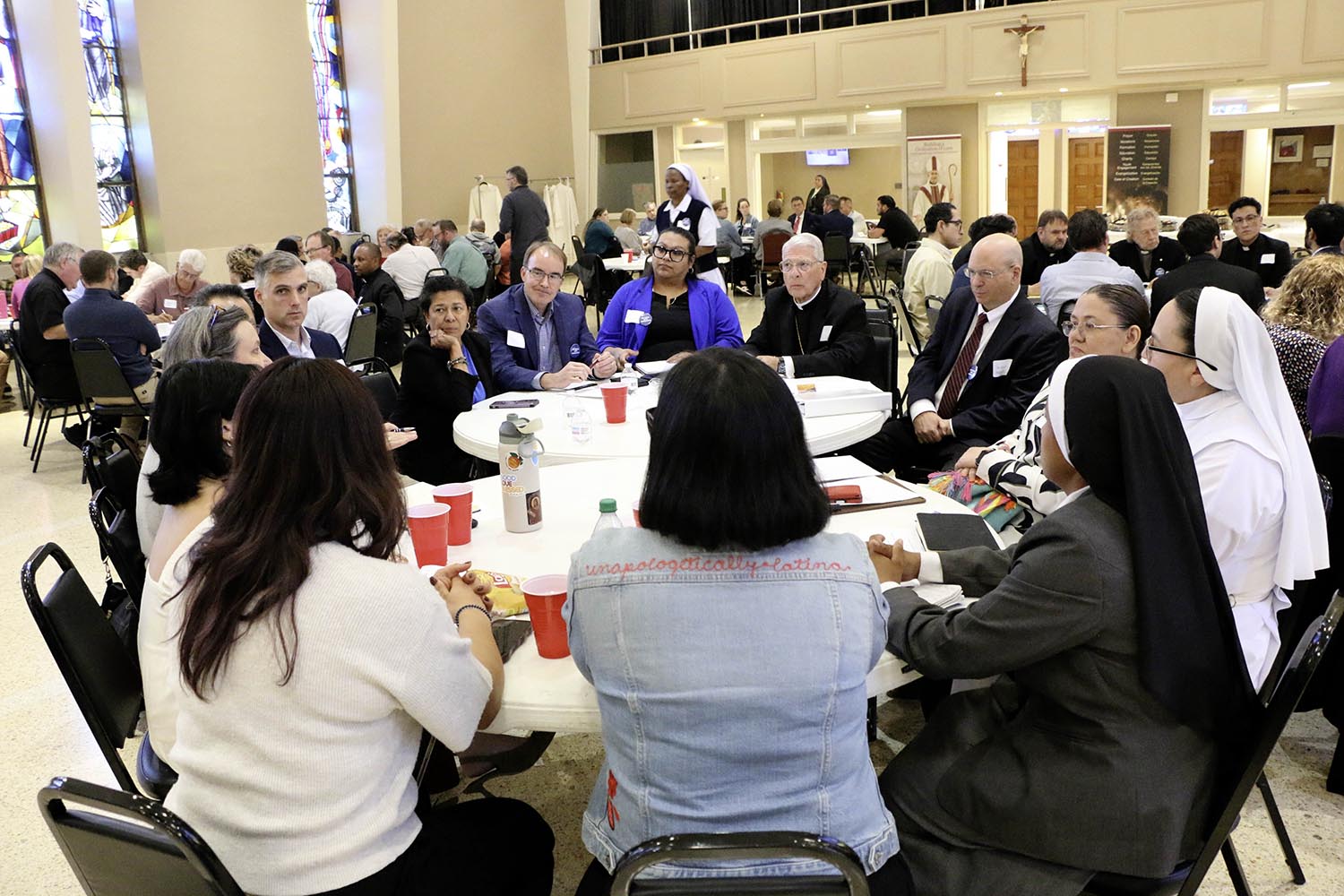
Archbishop Gregory J. Hartmayer of the Archdiocese of Atlanta leads a table discussion on immigration issues during the Deepening Our Moral Witness conference in Cathedral Hall on the campus of the Cathedral of the Most Sacred Heart of Jesus on Sept. 30. (Photo Bill Brewer)
Archbishop Hartmayer said that while many immigrants in the Archdiocese of Atlanta are filling church pews, there are many more who are no longer attending Mass because they are afraid.
“Fear is the underlying experience that I think most of our people who are undocumented experience. And that is a terrible way to live your life,” he said, noting that children can sense when their parents feel anxiety about their immigration status.
“They come here out of fear. And then they live here in fear of a different kind because they will either be arrested or sent back to where they came from, where life was miserable,” he added.
Father Iorio pointed out that Bishop Menjivar-Ayala’s episcopal motto is “He walked with them,” and he asked the bishop to recount his immigration story.
The West Virginia bishop was born in El Salvador and migrated to the United States when he was 19 in 1990 as his native country was suffering from a civil war. He said his only options were to be drafted by the Salvadoran Army and be killed, be conscripted into war by guerrillas and be killed, or flee the country.
He was imprisoned in Mexico as he tried to emigrate, and that is where he first encountered the Catholic Church. Catholics brought food and rosaries to him in prison. He was returned to El Salvador. He fled El Salvador three times, and on the third time he successfully made it to Los Angeles and then to the Washington, D.C., area.
He continued to follow the Catholic faith and entered seminary while living in the Washington, D.C., area. Then 19 years after fleeing his country, he became the first Salvadoran bishop in the United States. Pope Leo XIV earlier this year named him the bishop of Wheeling-Charleston, whose Hispanic population is less than 3 percent.
“When I talk about immigration, it is not an option for me. It is part of who I am. It is part of my identity,” Bishop Menjivar-Ayala said, adding that he believes U.S. families who are descendants of immigrants generations ago “have forgotten who they are.”
“When I go to the cemetery in Wheeling where most of the Catholics are buried, you see the last names. The whole world is buried there. That tells me the people who populated these hills of Appalachia in the United States are immigrants from all over … Italians, Polish, Irish, from the whole world,” he added.
He believes his call as a priest, as a bishop, is to walk with people, to assist them in encountering Jesus, especially through “the breaking of the bread.”
Bishop Stowe has been outspoken on the immigration issue and has called some immigration policies “immoral.”
He told the conference that everything he says and all that he believes comes from Scripture.
“The theological grounding is the same as with anything else we teach and believe as Catholics: Scripture and tradition, right? There’s no admonition that is more frequently proclaimed in the Old Testament than remember that you are a stranger and an alien in a foreign land, and do not oppress the alien; welcome the stranger,” Bishop Stowe said.
“Of course that is reinforced in the New Testament. The communities themselves were migrants themselves. We have no lasting home in this world. Our eternal home is in heaven. St. Francis of Assisi told his friars they were going to be pilgrims and strangers of this world because their real home is in the next. So, we’re all migrants.
“But the immorality of denying the humanity of another, practically, not necessarily philosophically, by separating children from their parents—the cruelty that we see—I don’t know any moral code that would say that is fine. Very often, what we hear is ‘What about illegal don’t you understand?’ ‘They broke the law when they came here.’ How do you compare the crossing of a boundary to jailing people or putting people in inhumane conditions like sleeping on floors, or places where the lights are on 24 hours where immigrants are being detained, or where they are fed food with maggots? All these things are clearly immoral. I don’t know that there should be a question about it.
“Scripture, tradition, look at the Catechism of the Catholic Church, look at the compendium of Catholic social teaching, they talk about the right to migrate and defend the dignity of the human person. Then the political side of that. I’m not worried about calling things political. I know that is unpopular. But if you remember, if we don’t resolve issues politically, then how do we resolve them? With violence? Politics is about how people get along in a multicultural society or in a group of people with a difference of opinions. We have to have policies in the polis—in the city—and that makes it political. It doesn’t have to be partisan. Clearly, neither party has been good on migration. One has been worse than the other, but none of them have been good on migration. I’m not afraid of that word politics, or political,” Bishop Stowe said.
Archbishop Hartmayer emphasized that people in the United States often fail to realize the contribution that people from other countries make in America.
“We’re a country of immigrants. We all have ancestors who came from somewhere else,” he said, noting that misinformation and confusion compound the immigration crisis, with the government unable to process immigrants who already are in this country or are wanting to enter.
“It’s a very difficult time because we don’t realize the ramifications,” he added. “There is no simple answer. But what we’re going through right now is not an answer.”
Bishop Beckman was pleased with the lineup of speakers at the conference and the robust attendance from around the South.
“It has been a fantastic success. We have had a huge number of people present from our own Diocese of Knoxville and throughout the region. I have been very impressed with the dedication and commitment on the part of the many people who showed up,” Bishop Beckman said. “My hope is that we can build some constructive momentum to move toward concrete support for our immigrants, some action steps to really help. This is the beginning.”