
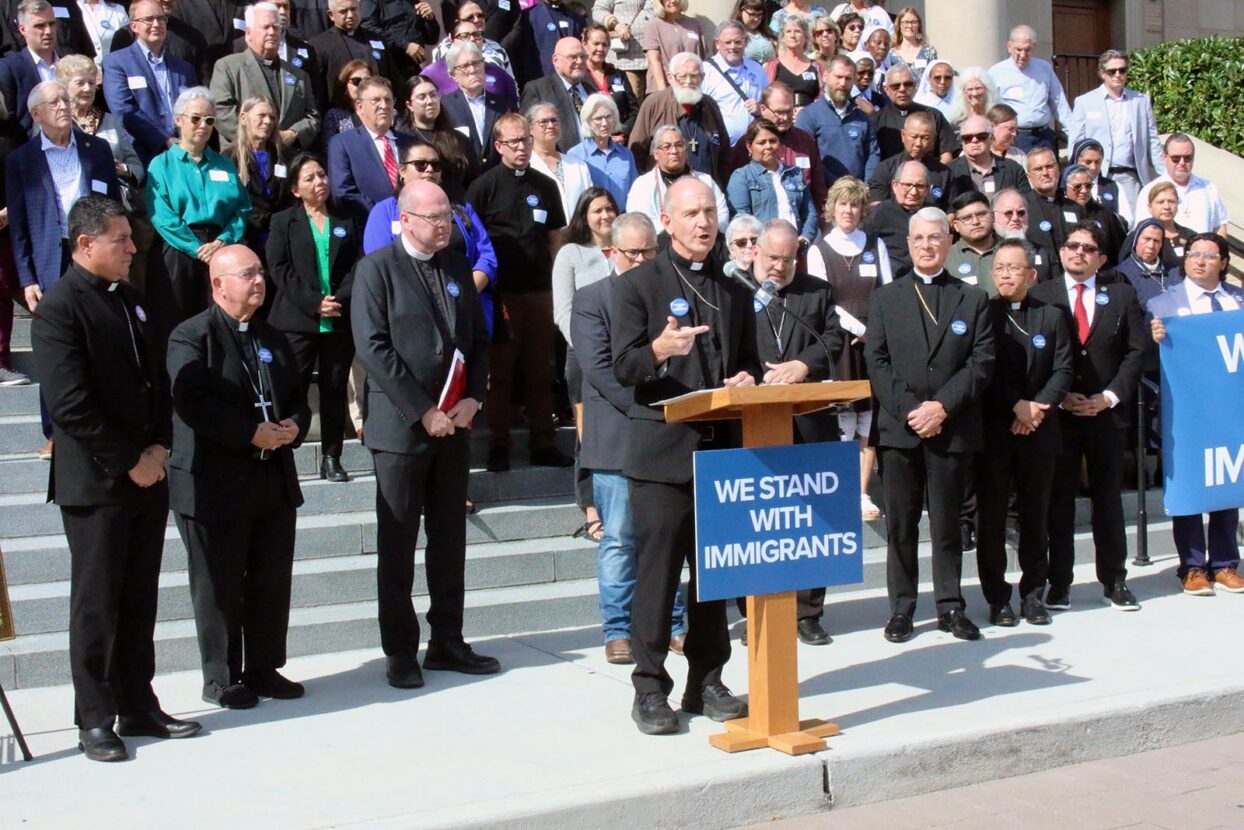
Diocese of Knoxville hosts regional immigration forum, press conference to address the continuing plight in U.S.
By Dan McWilliams
Bishop Mark Beckman and fellow bishops from Tennessee, Kentucky, Georgia, and West Virginia, in a press conference during the “Deepening Our Moral Witness” immigration event on Sept. 30, called for meaningful immigration reform, changes in immigration enforcement, and respect for the God-given dignity of every person.
The bishops, joined by laypeople working for immigration reform, urged local, state, and federal leaders to help end the fear gripping Hispanic communities, which also is negatively impacting states, cities, and neighborhoods.
Bishop Beckman recalled the Hispanic community who showed kindness to him when he arrived as the Diocese of Knoxville’s new shepherd in 2024.
Members of that community diocesan-wide are often living in fear of a knock at the door or a traffic stop that could lead to their deportation.
Bishop Beckman made his remarks to the media at the foot of the front steps of the Cathedral of the Most Sacred Heart of Jesus as he was surrounded by brother bishops from around the region as well as many East Tennessee Catholic faithful and several people from other faith traditions.
The Diocese of Knoxville bishop made reference to his Bearing the Light of Christ in East Tennessee pastoral vision launched on Sept. 18.
“I want to take a moment to say that one of my first moments as bishop in this diocese, this beautiful Diocese of Knoxville, was a welcome at St. Patrick’s Church up in Morristown. And it was largely our Spanish-speaking community who were present for that first deanery Mass that I celebrated,” Bishop Beckman said in his first comments during the press conference. “The sense of warm welcome that they gave me here in East Tennessee is what Appalachia is really all about, what it’s like to live in Tennessee.
“And because of that, I feel this special obligation now when I know that members of that community are suffering and struggling, that I, as a member of this community and a faith leader, with all of these other faith leaders around me and our business leaders, that I have something that I have to do in responsibility to care for God’s people. All of us together are called to build a civilization of love, to share the light of Christ, and when one person is suffering, as Paul puts it, all of us are suffering. And we have a responsibility to care for the dignity of each and every human person and to respect the rights and due process that are due to citizens and anyone who lives on U.S. soil.”
A message of Hope
Dylan Corbett, executive director of the Hope Border Institute in the Diocese of El Paso, Texas, opened the press conference. Hope Border Institute was one of the co-sponsors of the immigration conference in Knoxville.
“I’m happy to be here on behalf of Catholic IMMpact, an initiative of the Hope Border Institute and the Catholic Center for Migration Studies of New York, to assist the Church in standing with communities affected by policies of mass deportation,” Mr. Corbett said. “I want to thank Bishop Beckman, the bishop of Knoxville, as well as his staff here at the Diocese of Knoxville for hosting us at the cathedral and for this media conference today.
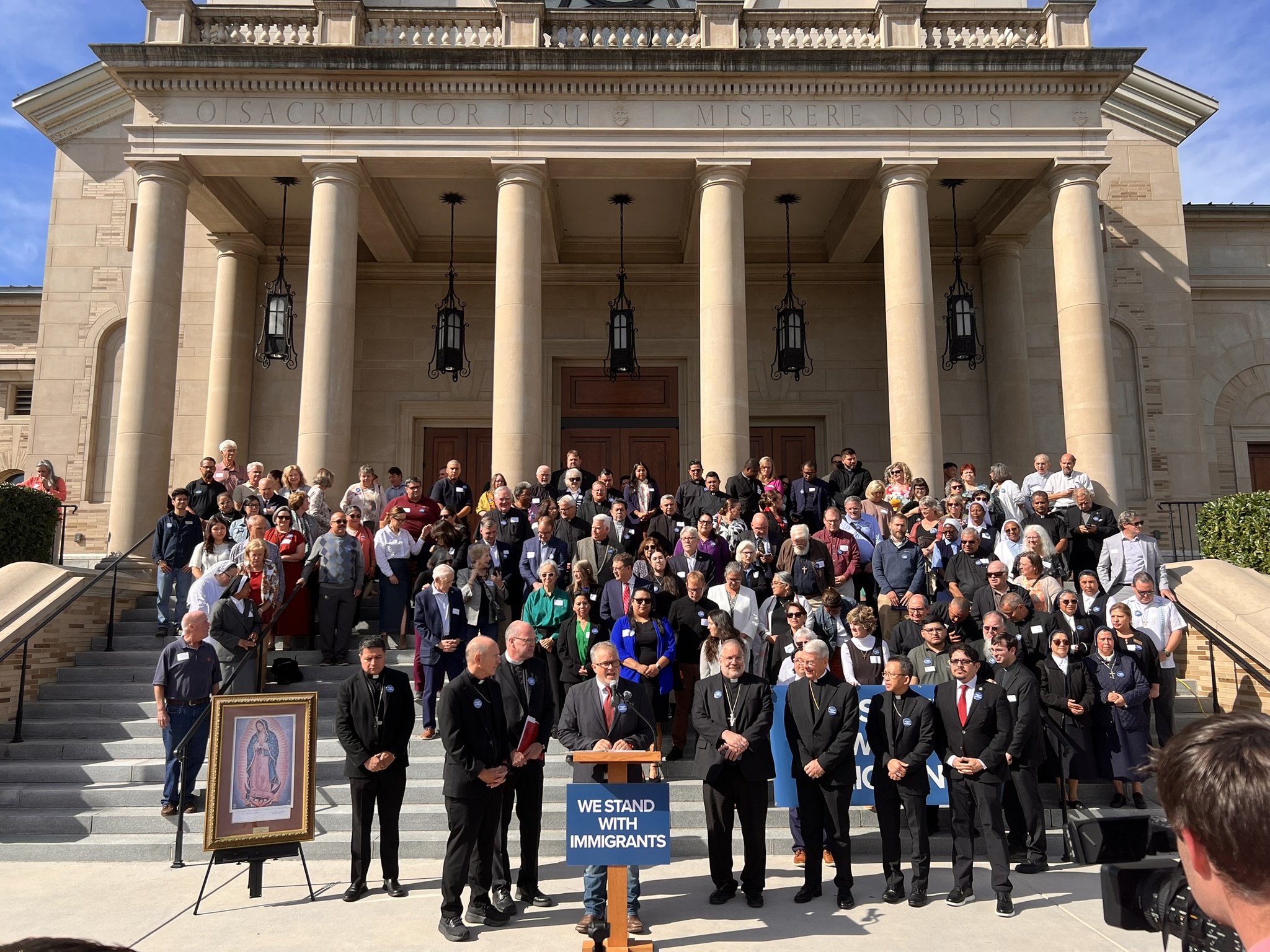
Dylan Corbett, executive director of the Hope Border Institute, addresses the media during a Sept. 30 press conference as part of the Deepening Our Moral Witness immigration conference. The press conference was held on the steps of the Cathedral of the Most Sacred Heart of Jesus. (Photo Emily Booker)
“Thank you for being here to the members of the media. Who’s here today? You’re seeing here on the steps of the cathedral bishops and church leaders from Tennessee, from Kentucky, from Georgia, from West Virginia, joined by ecumenical partners, joined by community partners and business partners. And behind them you see leaders from the Catholic Church in the region, folks from Catholic Charities, folks from social ministries, folks from Hispanic ministry, communication staff, clergy, religious Sisters, priests, deacons—these are the people who see what’s happening in parishes and in local communities every day.”
Mr. Corbett explained “why are we gathered here today?”
“Families across the country, families across the region here in Tennessee and in surrounding states, are living with fear, which has become part of daily life,” he said. “Parents think twice before driving to work, going to Mass, picking kids up from school. Children are listening for a knock at the door. These aren’t strangers—they’re parishioners, co-workers, neighbors, and many families, which include U.S. citizen children.
“When we talk about immigration, national attention often goes to the border, but the South and Appalachia are home to growing immigrant communities that are woven deeply into parishes and local community life. Parishes, faith communities, and small businesses here are on the frontlines and often with few resources. In a word, the Church stands with families who are afraid. The Church affirms the God-given dignity of every person, and the Church is calling on public leaders for meaningful immigration reforms that respond to that dignity, that respond to the contributions of migrants.”
Bishop Beckman followed Mr. Corbett, and Bishop John E. Stowe, OFM Conv, of the Diocese of Lexington, Ky., Bishop Brian L. Cole of the Episcopal Diocese of East Tennessee, and Yuri Cunza, president and CEO of the Nashville Hispanic Chamber of Commerce, spoke after Bishop Beckman before all of them fielded questions from the media. Also present were Archbishop Gregory J. Hartmayer, OFM Conv, and Auxiliary Bishop John Tran of the Archdiocese of Atlanta, Bishop David P. Talley of the Diocese of Memphis, and Bishop Evelio Menjivar-Ayala of the Diocese of Wheeling-Charleston, W.Va.
The bishops speak
“I’m very grateful to be standing with our immigrant brothers and sisters today, and I will tell you I was in St. Augustine, Fla., last week for a regional conference, and I was reminded that Spanish speakers arrived here before the pilgrims did, creating the first Mass in that community almost 100 years before the pilgrims,” Bishop Beckman said. “So, it’s been a long time that we’ve been here together.
“The other thing that I heard was the story of one of our Hispanic Sisters who was trying to give comfort to a little boy who was in tears because his family has to leave this country. And he looked up at Sister in tears and he said, ‘This is my country.’ This is the only country this little boy has ever known, and now they have to leave, so she was trying to give him comfort. I would like to say that we together as a community of hope can make a positive difference in the world today. And that difference is responding to the needs of each and every person in front of us that we see needs a response not only of compassion but also of justice. So, today, let’s work together to build a world where everyone has a home.”
Bishop Stowe was speaking as a Franciscan almost to the day of the 800th anniversary of the Transitus of St. Francis, his passing into eternal life.
“As a Franciscan, I was formed by a saint who knew the importance of crossing boundaries. He embraced the untouchable leper, entered a Muslim camp unarmed in the midst of the Crusades, and recognized every creature as a brother and sister,” Bishop Stowe said. “He understood 800 years ago that Christ will be found at the margins, not at the center. God all-powerful became incarnate among the outcast, and that is where the Church must stand right now, with the powerless—not adjacent to the suffering, not issuing statements about it from a safe distance, but right in the midst and in solidarity with immigrants and migrants.”
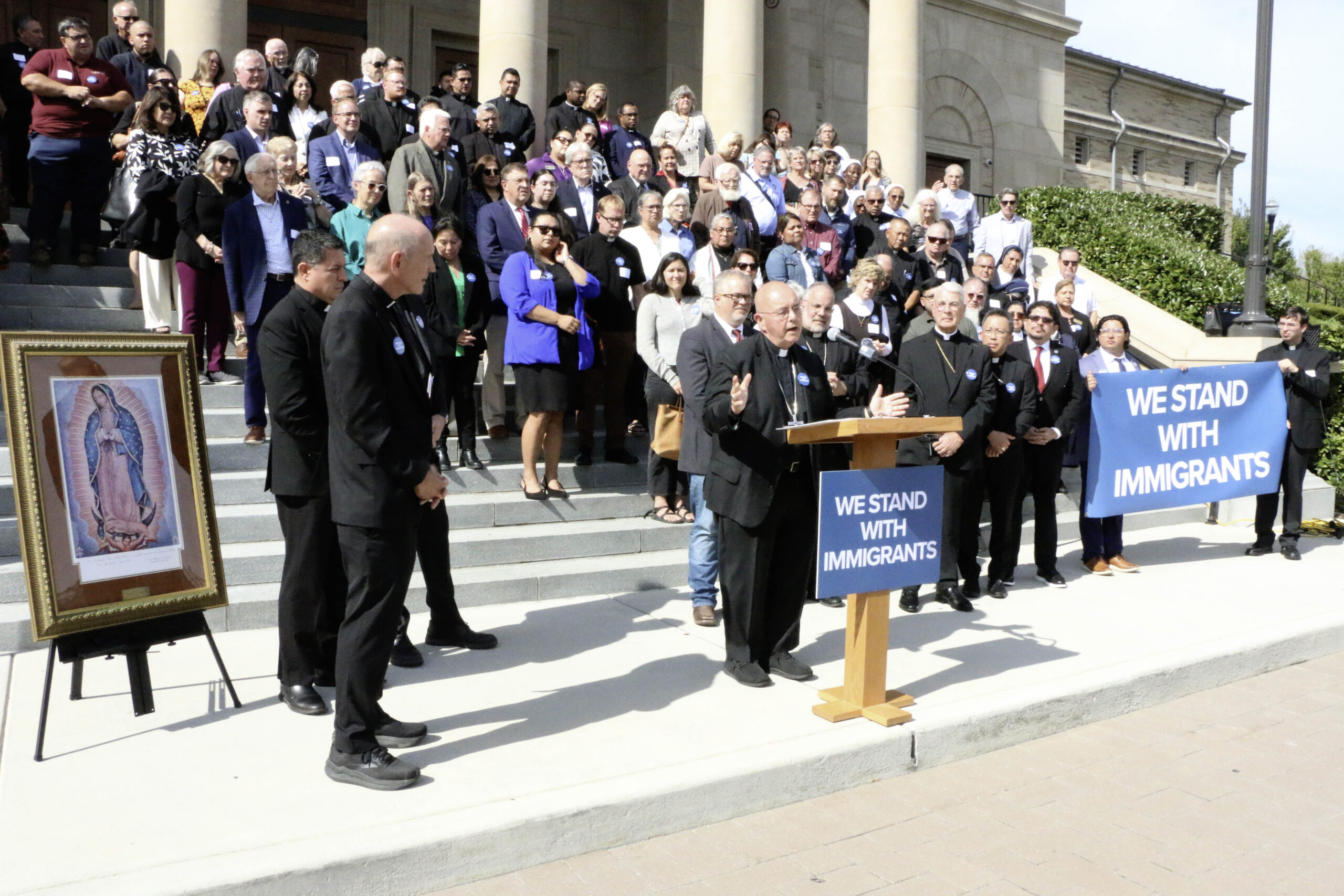
Bishop David P. Talley of the Diocese of Memphis speaks to the media about immigration concerns shared by dioceses across the country. (Photo Bill Brewer)
Deportation can result in the splitting-up of families, the Lexington bishop said.
“These sisters and brothers of ours, millions of them, our neighbors, live in fear, not fear of judgment but fear of separation,” he said. “Fear that a mother will not come home from work. Fear that a child will be left standing outside a locked door, backpack still on her shoulders, waiting for a parent who may or may not come. I’ve sat at the table with these families. I’ve heard these stories in confession, in hospital rooms, in requests for prayers for safety after Masses, in requests for accompaniment to hearings. These folks know that God is with them and God has been with them all along, but they wonder why they’re seen as a threat and treated as less than human by other people.”
Bishop Stowe said both he and the Church must be “very clear and unambiguous at this time” on immigration.
“Migrants and refugees are not an issue, are not a problem to be solved, and not a population to be managed. They are members of the one human family,” he said. “Jesus makes it clear that He identifies with them. ‘I was a stranger and you welcomed me,’ not tolerated me, not merely permitted me to remain—welcomed me. That’s why Catholic bishops from across this region—Knoxville, Lexington, Atlanta, Wheeling-Charleston, Memphis—stand together today, joined by my friend and brother in Christ, Bishop Brian Cole of the Episcopal Church, along with leaders from the business community who know something that political rhetoric too often gets wrong.”
Immigrants and refugees “are not criminals,” Bishop Stowe added.
“They are not a drain on society. They built this country. They feed this country. They bury their dead in this country and raise their children beneath the American flag. They worship in it alongside the rest of us every single Sunday,” he said. “If we could recognize the dignity and basic human rights of each person, we could find a way to fix the immigration system. We’re not naive about the complexity of immigration policy, but we know the simple truth that complexity is not an excuse for cruelty.
“We’re not just deporting criminals. We are deporting our brothers and sisters by people in masks and unmarked vehicles, intimidating the vulnerable. That’s not strength. That’s fear masquerading as resolve. Our migrant brothers and sisters have suffered enough. It’s time to end the cruelty. We won’t soften that message. We will keep saying it because the Gospel calls us to mercy and justice.”
‘Standing with the Catholic Church’
Bishop Cole said “the Episcopal Church stands with the Catholic Church in support of dignity and Christian hospitality and welcome to migrants. In our biblical story, we see again and again that the Spirit of God moves with people when they have to leave home and find refuge in the new land. The Episcopal Church, through our actions at General Convention, has consistently supported policies that afford protections to migrants and refugees and asylum seekers.”
Those baptized in the Episcopal Church make promises to carry out that spirit of supporting dignity and welcome, Bishop Cole said.

Bishop Brian L. Cole of the Episcopal Diocese of East Tennessee makes remarks during the Sept. 30 press conference. (Bill Brewer)
“We ask all gathered, will you serve Christ in all persons, loving your neighbor as yourself? We ask, will you strive for justice and peace among all people and respect the dignity of every human being? To both questions, the people gathered respond, ‘I will, with God’s help,’” Bishop Cole said.
“So, the call to respect the dignity of all is rooted in our baptism. The God who welcomes us in baptism calls us to welcome the stranger who comes to us to see the stranger as Christ before us. In a time when policies impacting migrants appear to be intended to dehumanize those who are most in need of help and welcome, it is good to join as one of the ecumenical partners today in proclaiming that these policies fail all of us.”
Bishop Cole added that “as Christians, we are called to welcome the migrant and the stranger. We are commanded by Jesus to welcome. We are all living in a time of fear and chaos and brutality. Increasingly, fear and chaos and brutality appear to be the point in immigration policy. As Christians, we are reminded in 1 John that perfect love casts out fear. We have to remain committed to perfect love with God’s help. Our perfect fear will cast out love.
“Again, it is good to join with the Catholic Church in renewing the Gospel call, the biblical call, to welcome the stranger, for we were once strangers, too. God has made us all, and we all belong to each other.”
‘Immigration is not an abstract issue’
Mr. Cunza of the Nashville Hispanic Chamber of Commerce was the final speaker before the bishops and he took questions from the media.
“For nearly three decades, our chamber has worked directly with businesses, employers, workers, and families across Nashville and Middle Tennessee. So, for us, immigration is not an abstract issue. We live it every day,” Mr. Cunza said. “And right now, Nashville is feeling it. We’re seeing businesses with fewer customers and lower sales. Employers are (telling) workers to stay home. People are afraid to go out, including citizens and legal residents. And recent reporting shows millions of dollars in economic losses following increased immigration enforcement.”
The Hispanic community “respects the law,” he said.
“We respect the responsibility of a government to protect public safety and maintain an orderly immigration system. But we also have to recognize reality. What happens to immigration enforcement does not affect only the person being targeted. It affects workers, it affects families, it affects businesses, and ultimately it affects entire communities,” Mr. Cunza said.
“That is why I have joined business and community leaders from across the country, including through the American Business Immigration Coalition, the U.S. Hispanic Chamber of Commerce, in conversations with members of Congress from both parties. That’s something really hard to do, given the state of divisiveness that our country is experiencing, political divisiveness.
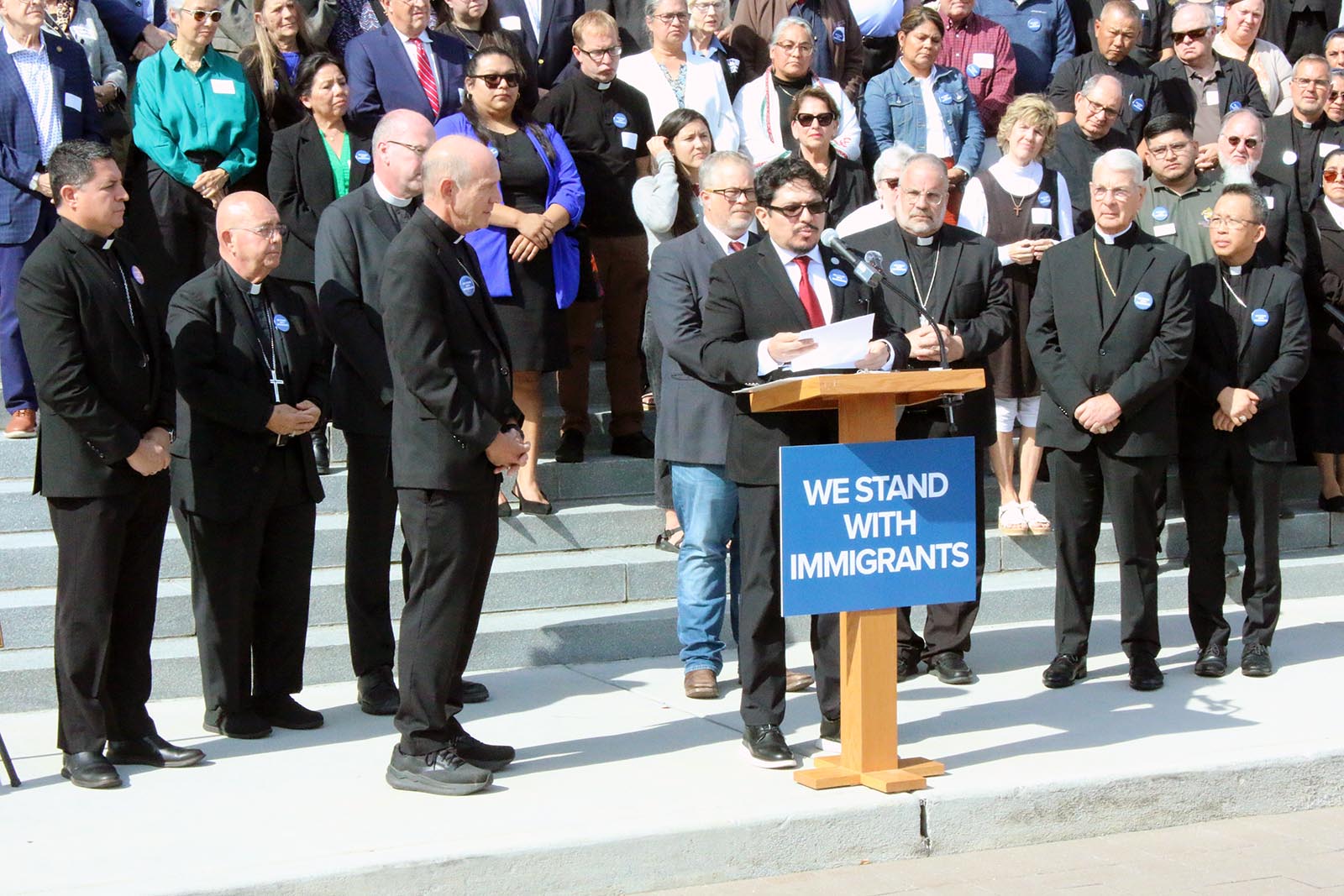
Yuri Cunza, president and CEO of the Nashville Hispanic Chamber of Commerce, addresses the media during a press conference as part of the regional immigration conference on Sept. 30. (Photo Dan McWilliams)
“And the message we have taken to Washington is simple: America should not have to choose between secure borders and immigrants. We can have order. We can have respect of the law. We can protect our borders, and we can have a stable workforce and recognize the dignity of the people who are already helping build this country because these are not statistics. These are the construction workers helping build Nashville. They are the people working our hotels and restaurants and welcoming millions of visitors to our city. They are entrepreneurs, taxpayers, parents, neighbors, and members of our community.”
Mr. Cunza said that is why he came to Knoxville to stand “alongside these faith leaders.”
“It means so much to me. I’m very honored. Thank you. I come from the business community. They bring the moral witness to faith, but those two voices meet in a very important place: human dignity,” he said. “Because behind every economic number is a person, behind every worker is a family, and behind every immigration case is a human story. We cannot allow people to become invisible simply because this is a difficult issue.
“So, today I want to make a very simple appeal to our government leaders. Do what is right. Yes, respect the law, protect our borders; yes, protect our communities, but we can do all of that without losing our humanity. Hispanic immigrants and immigrants from many other parts of the world are not outside the American story. They’re a part of it. They have helped build our cities, grow our businesses, raise our families, pay taxes, create jobs, and strengthen this country generation after generation, and that American story is still being written.
“We need an immigration system working for the country we believe America can be, one that respects the law, recognizes economic reality, keeps family and communities in mind, and never forgets the dignity of a human being. We can protect our country without forgetting who we are as a country, and we can recognize the dignity, work, history, and humanity of the immigrants who continue helping write the American story, that American story we want to be part of.”
Mr. Cunza concluded with brief remarks in Spanish.
Why speak out now?
The first question during the press conference, from a reporter with WBIR-TV in Knoxville, asked the bishops and others why they were speaking out then as the problems migrants face have been going on for some time.
“There’s never a time when this is not important. From the beginning of the most recent Trump administration, we’ve seen the types of deportations that are happening, the disruption of our communities and families affected incredibly, and we continue to see it get worse and worse,” Bishop Stowe said. “We just heard the Supreme Court say it’s OK to deport people to countries that they don’t even come from and don’t know. So, now is the time, and we hope we don’t have to keep doing it again and again, but we have to do it now.”
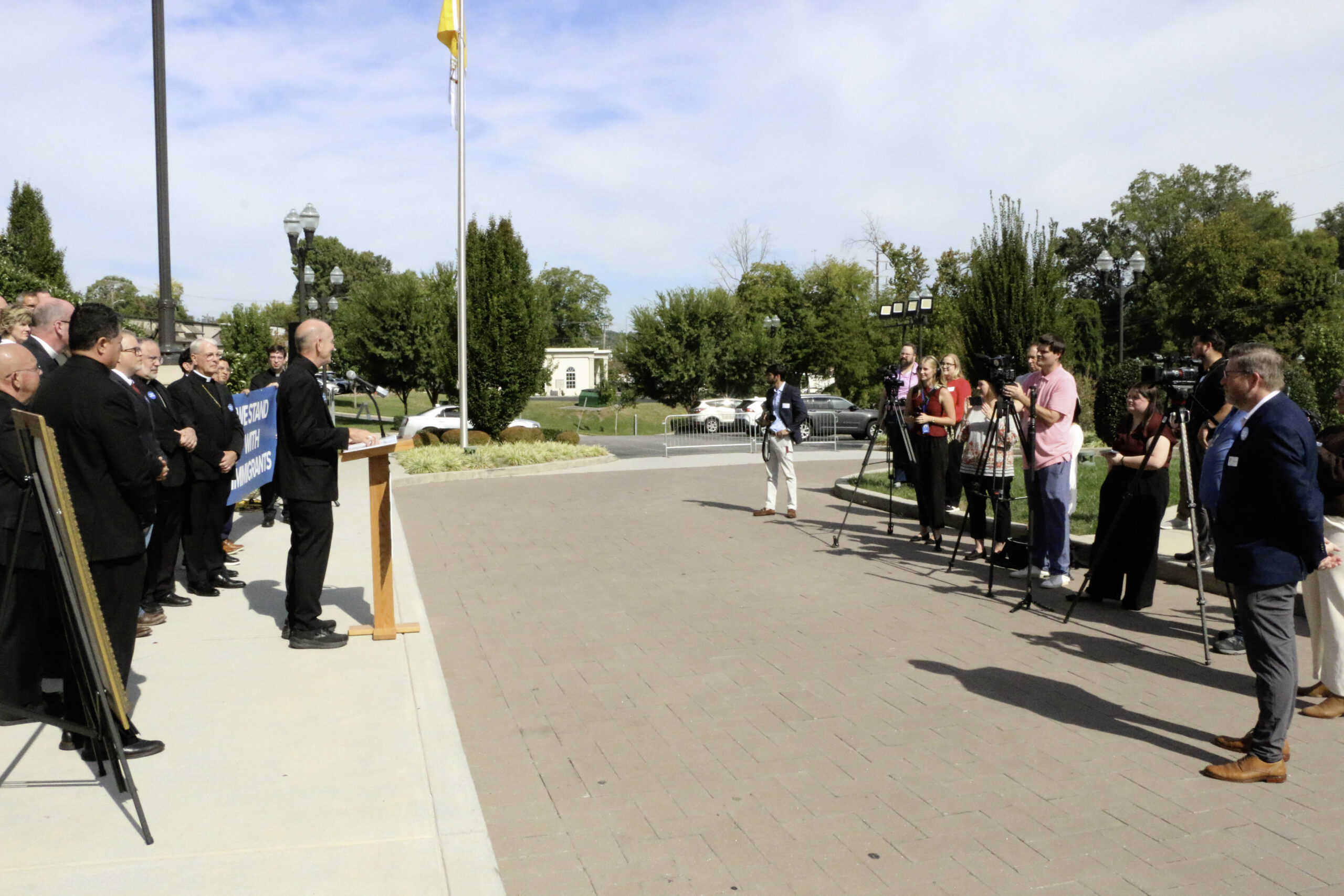
Members of the media report on the regional immigration conference co-sponsored by the Diocese of Knoxville. (Photo Bill Brewer)
Another question, on what parishioners are saying to the leaders, was fielded by Bishop Beckman.
“I’ve experienced a wide variety of responses. I have had a lot of people who have directly come up to me and expressed gratitude that we as a Church continue to speak about the foundations of faith that underlie our response to people who are in need,” he said. “There are some people at times who do raise questions about, are we concerned about border security? And of course, there’s a balance to be held with safe borders and yet at the same time the response to human dignity. So, it’s a matter of responding to those ongoing concerns and questions about where we’re going as a country, I think.”
Bishop Beckman was asked if policy changes to support migrants more were possible.
“It’s hard to say how people will respond, but I do know that anything significant that has been done in our nation’s history to help expand human dignity and rights always takes ongoing work on the part of a lot of people,” he said. “And it spreads over time. And you don’t give up just because you don’t get a yes on the first question.”
A reporter asked the bishops if they had heard any individual stories from the migrant community and the challenges its members face.
“Early on I spoke to our director of Hispanic Ministry and I said, is this happening here in East Tennessee? Because it wasn’t as visible here as it was in some other parts of the country,” Bishop Beckman said. “And the response I got was yes. And then I heard directly the story of a grandmother in the Chattanooga area who got in a fender-bender. She’d been in this state for many years. Her daughter is actually serving in the Marine Corps of the United States. As a result of that encounter, she was detained.
“And I thought, this is happening to real human beings who are faithfully worshiping in our parishes and have been part of our community for a long time. So, that was one of those moments when I realized this is happening to our community right here.”
Bishop Beckman said an ecumenical outreach is needed to support migrants.
“I think it’s important that we build bridges across the spectrum with a lot of faith communities,” he said. “A couple of weeks ago, we had an interfaith effort, a letter was written on the behalf of many faith leaders of many traditions, and I think the signatories were around 200, and it represented a whole broad variety of faith communities. We work together with anyone of goodwill who is desiring to build up the common good of our community and to help us to develop respect for the dignity of every single human being. So, we’re partners with everyone who’s willing to do that.”
Bishop Cole said he found common ground with Bishop Beckman on the issues migrants face from their first meeting.
“When Bishop Beckman came to Knoxville, at our first lunch together, I asked, I hoped there’d be things that we could do together, to work together on some issues of common support and common witness,” Bishop Cole said. “And again, the biblical witness is clear. The biblical witness is clear that God invites us to welcome the stranger. On the cross, Jesus makes all of us, returns all of us to God and makes us belong to each other.
“And so, while Christians often disagree about many things, I think we can agree about the biblical witness that God is consistent in welcoming the stranger, that Jesus and His family were exiles in Egypt, and that call to continue to be a people of welcome, people of care, people of kindness, to say no to brutal policy, to say yes to mercy—that’s a biblical story, and Christians of all different kinds of stripes can agree on that story, that common witness.”
Bishop Talley offered his perspective as the leader of West Tennessee Catholics.
“To all of the disciples of Jesus, the 4 percent in my diocese of West Tennessee who are Catholic, but all who are baptized into His life and death and resurrection, I want to say this: I give myself to all the speakers (at the press conference). I say amen to all that they have said,” Bishop Talley remarked. “But for me, it’s a simple message to our disciples of Jesus. This is not a political issue. It shouldn’t be framed as a political issue. It’s a moral issue.
“And secondly, I want to remind all that the crucified and risen Lord is the king. He is the king. He is the one who gives us the law of life, the law of love, and we are called to build His kingdom, a civilization of love, following His plan for the future and not the simple politics that come and go every November at the ballot box.”
Responding as if the other person ‘were Jesus Himself’
Bishop Stowe said that a pro-life response to migrants “begins with understanding that each person, made in the image and likeness of God, is given inalienable rights. It’s not just words from our Constitution. That’s something that comes to us from our faith. We reflect God’s image. That doesn’t require documents. That doesn’t require papers. It doesn’t matter where we were born, which none of us chose a place to be born, right? We are all made in God’s image and likeness. So, to be pro-life means not only to affirm the unborn child but to affirm life at all of its stages, to affirm the dignity of the human person and the human’s right to life and full life and flourishing.”
The bishop of Lexington said the spirit of the immigration conference must carry on after the Sacred Heart conference ended.
“We continue to try to change hearts and minds, to give a real human face to the story of the migrants, to recognize we’re not talking about statistics, we’re not talking about threats, we’re not talking about people who are here to do harm. We are here to talk about brothers and sisters who are striving to survive and striving to provide for their families,” Bishop Stowe said.
“And so, our work is to continue to humanize the story. Our work is to continue to help people recognize that this kind of cruelty that we’re witnessing is not part of our American tradition—at least it shouldn’t be—and that everybody is to be afforded due process under the law, and everybody’s human dignity should be affirmed, respected, and promoted.”
Bishop Beckman closed the press conference by thanking all present for their attendance.
“The work of building a civilization of love does not happen overnight,” he said. “This is an ongoing journey that the Christian community began in its very beginnings. It started in the Roman Empire, and the empire was transformed slowly over time by the lived witness and service and compassion and love of many Christians through the centuries. So, in our own modern world today, I think that we are called to bring to bear the light of Christ to each and every person that we meet on the streets, wherever we live, wherever we work.”
“We’re called to respond to the face of the other person as if it were Jesus Himself,” the bishop continued. “And that is the final reminder that Jesus gives us in Matthew’s Gospel when He tells us, ‘whatever you do for the least brother or sister, you do for me.’ So, it’s what we do for the little ones, the least, the people who need us the most—that’s how we respond to the love of God: in loving our neighbor. So, my prayer is that that light that’s been given to us by God Himself, that we’ll continue to spread that light, and so will everybody who hears this message. Let’s bring the light of Jesus into the world.”